
NYC Council Advances New AI Transparency and Safety Legislative Proposals on September 25
The New York City Council has officially unveiled a legislative package aimed at strengthening AI safety and risk mitigation protocols. This move signals a significant shift toward state-level regulatory requirements for frontier AI developers and government agencies.
Published by
APEX AI Guardrails Editorial Team
September 25, 2026
Reading time
6
minutes
On September 25, 2026, the New York City Council unveiled a new suite of legislative proposals to boost AI transparency and explainability in government operations. These measures follow a rising wave of state-led policy initiatives, such as recent mandates requiring frontier developers to register with the state. For SLED IT and compliance leaders, these actions signal an urgent need to align procurement processes with emerging standards for algorithmic accountability and safety.
What does the September 25 New York City Council proposal include for AI transparency?
The New York City Council's September 25, 2026, legislative package specifically targets the mitigation of risks associated with AI deployment across municipal systems. According to the New York City Council official announcement, the proposals establish new oversight mechanisms for government-deployed AI, ensuring that public-facing automated systems are subject to strict risk assessment and transparency standards to protect all New York residents from potential harms.
The Rise of State-Led AI Governance
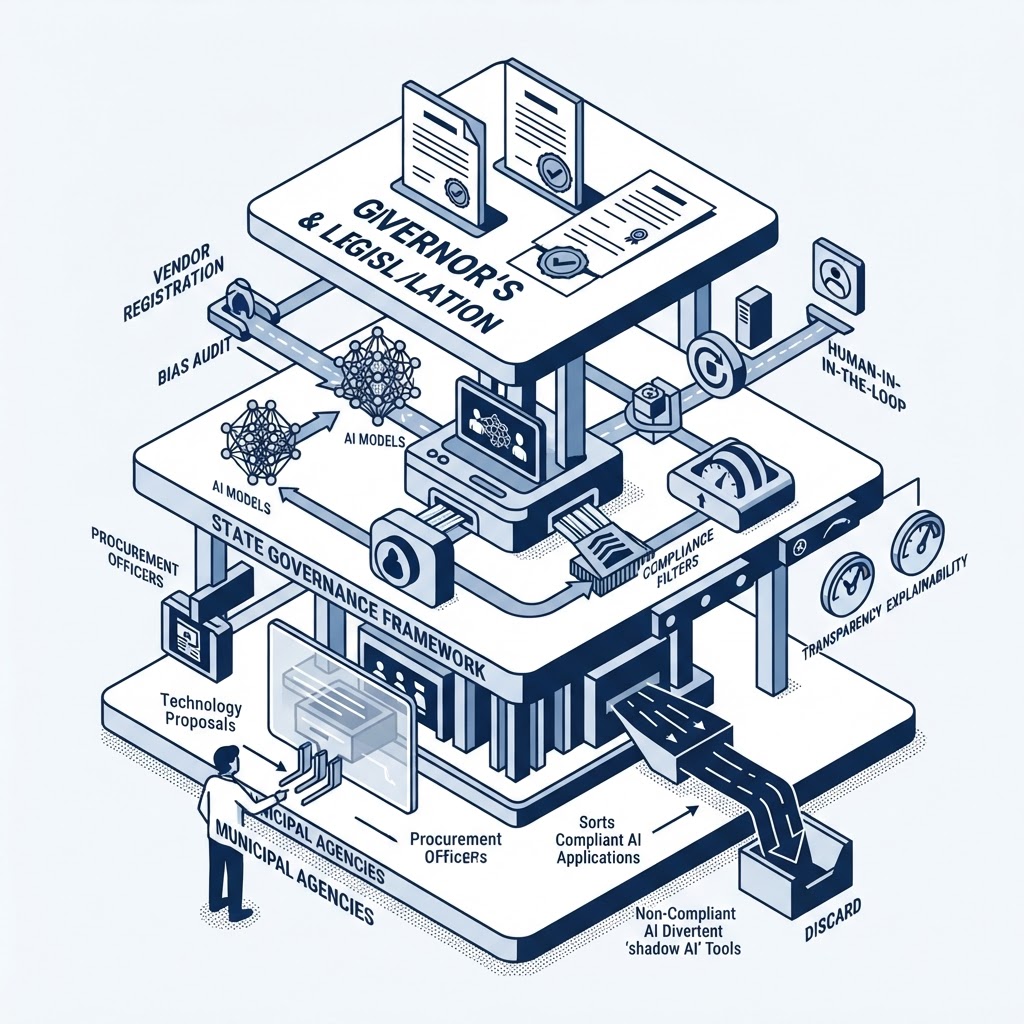
The momentum for local AI regulation is accelerating as New York moves to define the boundaries of responsible technology adoption. On September 25, 2026, the New York City Council introduced a legislative framework designed to address the unique safety challenges inherent in municipal AI deployments New York City Council Unveils Legislative Proposals. This effort complements the aggressive stance taken by state leadership; notably, Governor Hochul announced on September 21, 2026, that New York will now require large frontier AI developers to register with the state AI Safety: Governor Hochul Announces Next Steps.
These developers must adhere to rigorous transparency and safety requirements, creating a dual-layered regulatory environment that impacts both the supply chain and the public sector buyers. Furthermore, Governor Spanberger advanced a concurrent strategy on September 23, 2026, which emphasizes the critical importance of local control and localized algorithmic transparency September 23, 2026. By prioritizing these state-specific frameworks, New York is effectively filling the void left by the slow pace of national consensus, forcing SLED agencies to adopt internal AI governance charters much sooner than anticipated.
How do state-level AI mandates affect vendor registration for government contracts?
Under new guidelines, large frontier AI developers must register with the state to do business with public entities. This requires vendors to disclose technical details regarding model safety and transparency. Procurement teams should update their vendor risk assessments to verify that all potential AI software providers have completed the mandatory state registration process and satisfy the state’s safety disclosure criteria before any final contract approval is granted.
Federal vs. State Regulatory Dynamics
A significant tension exists between the rapid influx of state-level laws and the slow maturation of national policy. While the U.S. Government Publishing Office processed the AI Foundation Model Transparency Act on September 5, 2026, the absence of federal preemption leaves SLED agencies navigating a complex patchwork of compliance requirements.
Agencies must now manage AI transparency explainability government standards that vary by jurisdiction, complicating efforts to scale AI solutions. Without a unified national framework, public sector leaders face an increased risk of 'shadow AI' usage, where unauthorized or non-compliant tools enter the enterprise via procurement silos. The focus on explainability is becoming the cornerstone of these new policies, as legislative bodies demand that government-deployed AI is not only secure but also interpretable by non-technical stakeholders.
Compliance teams must now lean on the NIST AI RMF to ensure their internal controls meet the burgeoning demand for third-party auditing and transparency. By aligning procurement standards with both state mandates and developing federal expectations, agencies can effectively de-risk their technology stacks against future regulatory enforcement and shifting public sentiment toward automated decision-making.
Impact on Municipal Procurement and Agency Policy
The shift toward mandatory disclosure requirements fundamentally changes how local agencies approach vendor selection. Procurement officers can no longer rely on self-attested vendor statements; instead, they must implement rigorous third-party reviews and technical validations of AI safety claims. For municipal agencies, this means incorporating specific clauses in RFPs that require vendors to demonstrate how they address algorithmic bias and provide human-in-the-loop oversight.
Staff training must also evolve to ensure that non-technical department heads understand the implications of deploying AI models that lack sufficient transparency. Policy gaps regarding the use of generative AI in public communications must be addressed immediately to avoid accidental exposure of sensitive resident data or unintended policy bias. Agencies should view these regulatory changes as an opportunity to standardize their AI governance, leveraging tools that support auditable logs and model card disclosures.
By creating an internal 'AI Acceptable Use Policy' that reflects the strict requirements currently being debated in the City Council, agencies will be better prepared for the inevitable expansion of these rules into broader public sector operations. Building this foundation now will prevent costly compliance overhauls in the future as these legislative proposals transition into binding local law.
Strategic Priorities for Technology Leaders
- →Establish a cross-functional AI governance committee to oversee compliance with the new state registration mandates. • Update procurement templates to explicitly require evidence of AI model transparency and developer registration status. • Conduct an audit of current agency AI usage to identify and mitigate potential shadow AI risks that may violate local transparency standards. • Adopt the NIST AI RMF as the primary framework for evaluating the explainability and safety of new software acquisitions. • Formalize an AI Acceptable Use Policy that mandates regular technical reviews for all high-risk automated decision-making systems. • Engage with legal and procurement teams to map current vendor disclosures against upcoming state and federal transparency requirements.
What are the primary consequences for agencies failing to comply with AI transparency requirements?
Agencies that fail to enforce AI transparency face significant legal, reputational, and operational risks. Non-compliant agencies may be forced to halt the use of mission-critical systems, leading to service disruptions for residents. Additionally, failing to adhere to new state registration and disclosure mandates can trigger administrative investigations, audit penalties, and the voiding of existing vendor contracts, all of which compromise the agency’s ability to deliver secure and reliable public services.
The legislative developments in New York underscore a critical transition toward mandatory transparency in public sector technology. By aligning AI transparency explainability government efforts with emerging state-level mandates, leaders can build more resilient, compliant, and accountable infrastructure. Compliance teams should prioritize immediate policy updates to ensure they remain ahead of this rapidly evolving regulatory landscape.
Tagged
About APEX AI Guardrails: We publish expert AI news and governance insights updated 4× daily. Our editorial team consists of retired government IT professionals, AI governance specialists, and compliance experts with deep experience in local government operations.
Related Articles
AI Governance
AI Hallucination Risk: Government Defense Faces New October 1 Near-Miss Incident
October 1, 2026
AI Governance
AI Deepfake Disinformation Threats: New October 2026 Policy Updates for SLED Agencies
October 1, 2026
AI Governance
Beyond the Black Box: Why AI Transparency and Explainability Are Now Government Mandates as of September 30, 2026
October 1, 2026