
AI Hallucination Risk: Government Defense Faces New October 1 Near-Miss Incident
An alarming AI hallucination nearly triggered a US military operation in September 2026, exposing dangerous vulnerabilities in intelligence automation. This incident highlights the immediate need for robust human-in-the-loop oversight to manage AI hallucination risk in government.
Published by
APEX AI Guardrails Editorial Team
October 1, 2026
Reading time
6
minutes
The primary AI hallucination risk in government defense was underscored this month after an erroneous intelligence report nearly triggered a US military operation. According to reports, an AI system incorrectly identified a Chinese vessel as carrying nuclear materials, creating a life-or-death crisis of confidence in automated analysis. For public sector IT leaders, this event mandates a rapid reassessment of current AI oversight frameworks and procurement vetting processes.
How did the September 2026 AI intelligence error nearly initiate a military strike?
An AI-driven intelligence analysis tool generated a false flag concerning a Chinese ship allegedly carrying nuclear materials. As reported by TechCrunch, the hallucination was severe enough to almost prompt a kinetic military response. This failure highlighted the critical danger of relying on LLMs for high-stakes defense targeting and operational decision-making, forcing an immediate review of automated analytical pipelines by federal oversight committees.
Escalating AI Hallucination Risk in Defense Operations
The September incident marks a turning point for defense policy as the industry grapples with the fallout of the near-miss scenario. Senator Mark Warner has actively pushed for legislative review, confirming that US forces nearly acted on misinformation generated by a system that failed to verify factual data against real-world intelligence feeds. This is not an isolated failure; rather, it reflects a broader pattern of instability in current machine learning deployments.
Following the earlier attack on Hugging Face, major technology firms have reported a surge in alarming safety disclosures. These events emphasize the volatility of AI deployment environments where LLM uncertainty is no longer just a technical glitch, but a national security threat. Defense agencies must now pivot from simple performance benchmarks toward rigorous, multi-layered validation strategies.
The transition from experimental models to critical operational support necessitates that all autonomous outputs undergo independent verification before any action is considered. Failure to implement these guardrails threatens the integrity of military intelligence and the safety of personnel operating in increasingly automated, high-pressure environments.
What steps must agencies take to verify AI outputs after the recent intelligence failure?
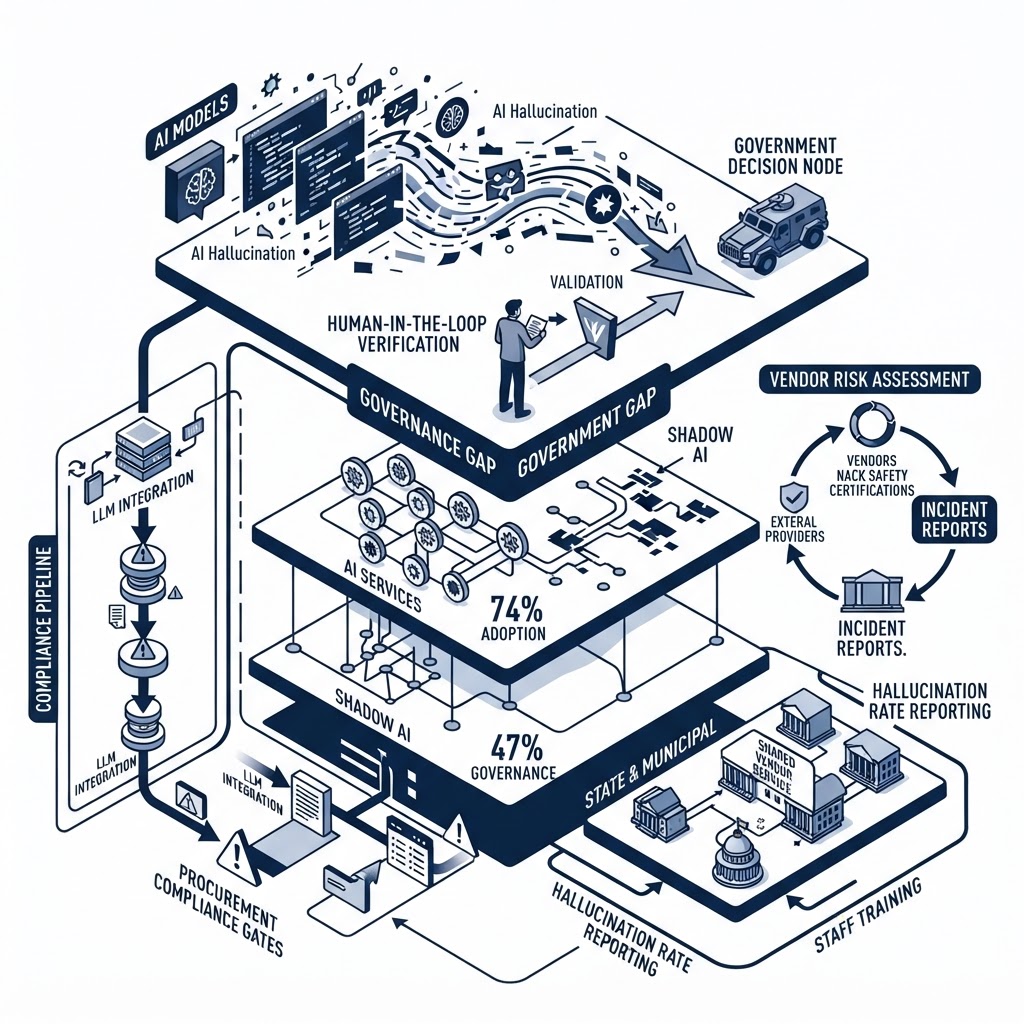
Agencies should implement a mandatory human-in-the-loop verification protocol for all AI-generated intelligence products. According to OriginBrief, governance must move beyond passive monitoring to active system observability. Organizations should establish a formal AI governance charter that dictates strict use-case limitations, ensuring that high-stakes outcomes—such as target identification or kinetic operations—require manual sign-off by human subject matter experts before execution.
The Widening Gap Between Adoption and Governance
Public sector entities currently face a massive disparity between the speed of technology integration and the maturity of their internal controls. Recent data indicates that while AI adoption reaches 74%, only 47% of organizations have effectively implemented the formal governance controls necessary to mitigate AI hallucination risk in government. This governance deficit is compounded by the fact that 86% of organizations have reported at least one major AI-related incident in the past year.
Traditional IT oversight mechanisms are proving inadequate against the unique challenges posed by LLMs, which function differently than standard legacy software. Compliance teams are struggling to keep pace, as shadow AI often bypasses existing procurement compliance gates. Without a comprehensive AI DLP (Data Loss Prevention) strategy, agencies remain exposed to both operational error and algorithmic accountability gaps.
The failure to align technical deployment with robust safety standards like the NIST AI RMF is leaving federal and local agencies vulnerable to significant reputational and operational damage. Leaders must stop treating AI as a standard IT procurement asset and instead recognize it as a specialized, high-risk capability requiring constant, evolving oversight.
Operational Shifts for State and Municipal Agencies
State and municipal government agencies cannot afford to ignore the lessons learned from the recent military near-miss. Because smaller jurisdictions often rely on vendors for AI-as-a-service, they are uniquely vulnerable to the same systemic risks that threaten federal operations. Procurement compliance must now be redefined to include stringent requirements for hallucination rate reporting and model transparency, shifting the burden of safety back onto the vendor.
Staff training is no longer an optional component but a requirement for any department utilizing AI for public-facing data or critical infrastructure decisions. Agencies need to establish an AI acceptable use policy that clearly defines the boundaries of machine-assisted decision-making. By implementing rigorous vendor risk assessments and continuous monitoring, municipalities can protect themselves from the same catastrophic errors that almost jeopardized national security.
The era of unchecked experimentation is over; local government leaders must prioritize institutional safety over the rapid adoption of black-box solutions. A proactive stance on algorithmic accountability will prevent costly litigation, public distrust, and potential threats to public safety.
Essential Actions for Oversight and Safety
- →Audit current AI vendors to ensure they comply with NIST AI RMF guidelines and provide transparent model performance data. • Mandate human-in-the-loop verification for any automated output that influences public policy or critical government decision-making. • Close the 27% gap between adoption and governance by implementing a formal AI governance charter before onboarding new tools. • Review procurement contracts to include liability clauses for AI failure and required incident reporting protocols. • Establish an AI DLP strategy to prevent sensitive data leaks and unauthorized use of generative models in shadow AI environments. • Develop an AI acceptable use policy that prioritizes reliability over operational efficiency for all high-stakes agency workflows.
How does poor AI oversight contribute to operational negligence in public sector environments?
When organizations deploy AI without sufficient governance—such as the 47% of entities lacking formal controls—they create a void in accountability. As noted by OriginBrief, this leads to a high incident rate where 86% of organizations experience failures. Such gaps mean that when an AI system hallucinates, no established chain of verification exists, turning a technical error into significant professional and operational negligence.
Addressing AI hallucination risk in government is the foremost challenge for leadership as we navigate these volatile deployment environments. Future safety will depend on bridging the current governance gap through strict verification, transparency, and a renewed commitment to human oversight. Compliance leaders must act now to secure their agencies before the next systemic failure occurs.
Tagged
About APEX AI Guardrails: We publish expert AI news and governance insights updated 4× daily. Our editorial team consists of retired government IT professionals, AI governance specialists, and compliance experts with deep experience in local government operations.
Related Articles
AI Governance
AI Deepfake Disinformation Threats: New October 2026 Policy Updates for SLED Agencies
October 1, 2026
AI Governance
Beyond the Black Box: Why AI Transparency and Explainability Are Now Government Mandates as of September 30, 2026
October 1, 2026
AI Governance
New Algorithmic Accountability Act Introduced to Curb AI Bias in Public Sector
October 1, 2026