
AI Deepfake Disinformation Threats: New October 2026 Policy Updates for SLED Agencies
The surge in AI-generated deepfakes is forcing a rapid policy shift across U.S. states and federal agencies. Local governments must navigate a complex regulatory landscape to protect democratic integrity.
Published by
APEX AI Guardrails Editorial Team
October 1, 2026
Reading time
6
minutes
Government IT leaders are grappling with rising AI deepfake disinformation threats as high-fidelity audio and video content increasingly target electoral processes in 2026. Data shows that 29 states have enacted specific legislative barriers to combat these synthetic media risks, creating a fragmented compliance environment for public sector agencies. Understanding these regulatory shifts is essential for maintaining institutional trust and securing digital communications during the 2026 midterm cycle.
How many U.S. states have passed legislation to combat election-related AI deepfakes as of late 2026?
As of June 2026, 29 states have successfully enacted laws regulating AI-generated election deepfakes to protect voters from misinformation. This legislative wave reflects a growing urgency to address synthetic media threats, although it has resulted in a patchwork of requirements that complicates cross-state regulatory alignment and consistent enforcement for public institutions and government IT departments nationwide.
The Growing Threat of AI-Driven Disinformation
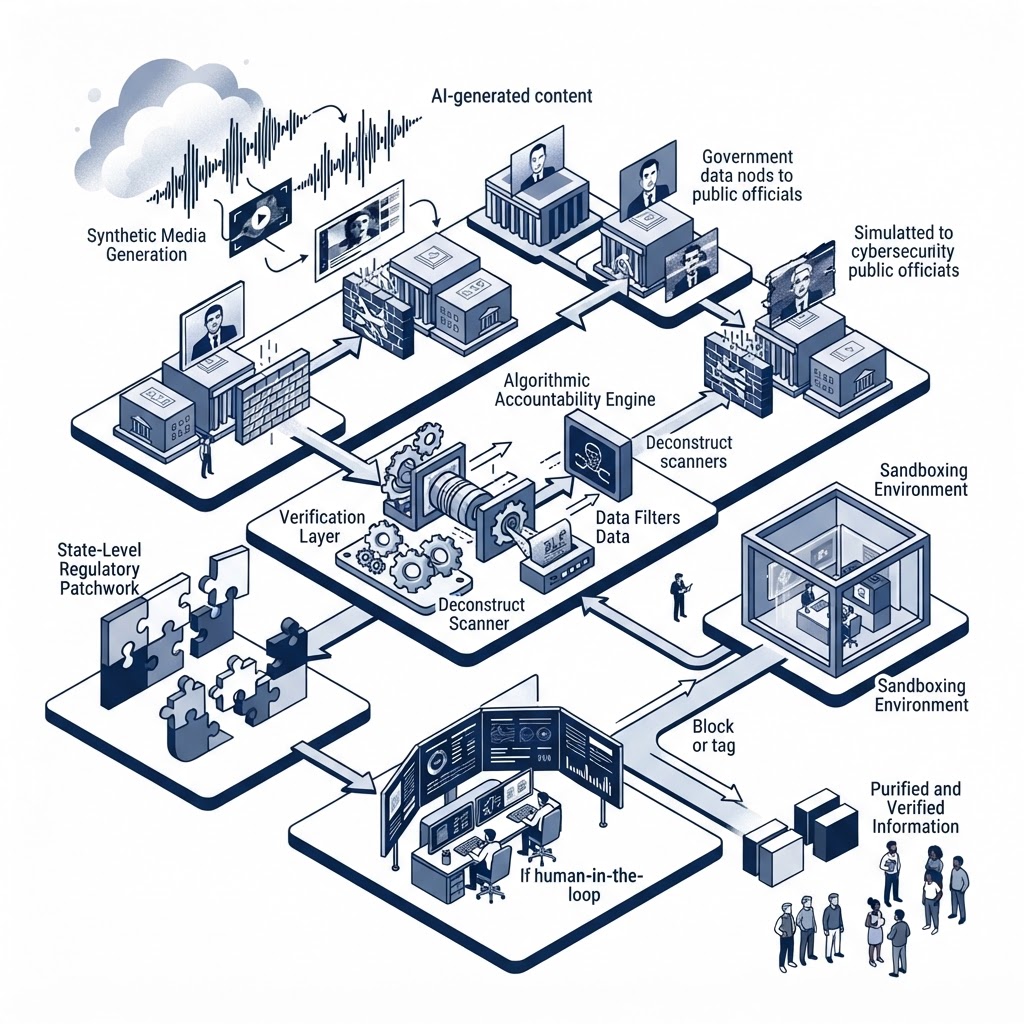
The rapid proliferation of hyper-realistic AI content is fundamentally altering the landscape of public trust in government institutions. Unlike earlier, generic forms of misinformation, modern AI tools allow for the creation of targeted, high-fidelity deepfakes designed specifically to disrupt electoral processes and sway public opinion. This shift in capability demands that SLED agencies look beyond traditional cybersecurity protocols to incorporate algorithmic accountability into their digital strategy.
By exploiting the subtle nuances of audio and video, malicious actors can mimic high-ranking officials to disseminate false policy announcements or fabricated electoral news, making detection a primary concern for IT infrastructure. According to recent reporting, voters face uneven AI deepfake protections as state legislatures scramble to respond to these risks, often with inconsistent results. This environment creates a significant vulnerability, as shadow AI tools are increasingly utilized by sophisticated threat actors to bypass standard content moderation efforts.
To counter these threats, agencies must adopt an AI acceptable use policy that emphasizes verification and human-in-the-loop oversight to ensure that official communications remain untampered and transparent, thereby protecting the integrity of government messaging throughout the 2026 midterm cycle.
What is the status of federal collaboration on AI election security efforts?
Bipartisan lawmakers have formally pressured the Cybersecurity and Infrastructure Security Agency (CISA) and the Federal Election Commission (FEC) to increase coordination on AI model consistency. This effort aims to establish robust federal guardrails that prevent the spread of AI-driven election-related misinformation, providing a more uniform defense strategy across state lines to protect the democratic process from evolving synthetic threats during critical election windows.
State-Level Regulatory Patchwork and Compliance Challenges
Navigating the current legal environment requires a sophisticated understanding of the state-level regulatory patchwork regarding AI-generated media. While 29 states have moved to restrict deepfakes, the lack of a standardized federal framework creates operational difficulties for SLED agencies that operate across multiple jurisdictions or rely on national vendor contracts. Compliance teams must now perform granular assessments to ensure their tools align with varying state-specific requirements regarding the labeling and disclosure of AI-generated content.
This creates a risk of procurement compliance gaps if current vendors fail to keep pace with the evolving requirements for algorithmic transparency. Experts warn that inconsistent state laws may leave smaller municipalities particularly vulnerable to misinformation campaigns that exploit these regulatory holes. By integrating the NIST AI RMF into their strategic planning, agencies can better identify areas of non-compliance and implement automated detection features that align with regional standards. Electoral Commission launches deepfake detection pilot to counter AI misinformation underscores the international shift toward proactive technical monitoring, providing a blueprint for domestic agencies looking to harden their own defenses through real-time verification pilots.
Strengthening Defenses via Sandboxes and Detection Pilots
To mitigate risks effectively, government leaders are increasingly turning toward controlled sandboxes and pilot programs for testing AI deployment. Arizona serves as a notable model, where the Secretary of State has proposed an AI Elections Lab to serve as a secure testing environment for AI tools before they are approved for statewide implementation. This approach allows agencies to vet new technology against potential deepfake vulnerabilities without risking live production environments.
Municipalities and counties should prioritize similar strategies for their procurement cycles, ensuring that every AI solution undergoes a rigorous evaluation for security, transparency, and data leakage protection before it touches internal workflows. Investing in staff training is equally vital, as personnel must be capable of identifying the subtle markers of AI-generated material that evade standard detection filters. By fostering a culture of responsible AI use, agencies can bridge the policy gaps currently hindering rapid deployment and maintain public confidence.
Strategic Priorities for 2026 Governance
- →Establish an agency-wide AI governance charter that explicitly prohibits the use of unauthorized synthetic media generators. • Evaluate all current AI-driven vendor tools against the NIST AI RMF to ensure compliance with state labeling requirements. • Implement regional sandboxes inspired by the Arizona AI Elections Lab to vet new technology before public release. • Coordinate with CISA to ensure federal consistency in AI election threats monitoring. • Prioritize procurement contracts that require vendors to provide documentation on data provenance and algorithmic bias mitigation. • Mandate biannual staff training sessions focused on the identification of AI-generated deepfake disinformation threats.
What are the specific risks to local government if they ignore AI deepfake threats during elections?
Ignoring these threats exposes local governments to catastrophic risks, including eroded public trust, the dissemination of false emergency directives, and potential paralysis of administrative operations. Regulators warn that failing to detect deepfakes can lead to legal liabilities and loss of institutional control, as AI-driven misinformation can incite public confusion and manipulate official election data, ultimately undermining the very foundation of localized democratic decision-making and accountability.
Addressing AI deepfake disinformation threats requires a blend of rigorous technical testing and proactive policy coordination at every level of government. As the 2026 midterm cycle progresses, agencies that prioritize transparency and secure, validated technology deployments will be best positioned to protect their institutions. Compliance leaders must act immediately to close policy gaps and integrate robust detection frameworks to maintain the public's confidence.
Sources
Tagged
About APEX AI Guardrails: We publish expert AI news and governance insights updated 4× daily. Our editorial team consists of retired government IT professionals, AI governance specialists, and compliance experts with deep experience in local government operations.
Related Articles
AI Governance
AI Hallucination Risk: Government Defense Faces New October 1 Near-Miss Incident
October 1, 2026
AI Governance
Beyond the Black Box: Why AI Transparency and Explainability Are Now Government Mandates as of September 30, 2026
October 1, 2026
AI Governance
New Algorithmic Accountability Act Introduced to Curb AI Bias in Public Sector
October 1, 2026