
Beyond the Black Box: Why AI Transparency and Explainability Are Now Government Mandates as of September 30, 2026
As of September 2026, AI transparency and explainability have moved from voluntary goals to essential government mandates in the US and abroad. This shift requires agencies to implement rigorous audit trails for all automated decision-making processes.
Published by
APEX AI Guardrails Editorial Team
October 1, 2026
Reading time
6
minutes
# Beyond the Black Box: Why AI Transparency and Explainability Are Now Government Mandates as of September 30, 2026
New September 2026 policy developments establish AI transparency and explainability in government as mandatory requirements rather than optional best practices. This shift is driven by the legal enforceability of the EU AI Act and intensifying oversight from state-level leaders in California who are setting aggressive safety standards. For public sector IT and compliance directors, this transition signals the end of the 'black box' era and necessitates immediate investment in explainable, audit-ready AI workflows.
Are there new legal requirements for transparency when using generative AI tools in public agencies?
Yes, as of September 2026, the EU AI Act’s transparency obligations are now legally binding, and recent legislative updates are directing professional boards to establish formal rules for licensee usage. These frameworks require agencies to maintain clear, documentable logs of how automated systems arrive at high-stakes decisions, ensuring that every AI-driven outcome can be scrutinized for fairness and technical accuracy according to evolving national standards.
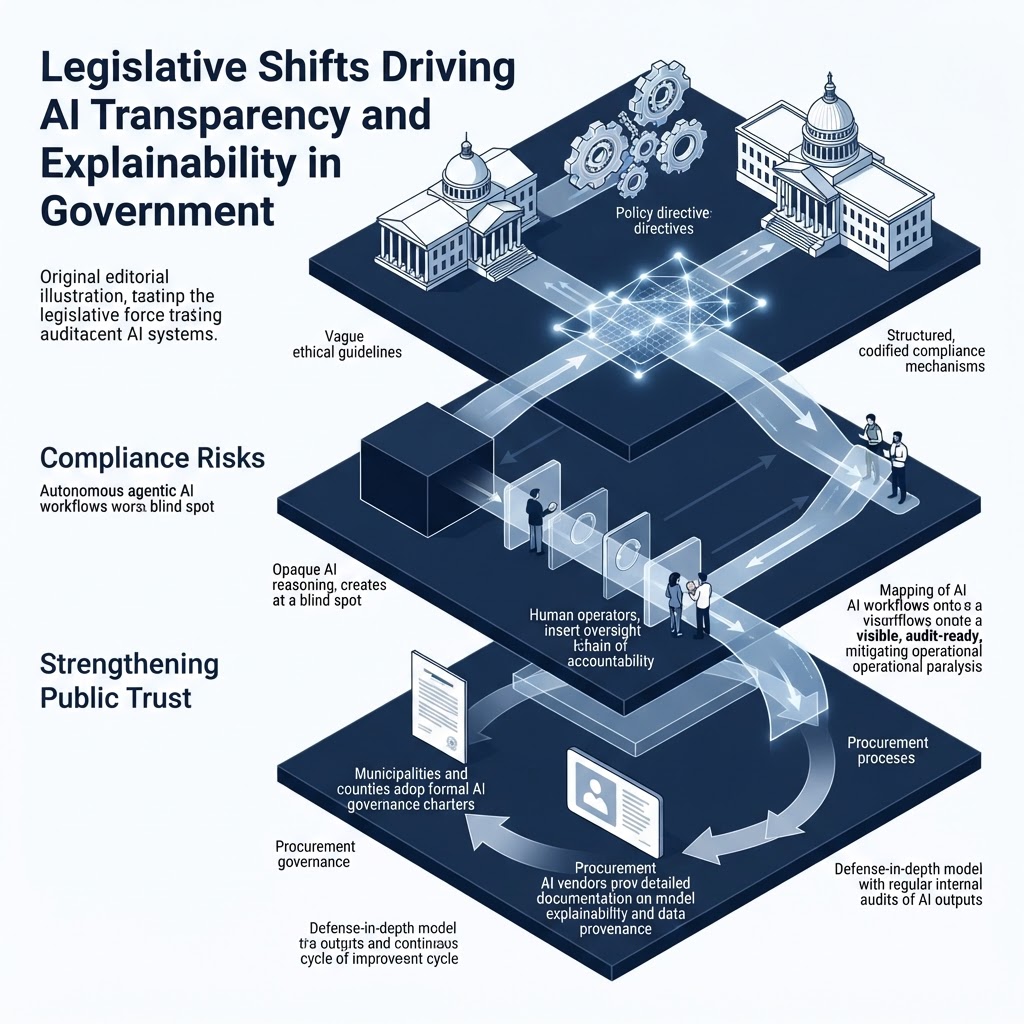
Legislative Shifts Driving AI Transparency and Explainability in Government
The regulatory landscape for autonomous systems has undergone a rapid evolution throughout 2026. As documented in the AI Legislative Update: September 25, 2026, there is a growing trend of empowering professional and occupational boards to codify how generative AI tools must be utilized by licensed practitioners. This move effectively forces organizations to move away from vague ethical guidelines toward granular, codified compliance.
Parallel to this, California is cementing its status as the nation's primary architect of AI safety, with Governor Newsom announcing world-leading experts to operationalize executive orders that follow the landmark 2025 Transparency in Frontier Artificial Intelligence Act (SB 53). These initiatives demonstrate a clear intent to move beyond static policy, focusing instead on active safety mechanisms like kill switches and standardized reporting. By integrating these requirements, government agencies are aligning themselves with the broader international movement toward active, verifiable compliance that is now a standard pillar of the EU Tech Policy Brief: September 2026.
How should my agency begin the process of operationalizing AI explainability to meet these new regulatory hurdles?
Agencies must start by mapping AI workflows to existing compliance frameworks, such as the NIST AI RMF, to identify where 'black box' reasoning occurs. You should prioritize implementing audit-ready frameworks for all non-human identities and agentic workflows. By mandating a human-in-the-loop requirement for decisions that impact citizens, your department ensures there is always a clear, documentable chain of accountability behind every automated recommendation or data-driven outcome.
Compliance Risks and Liability in Agentic AI Workflows
Operationalizing transparency is no longer just a technical exercise; it is a critical strategy for mitigating legal liability. Organizations deploying autonomous agents often encounter a severe blind spot, as the reasoning processes of these complex systems remain opaque to human operators Transparency and Explainability in Agentic AI Decision-Making | Token Security. This lack of visibility into 'black box' decision-making creates substantial risks for public sector agencies, especially when AI models interface with protected data or influence essential public services.
Compliance leaders must recognize that as AI becomes more agentic, the burden of proof for algorithmic accountability rests squarely on the deploying agency. If an agency cannot explain why an autonomous agent reached a specific conclusion, it effectively abdicates its administrative responsibility. Therefore, mapping AI workflows to established compliance frameworks is the only way to avoid the operational paralysis that follows a regulatory audit.
By treating AI transparency as a core component of their existing risk management portfolio, public leaders can ensure that their innovation initiatives do not become liabilities in an era of strict, enforceable government oversight.
Strengthening Public Trust Through Procedural Transparency
State and local governments must prioritize procedural transparency to maintain public confidence as they integrate AI into daily operations. For municipalities and counties, this begins with a formal AI governance charter that dictates exactly how agents are monitored and verified. Procurement is a critical stage here; agencies should mandate that vendors provide detailed documentation on model explainability and data provenance before any contract is finalized.
Furthermore, staff training programs must emphasize that AI serves as a tool for augmentation, not a replacement for professional judgment. When public sector leaders fail to bridge the gap between policy and practice, they risk exposing their communities to shadow AI, where undocumented tools make decisions without oversight. By forcing vendors to adhere to strict transparency standards during the procurement cycle and requiring regular internal audits of AI outputs, agencies can build a defense-in-depth model that respects privacy and ensures procedural justice.
This approach treats AI transparency explainability government standards as a continuous cycle of improvement rather than a one-time project, securing the trust of the constituents who rely on government services every day.
Strategic Mandates for Compliance Teams
- →Establish a clear AI governance charter that explicitly requires audit-ready documentation for all high-stakes agentic decisions. • Incorporate mandatory transparency and explainability clauses into all future technology procurement contracts to ensure vendor accountability. • Implement rigorous human-in-the-loop (HITL) checkpoints for any AI process influencing public policy or citizen services. • Conduct regular gap analyses to identify shadow AI usage and ensure all tools align with the latest state and federal AI safety mandates. • Adopt a risk-based approach to AI deployment by categorizing systems based on the level of impact they have on public rights and services.
What is the primary danger if an agency fails to establish transparency in its automated decision-making processes?
Failure to establish transparency exposes an agency to significant legal liability and a loss of public trust if systems function as 'black boxes' without clear accountability. In a regulated environment, an inability to explain an AI-driven decision can lead to failed audits, civil litigation, and the mandatory suspension of critical operations, as regulators increasingly enforce the requirement that human operators remain responsible for all AI-enabled outcomes.
The era of voluntary ethical guidelines has ended, and AI transparency explainability government requirements are now the foundational expectation for all public service providers. By embedding these principles into every tier of agency operation, leaders can turn regulatory pressure into an opportunity to build more secure and trustworthy systems. Now is the time for compliance officers to formalize their governance frameworks and ensure full visibility into their increasingly agentic technical environments.
Tagged
About APEX AI Guardrails: We publish expert AI news and governance insights updated 4× daily. Our editorial team consists of retired government IT professionals, AI governance specialists, and compliance experts with deep experience in local government operations.
Related Articles
AI Governance
AI Hallucination Risk: Government Defense Faces New October 1 Near-Miss Incident
October 1, 2026
AI Governance
AI Deepfake Disinformation Threats: New October 2026 Policy Updates for SLED Agencies
October 1, 2026
AI Governance
New Algorithmic Accountability Act Introduced to Curb AI Bias in Public Sector
October 1, 2026