
New Algorithmic Accountability Act Introduced to Curb AI Bias in Public Sector
Federal lawmakers have introduced the Algorithmic Accountability Act to standardize AI oversight across state and local government agencies. This legislation marks a significant shift toward mandatory transparency and rigorous testing of automated systems.
Published by
APEX AI Guardrails Editorial Team
October 1, 2026
Reading time
6
minutes
On September 29, 2026, the U.S. Government Publishing Office officially recorded the introduction of the Algorithmic Accountability Act to standardize oversight for public sector automated decision-making. This federal legislation targets systemic risks in government technologies, mirroring calls from agencies like NIST to improve system reliability and explainability.
For SLED government IT and compliance leaders, this shift necessitates a rapid move toward formal AI auditing and data transparency protocols to ensure ongoing regulatory compliance.
How does the 2026 Algorithmic Accountability Act affect state and local government procurement?
The legislation mandates that agencies implement rigorous testing and impact assessments for automated decision-making tools. Under this framework, SLED organizations must now evaluate vendor software for bias and transparency before deployment. Agencies should align their procurement processes with the Algorithmic accountability for the public sector guidelines to ensure that all new AI tools satisfy federal fairness and auditability standards as required by the newly introduced bill.
Legislative Mandates for Federal and SLED AI Oversight
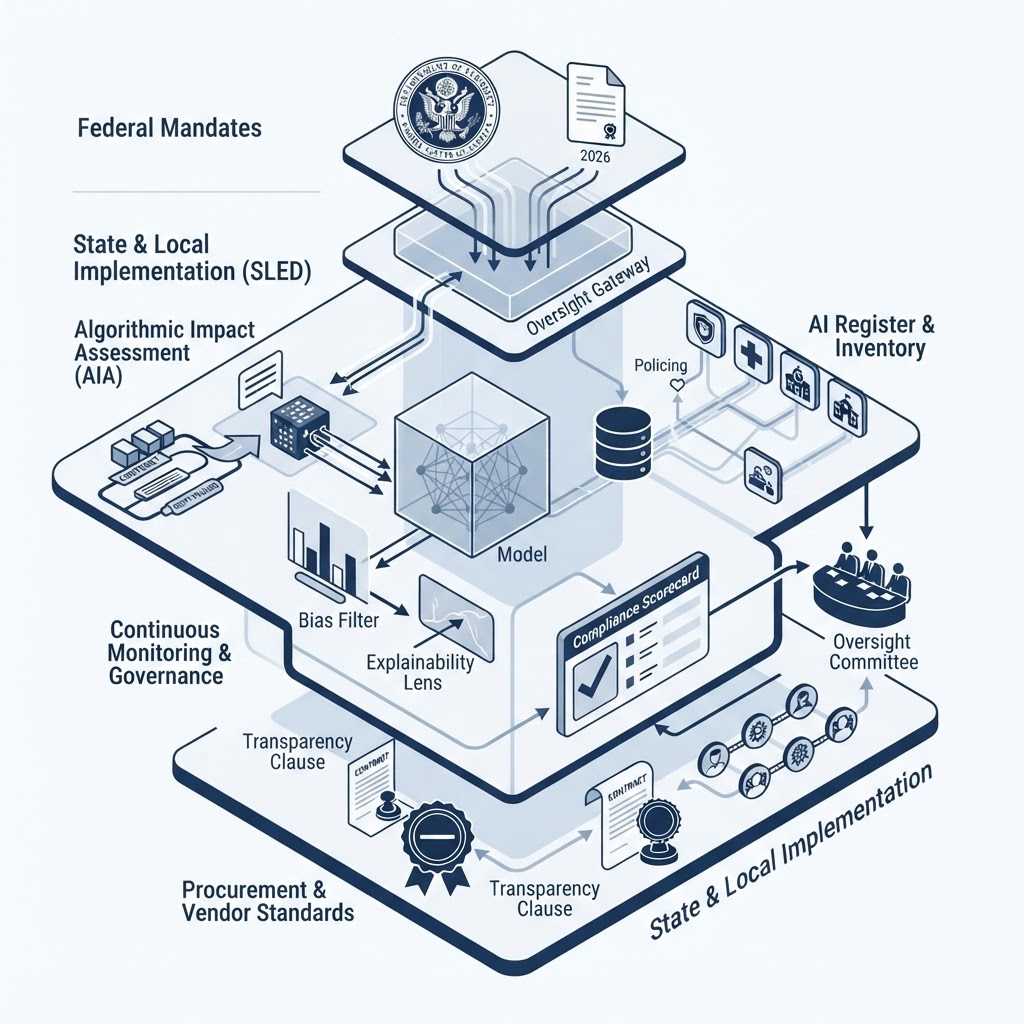
The introduction of the Algorithmic Accountability Act, officially documented on September 29, 2026, marks a turning point for digital governance in the United States. Federal lawmakers have structured this bill to curb unchecked AI expansion by requiring public sector agencies to move beyond vague ethical commitments toward concrete, enforceable accountability. The legislation specifically mandates that any agency employing AI for high-stakes decision-making must conduct standardized impact assessments and maintain public-facing AI registers.
These mechanisms are designed to demystify complex algorithms and ensure that local, state, and federal offices remain accountable to the citizens they serve. By codifying these requirements, the federal government is signaling that 'black box' systems are no longer acceptable for essential services. Agencies must prepare for increased scrutiny regarding their internal data pipelines and model testing methodologies.
This move aligns with broader efforts to ensure technology does not bypass democratic oversight or civil rights protections, effectively formalizing the requirement for explainable and reliable automated systems across all levels of the public sector.
What are the primary steps for an agency to comply with the new Algorithmic Accountability Act?
Agencies must first establish a formal AI register to inventory all deployed models. Second, they must conduct Algorithmic Impact Assessments (AIAs) to identify potential bias, as recommended by the Ada Lovelace Institute. Third, teams should integrate NIST-aligned technical standards for model explainability. Finally, establishing a continuous monitoring program ensures ongoing compliance with these new federal transparency and fairness reporting obligations.
Addressing Historical Failures and Systemic Bias
Public sector leaders are under increased pressure to eliminate algorithmic bias that has historically led to the denial of critical benefits and inequitable outcomes in policing and social services. According to the American Association for the Advancement of Science (AAAS), documented instances of faulty data leading to the arbitrary denial of Medicaid benefits highlight the dangers of deploying automated systems without robust oversight. These historical failures demonstrate that technical bias is not merely a software bug; it is a civil rights issue that can severely damage public trust and exacerbate inequality.
The Algorithmic Accountability Act aims to transition the public sector from reactive bias mitigation to proactive fairness standards. This shift requires agencies to interrogate the data sources, weights, and encoded rules that underpin their decision-making algorithms. Organizations that fail to address these systemic vulnerabilities face significant legal and reputational risks, particularly as regulatory focus on equity increases.
By centering fairness as a primary metric in system performance, SLED agencies can move toward a model of responsible AI use that respects individual rights while leveraging the efficiency of automation.
Strategic Priorities for State and Local Agency Compliance
Municipalities and state agencies must prioritize the integration of Algorithmic Impact Assessments (AIAs) into their existing project management frameworks. The era of unchecked 'shadow AI' deployment is ending as procurement teams must now verify that vendors adhere to the transparency requirements outlined in the 2026 act. This involves a comprehensive review of AI governance charters and the establishment of dedicated audit teams to oversee model life cycles.
Agencies should leverage NIST guidance on bias in AI to develop internal testing protocols that go beyond data quality and focus on the reliability and explainability of the entire system architecture. Furthermore, staff training is essential to ensure that personnel understand how to interpret algorithmic outputs and identify potential bias markers in daily operations. For smaller municipalities, the burden of these requirements may necessitate regional partnerships or the pooling of governance resources to meet the new federal standards effectively.
Proactive compliance will serve as a defensive measure against future regulatory audits and civil rights complaints, effectively shielding the agency from the liabilities associated with non-transparent or discriminatory automated processes.
Actions for Responsible AI Governance
- →Establish a centralized AI register to track all high-stakes automated decision-making systems within the agency. • Conduct thorough Algorithmic Impact Assessments (AIAs) before and during the lifecycle of any AI deployment. • Adopt NIST-aligned technical standards to ensure all systems are explainable and minimize demographic bias. • Incorporate transparency and fairness clauses into all vendor procurement contracts to ensure compliance with the new federal act. • Implement continuous monitoring of AI outputs to detect and address potential service delivery failures in real-time. • Appoint an internal governance oversight committee responsible for ensuring alignment with federal algorithmic accountability requirements.
What is the legal consequence for an agency failing to adhere to the Algorithmic Accountability Act?
While specific enforcement penalties are tiered, non-compliance exposes agencies to federal oversight audits, potential loss of federal funding, and increased litigation risk regarding civil rights violations. As noted by NIST, failure to provide explainable systems can result in the loss of public trust. Regulatory scrutiny will likely focus on agencies that cannot prove their models are free from systemic bias or technical failures.
The introduction of the Algorithmic Accountability Act represents a foundational shift in how public sector organizations must approach the development and oversight of automated systems. As states and municipalities move to align with these federal standards, the ability to demonstrate fairness and transparency will become a core competency for government IT. Compliance leaders must act immediately to establish robust auditing frameworks to ensure their future AI initiatives remain both compliant and equitable.
Tagged
About APEX AI Guardrails: We publish expert AI news and governance insights updated 4× daily. Our editorial team consists of retired government IT professionals, AI governance specialists, and compliance experts with deep experience in local government operations.
Related Articles
AI Governance
AI Hallucination Risk: Government Defense Faces New October 1 Near-Miss Incident
October 1, 2026
AI Governance
AI Deepfake Disinformation Threats: New October 2026 Policy Updates for SLED Agencies
October 1, 2026
AI Governance
Beyond the Black Box: Why AI Transparency and Explainability Are Now Government Mandates as of September 30, 2026
October 1, 2026