
NIST AI Risk Management Framework: New August 2026 Updates for Government Agencies
NIST has updated its AI Risk Management Framework engagement portal as of August 13, 2026, signaling a transition toward mandatory compliance and revised technical standards for government agencies.
Published by
APEX AI Guardrails Editorial Team
August 16, 2026
Reading time
7
minutes
The NIST AI Risk Management Framework has reached a pivotal milestone following the August 13, 2026, activation of a new engagement portal designed to collect multi-year feedback for the framework's next major revision. As of August 10, 2026, federal and state regulators have officially transitioned toward treating this framework as a base layer for compliance rather than just voluntary guidance. This shift necessitates an immediate re-evaluation of AI procurement and deployment strategies for all SLED and government IT leaders to ensure alignment with emerging technical mandates.
How has the legal status of the NIST AI Risk Management Framework changed for government contractors and agencies as of August 2026?
While the framework was initially released as voluntary, by August 10, 2026, the NIST AI RMF is being treated by regulators and auditors as a foundational base layer for legal compliance. This means that agencies and their technology vendors are now expected to demonstrate framework alignment during standard IT audits, making its adoption a mandatory operational requirement for those seeking to minimize legal liability and ensure project viability in the public sector.
Operationalizing the NIST AI Risk Management Framework: From Engagement to Auditable Standards

On August 13, 2026, NIST significantly updated its AI Risk Management Framework engagement portal, signaling a new era of community-driven refinement. This update isn't merely administrative; it is the starting gun for a comprehensive revision of the framework based on two years of real-world implementation data. For government agencies, the focus has shifted from trust-claiming—simply stating that a system is safe—to trust-building, which requires documented proof of specific subcategory actions.
This involves the creation of a formal AI governance charter and the enforcement of a comprehensive AI acceptable use policy to curb the spread of shadow AI. Governance is no longer a peripheral IT concern; it is a core operational requirement. Public sector leaders must now demonstrate how they are using the framework's Map, Measure, and Manage functions to mitigate bias and ensure algorithmic accountability.
By engaging with the new portal, agencies can contribute to shaping standards that reflect the unique budgetary and personnel challenges faced by state and local governments. As these revisions take hold, the framework will likely become even more prescriptive, leaving less room for abstract compliance and demanding more concrete, auditable evidence of risk mitigation.
What new technical security controls were finalized in August 2026 to protect public sector AI deployments?
On August 3, 2026, NIST published the final version of IR 8607, the Cyber AI Profile, which introduces specific SP 800-53 Control Overlays (COSAiS). These technical controls are designed to secure AI systems against modern threats such as prompt injection and data privacy breaches. The profile provides a standardized method for government IT teams to implement AI DLP and other security measures that protect sensitive citizen data within large language models and autonomous agents.
Hardening Infrastructure with the NIST AI Risk Management Framework and Cyber AI Profile
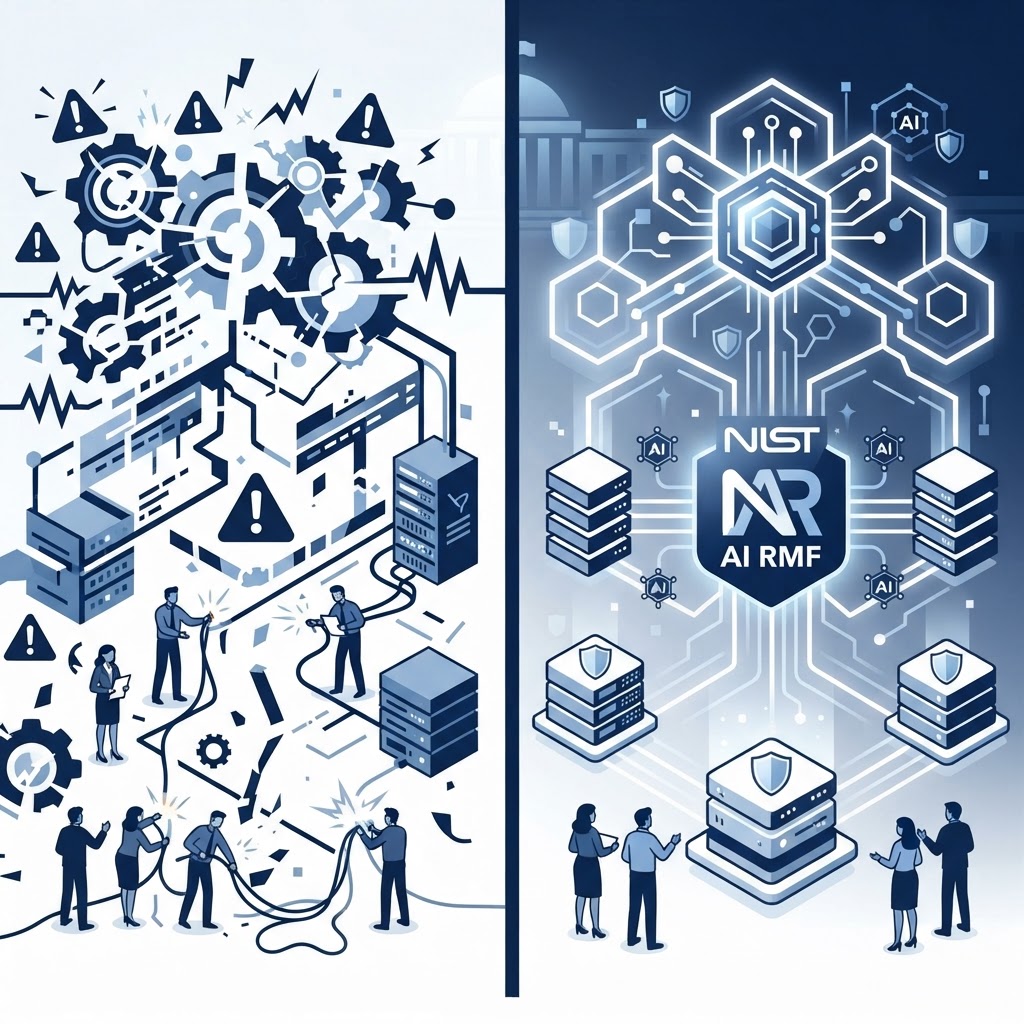
The release of the final report for IR 8607, the Cyber AI Profile, on August 3, 2026, provides the technical teeth that the NIST AI Risk Management Framework previously lacked in specific security domains. By integrating SP 800-53 Control Overlays (COSAiS), NIST has unified AI security with the existing federal standards that govern traditional IT infrastructure. This integration is crucial for agencies that must protect citizen data from prompt injection attacks and unauthorized data leakage from training sets.
For instance, an agency deploying a generative AI chatbot for 311 services must now apply these specific overlays to ensure that the model cannot be manipulated into revealing PII or internal system architecture. The framework also addresses AI transparency by requiring detailed documentation of model provenance and data lineage. Furthermore, with the anticipated Q4 2026 release of the AI Agent Interoperability Profile, the framework is expanding to cover autonomous systems that act on behalf of users.
These updates ensure that AI risk management is integrated directly into the security operations center (SOC), rather than existing as an isolated compliance checklist. This technical maturation allows for real-time monitoring of AI systems, providing the data necessary to satisfy both internal auditors and external regulatory bodies.
Navigating Procurement Risks and International Standards in Local Government
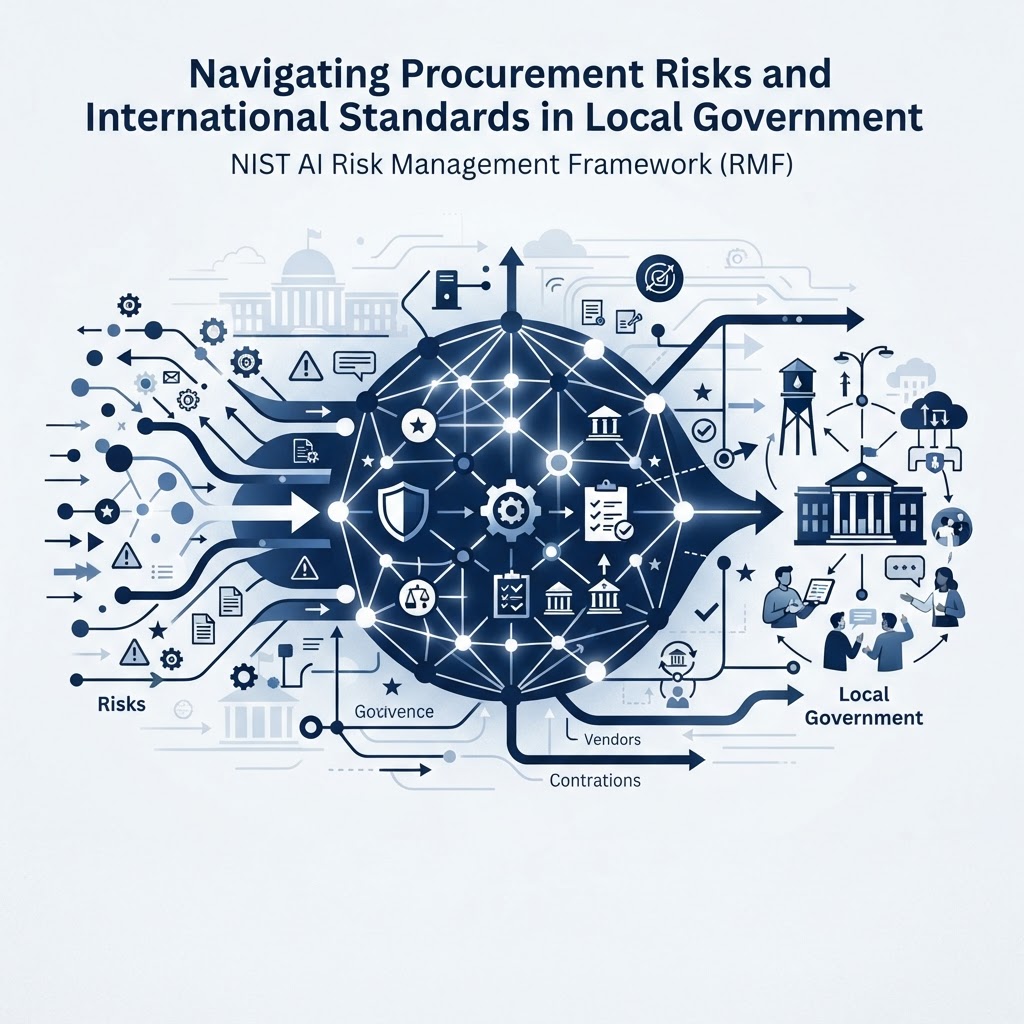
As of August 2026, the global regulatory environment is exerting unprecedented pressure on U.S. government agencies to professionalize their AI oversight. A technology brief from August 3, 2026, highlighted that AI governance has moved from a concept to an operational imperative due to the enforcement of major international laws like the EU AI Act. Even for local municipalities in the U.S., these standards are becoming the benchmark for high-risk system management.
However, the transition is proving difficult; current estimates suggest that 78% of organizations are still struggling to implement meaningful compliance steps despite the August 2026 deadlines. This lag creates significant procurement risks, as agencies may inadvertently acquire tools that do not meet future state or federal safety mandates. To mitigate this, SLED leaders must prioritize vendor risk assessments that specifically utilize NIST RMF criteria.
Training staff on the responsible AI lifecycle is also essential, as the human-in-the-loop requirement becomes a standard feature of state-level algorithmic accountability bills. By operationalizing governance now, agencies can avoid the costly rip-and-replace scenarios that occur when non-compliant systems are flagged by auditors or civil rights watchdogs.
Necessary Actions for Public Sector Technology Directors
- →Audit all current AI deployments against the new SP 800-53 COSAiS overlays to identify vulnerabilities to prompt injection. • Update existing procurement contracts to include mandatory NIST AI Risk Management Framework alignment from all third-party software vendors. • Establish a centralized AI governance charter that defines roles for data privacy, security, and algorithmic accountability across all departments. • Review the latest NIST engagement portal updates to prepare for the upcoming framework revisions and provide feedback on resource needs. • Implement AI DLP protocols specifically designed to monitor large language model outputs for PII and sensitive government data. • Schedule a training session for legal and IT staff on the interoperability of the NIST framework with international standards like the EU AI Act.
What are the primary risks for government agencies that fail to align with the NIST AI RMF by late 2026?
Agencies that ignore these updates face severe operational and legal risks, as AI governance has become a mandatory strategic priority to avoid regulatory scrutiny. Failure to comply can result in the loss of federal funding, increased exposure to litigation over biased algorithmic decisions, and the mandatory decommissioning of high-risk AI systems that do not meet the now-standardized base layer of safety and security requirements.
The August 2026 updates to the NIST AI Risk Management Framework signal a definitive end to the era of voluntary and abstract AI ethics in government. By formalizing technical controls and opening the framework for rigorous revision, NIST is providing the tools necessary for agencies to build genuine public trust. Compliance leaders must act immediately to operationalize these standards, ensuring that their AI initiatives are both resilient to emerging threats and fully aligned with global regulatory expectations.
Tagged
About APEX AI Guardrails: We publish expert AI news and governance insights updated 4× daily. Our editorial team consists of retired government IT professionals, AI governance specialists, and compliance experts with deep experience in local government operations.
Related Articles
Government AI
AI Hallucination Risk Governance in SLED: September 4 Disciplinary Actions and New Deployer Liability
September 4, 2026
AI Governance
AI Deepfake Disinformation Threats: Global Governments Ramp Up Oversight in September 2026
September 4, 2026
Government AI
AI Transparency Government Decision Making: California Passes 30 Oversight Bills Ahead of September Deadline
September 4, 2026