
NIST AI Risk Management Framework: New August 2026 Federal Guidance and AI Act Alignment
This article explores the August 2026 updates to the NIST AI Risk Management Framework and its alignment with the White House AI Action Plan. It provides actionable guidance for federal and SLED agencies to navigate EU AI Act compliance and emerging AI agent standards.
Published by
APEX AI Guardrails Editorial Team
August 19, 2026
Reading time
7
minutes
As of August 19, 2026, the NIST AI Risk Management Framework (AI RMF) has become the definitive benchmark for federal agencies striving to meet the benchmarks set by the White House AI Action Plan. With the EU AI Act’s high-risk obligations beginning their phase-in this month, the framework offers a critical pathway for organizations to demonstrate algorithmic accountability and maintain procurement compliance. For government IT leaders, implementing this framework is now essential for securing federal contracts and ensuring the safe deployment of generative technologies in regulated environments.
How does the August 13, 2026 NIST engagement update impact current federal contractor obligations?
The update released on August 13, 2026, signals a shift toward mandatory 'NIST-aligned' governance for any entity seeking federal contracts. According to the AI Risk Management Framework - Engage | NIST, NIST is intensifying collaborative workshops to refine the voluntary framework into a structured requirement, ensuring that third-party vendors adhere to the safety and ethical standards necessitated by the White House AI Action Plan.
Federal Agency Alignment with the NIST AI Risk Management Framework
As we move through mid-August 2026, NIST is actively updating its engagement strategies to ensure that federal agencies are fully synchronized with the White House AI Action Plan. This alignment is not merely a suggestion; it has become a cornerstone of federal agency operations, where 'NIST-aligned' governance is increasingly treated as a mandatory prerequisite for federal contractors and technology providers. According to the latest updates from NIST, these collaborative engagement efforts utilize ongoing workshops and public feedback to refine how the public and private sectors implement the framework.
While the framework itself remains technically voluntary, it carries immense regulatory weight, with major bodies like the FTC, FDA, and SEC frequently referencing its core principles in their oversight activities. For agencies, this means transitioning from a check-the-box compliance mentality to a robust implementation of the NIST AI Risk Management Framework to manage risks throughout the AI lifecycle. Responsible AI use is now a primary focus, ensuring that innovation does not come at the cost of information integrity or algorithmic accountability.
Leaders are encouraged to adopt a maturity-driven process that moves beyond documentation toward active, continuous monitoring of AI systems to prevent the emergence of shadow AI within their departments.
Can the NIST AI Risk Management Framework be used to satisfy high-risk AI system obligations under the EU AI Act?
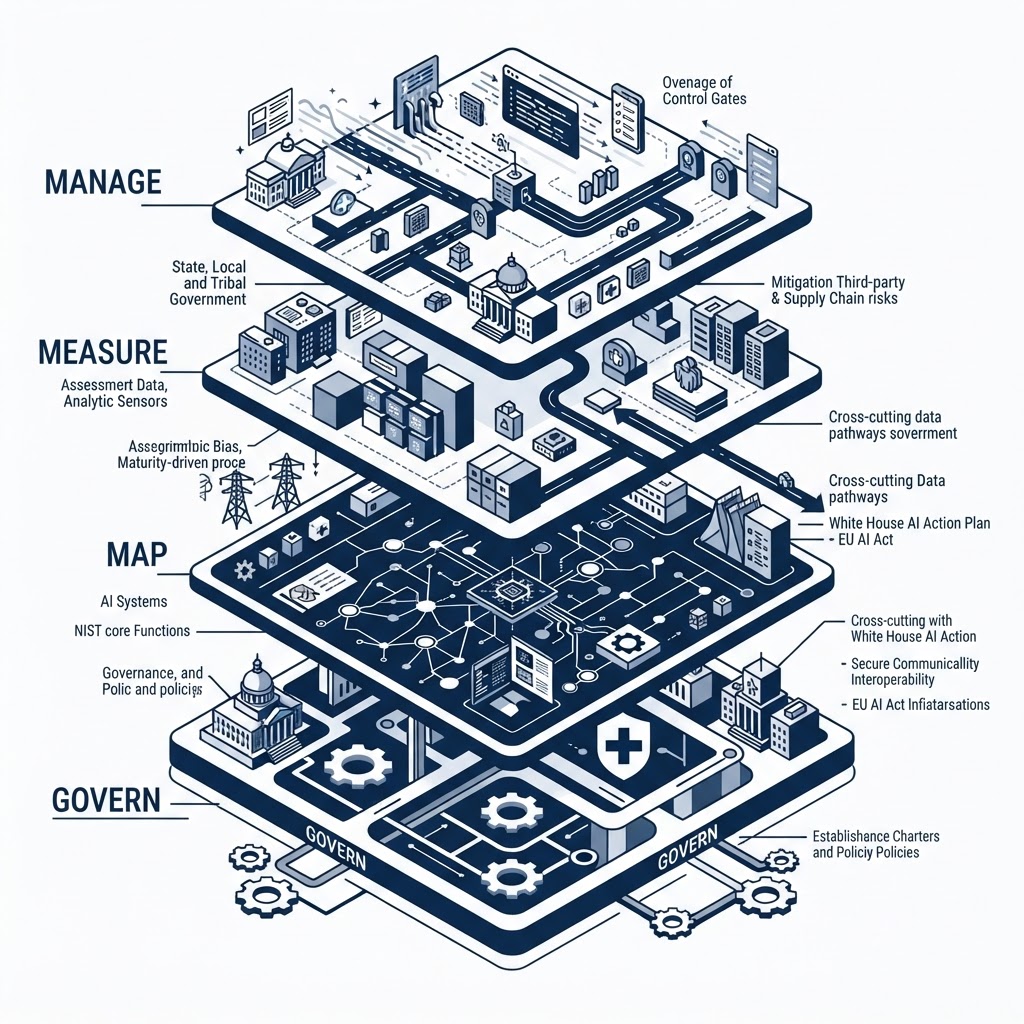
Yes, the NIST AI Risk Management Framework is currently serving as a vital operational companion for U.S. organizations meeting EU AI Act obligations that are phasing in during August 2026. As noted by Mitratech, the framework’s four core functions—Govern, Map, Measure, and Manage—can be mapped directly to European regulatory requirements, providing a structured approach for managing high-risk AI systems and ensuring global market access.
NIST AI Risk Management Framework as a Global Compliance Standard
The arrival of August 2026 marks a significant milestone in the global regulatory landscape, as the European Union’s AI Act begins phasing in its stringent obligations for high-risk AI systems. For U.S.-based government agencies and their partners, the NIST AI Risk Management Framework has emerged as the essential 'base layer' for achieving international compliance. By utilizing the framework, organizations can address complex international expectations for transparency and accountability without needing to overhaul their existing governance structures.
The framework’s four central functions—Govern, Map, Measure, and Manage—are being meticulously mapped to the EU’s regulatory demands. According to Mitratech, this operational alignment helps agencies manage the nuances of third-party risk and supply chain integrity, which are critical components of the August 2026 compliance window. Furthermore, as organizations navigate these international waters, the focus on responsible AI development ensures that data privacy and data loss prevention (AI DLP) remain paramount.
The framework provides the necessary tools to document the decision-making process, thereby satisfying both domestic requirements and the rigorous transparency standards mandated by overseas regulators. This cross-border utility reinforces the framework’s position as a global standard for algorithmic safety.
Technological Frontiers: AI Agent Interoperability and Critical Infrastructure
Looking toward the remainder of 2026, NIST is expanding the scope of the framework to address the next generation of autonomous technology. A new AI Agent Interoperability Profile is currently in development and is targeted for release in Q4 2026, a move that aims to standardize how autonomous agents interact across different platforms. This follows the release of a concept note for 'Trustworthy AI in Critical Infrastructure' in April 2026, which signals a strategic shift toward sector-specific profiles for energy, healthcare, and manufacturing.
These developments, highlighted by Alation, underscore the need for agencies to prepare for increasingly complex AI ecosystems where interoperability is a security requirement. Simultaneously, the Department of the Treasury has already expanded upon the NIST structure for financial services, integrating 230 specific control objectives into its own AI Risk Management Framework. This level of granularity reflects a broader trend toward maturity-driven processes and continuous monitoring within government IT.
For SLED agencies, this means focusing on the 'GOVERN' function, specifically the three categories dedicated to vendor oversight and supply chain risk. By implementing an AI acceptable use policy and a formal AI governance charter, local and state agencies can mitigate the risks of unmanaged 'shadow AI' deployments and ensure that all automated systems are subject to data privacy and information integrity standards.
Strategic Roadmap for AI Compliance Officers
- →Establish a formal AI governance charter that explicitly adopts the NIST AI RMF core functions to ensure cross-departmental alignment. • Conduct a comprehensive audit of all current AI deployments to identify and mitigate 'shadow AI' that may exist outside of IT oversight. • Update procurement compliance documents to require that all third-party vendors provide evidence of 'NIST-aligned' risk management practices. • Implement an AI acceptable use policy that includes specific guidelines for data privacy and AI DLP to prevent sensitive government data leaks. • Prepare for the Q4 2026 release of the AI Agent Interoperability Profile by assessing current agent-based systems for potential compatibility gaps. • Utilize the over 200 suggested actions in the NIST AI RMF Playbook to build a maturity-driven continuous monitoring process for all high-risk systems.
What specific regulatory consequences face agencies that fail to adopt NIST-aligned governance by the end of 2026?
Agencies failing to adopt the NIST AI Risk Management Framework by late 2026 face significant risks, including the loss of eligibility for federal grants and increased scrutiny from regulators like the FTC. According to recent updates on responsible AI use, non-compliant agencies are more susceptible to legal challenges regarding algorithmic bias and could face severe operational disruptions if their third-party vendors are excluded from federal procurement lists due to inadequate risk management.
The NIST AI Risk Management Framework has evolved into an indispensable tool for ensuring safety and transparency in the rapidly advancing world of government technology. By aligning with these standards in August 2026, agencies can navigate both the White House AI Action Plan and international regulations like the EU AI Act with confidence. Future-proofing agency operations requires a commitment to continuous monitoring and a proactive approach to the emerging standards that will define the next era of public sector innovation.
Tagged
About APEX AI Guardrails: We publish expert AI news and governance insights updated 4× daily. Our editorial team consists of retired government IT professionals, AI governance specialists, and compliance experts with deep experience in local government operations.
Related Articles
Government AI
AI Hallucination Risk Governance in SLED: September 4 Disciplinary Actions and New Deployer Liability
September 4, 2026
AI Governance
AI Deepfake Disinformation Threats: Global Governments Ramp Up Oversight in September 2026
September 4, 2026
Government AI
AI Transparency Government Decision Making: California Passes 30 Oversight Bills Ahead of September Deadline
September 4, 2026