
NIST AI Risk Management Framework Implementation Faces Leadership Gap as Federal Chief AI Officer Departs OMB
Federal Chief AI Officer Greg Barbaccia is scheduled to depart the OMB on August 31, 2026, creating a leadership vacuum for the CAISI review process. This transition occurs as CISA finalizes mandatory AI incident reporting rules and state-level legislative momentum builds in California and New York.
Published by
APEX AI Guardrails Editorial Team
August 10, 2026
Reading time
7
minutes
The **NIST AI Risk Management Framework** is entering a critical period of institutional transition following the announcement that Federal Chief AI Officer Greg Barbaccia will depart the Office of Management and Budget on August 31, 2026. This leadership shift occurs just as federal agencies face mounting pressure to operationalize the federal AI cybersecurity clearinghouse and the CAISI review process. For state, local, and federal IT leaders, the vacancy at the OMB threatens to stall the momentum of transitioning from voluntary risk assessments to mandatory algorithmic accountability frameworks.\n\n
How will the departure of Greg Barbaccia influence the federal CAISI review process and the NIST AI Risk Management Framework adoption?\n\n
The departure of Federal CIO and Chief AI Officer Greg Barbaccia on August 31, 2026, creates a significant leadership gap in the execution of the CAISI review process. As noted in the AI Governance Tracker, his exit interrupts the central coordination of the federal AI cybersecurity clearinghouse. This makes it more difficult for agencies to standardize their use of the NIST AI Risk Management Framework when evaluating third-party AI vendors and internal system security.\n\n
Navigating the **NIST AI Risk Management Framework** During Federal Leadership Transitions\n\n
The dual role held by Greg Barbaccia as both Federal CIO and Chief AI Officer was instrumental in bridging the gap between high-level policy and the technical implementation of the NIST AI RMF. According to reporting from Nextgov, his departure at the end of August leaves the Office of Management and Budget without its primary architect for NIST-aligned governance across the executive branch. This vacancy is particularly concerning for the CAISI review process, which serves as a centralized node for identifying and sharing AI-specific risks among federal agencies.
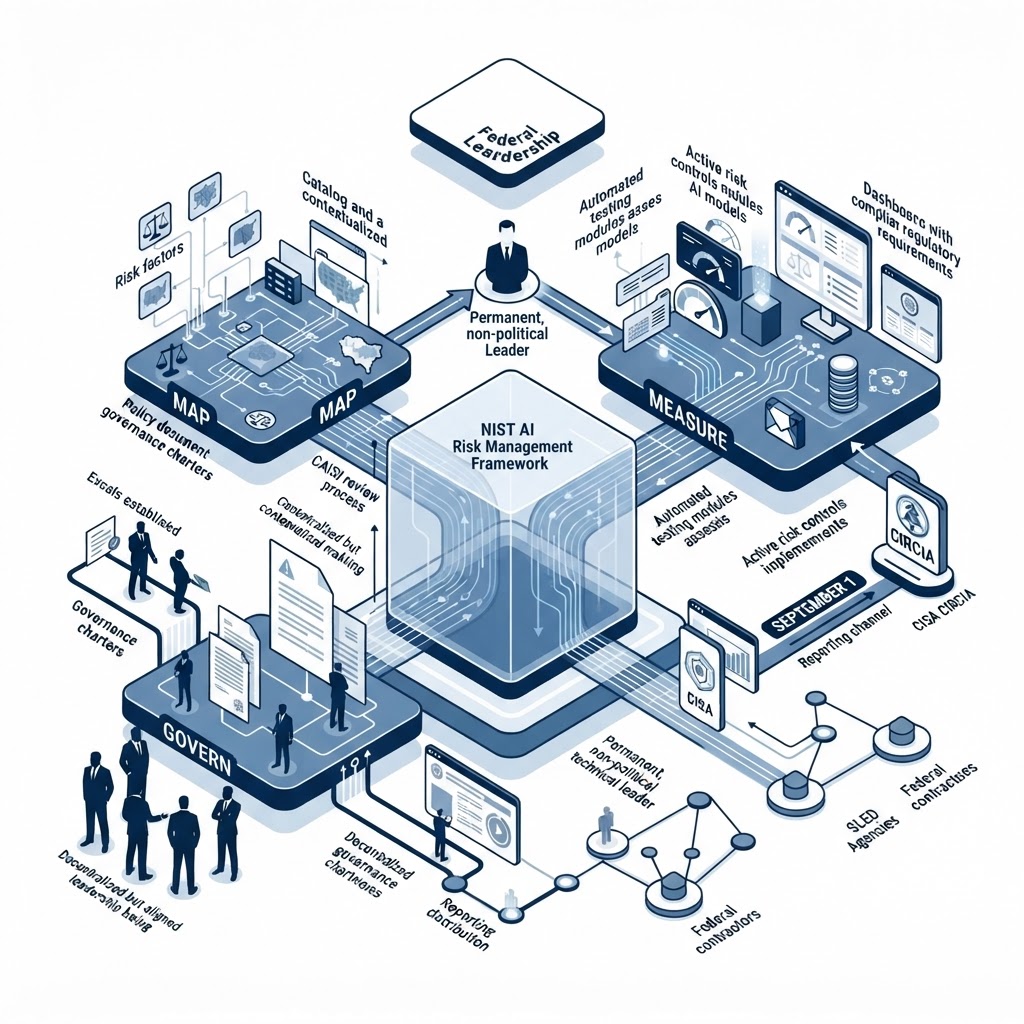
Without a permanent Chief AI Officer to oversee the federal AI cybersecurity clearinghouse, there is a heightened risk of fragmented adoption, where individual agencies develop siloed governance charters that fail to interoperate. This leadership gap emerges at a time when the federal government is attempting to move beyond the "Govern" and "Map" stages of the NIST framework into the more rigorous "Measure" and "Manage" phases. Public sector IT leaders must now navigate these waters by establishing robust internal AI governance structures that can survive executive turnover, ensuring that shadow AI implementations do not bypass necessary safety protocols.
The transition highlights the need for a permanent, non-political technical leadership structure to maintain the integrity of federal AI oversight as the technology continues to evolve faster than policy cycles.\n\n
When will CISA begin requiring mandatory incident reporting for artificial intelligence systems?\n\n
CISA is targeting September 1, 2026, for the release of the final CIRCIA rule. According to Bloomberg Law, this rule will mandate that critical infrastructure entities report substantial cyber incidents, including those involving AI systems. This move effectively integrates the NIST AI Risk Management Framework into the regulatory reporting cycle, forcing organizations to document and disclose vulnerabilities in their algorithmic workflows to avoid federal penalties.\n\n
Regulatory Integration and the **NIST AI Risk Management Framework**\n\n
Despite the leadership transition at the OMB, the regulatory momentum behind AI safety continues to solidify around existing standards. As of August 7, 2026, the NIST AI RMF 1.0 remains the foundational voluntary standard referenced by major federal regulators, including the FTC, FDA, and SEC, for enforcement and oversight guidance as detailed in US AI regulation records. This reliance on a central framework has allowed other departments to build specialized offshoots; for instance, the Treasury Department has recently expanded its Financial Services AI Risk Management Framework to include 230 control objectives specifically tailored for financial institutions.
These objectives are designed to mitigate risks associated with automated credit scoring and fraud detection, placing a heavy emphasis on AI transparency and data loss prevention (DLP). Furthermore, the upcoming release of the CISA CIRCIA rule on September 1, 2026, will turn what was once a voluntary framework into a reporting necessity. As reported by Bloomberg Law, critical infrastructure providers must be prepared to disclose AI-related breaches, which necessitates a mature "Manage" capability under the NIST structure.
Organizations that have not yet formalised their responsible AI practices may find themselves unprepared for the rigor of mandatory federal reporting, potentially facing investigations into their algorithmic accountability measures if an incident occurs without a prior risk mitigation plan in place.\n\n
Critical Developments for State and Municipal AI Compliance Strategies\n\n
The federal leadership vacuum at the OMB is creating a ripple effect at the state level, where legislators are moving quickly to fill the governance void. California’s suspense committees are scheduled to vote on approximately 30 pending AI bills on August 13, 2026. Many of these legislative efforts specifically reference the NIST AI Risk Management Framework as the required baseline for risk mitigation in public sector procurement.
Similarly, New York has introduced significant bills, including S8451 and A9349, which focus on generative AI news disclosure and strict bans on surveillance pricing. For SLED (State, Local, and Education) agencies, this legislative activity creates a complex patchwork of compliance requirements. To maintain interoperability and ensure their systems can interface with federal data streams, local government IT leaders are increasingly adopting the NIST RMF as a universal baseline.
This approach helps municipalities navigate vendor risk assessments and procurement compliance, especially as state laws begin to mandate disclosure of automated decision systems. Without clear federal coordination following Barbaccia's departure, local agencies must take the lead in establishing AI acceptable use policies that address the unique risks of shadow AI within their departments. Training staff to recognize the limitations of generative tools and ensuring that all AI governance charters are publicly accessible will be essential for maintaining public trust and avoiding legal challenges under these emerging state-level mandates.\n\n
Critical Actions for Public Sector Technology Strategists\n\n
- →Align all AI system deployments with the NIST AI RMF 1.0 to ensure readiness for the CISA CIRCIA reporting deadline on September 1, 2026.\n• Update internal procurement compliance policies to require vendors to provide documentation of their algorithmic accountability and transparency controls.\n• Monitor the outcome of California's suspense committee votes on August 13 to anticipate new requirements for large-scale model risk assessments.\n• Establish a formal AI governance charter that designates a departmental lead responsible for the federal AI cybersecurity clearinghouse interface.\n• Implement automated AI Data Loss Prevention (DLP) tools to prevent the unauthorized upload of sensitive citizen data into generative AI platforms.\n• Review New York's S8451 disclosure requirements for any public-facing generative AI content to ensure municipal compliance with new transparency standards.\n\n
What regulatory risks do contractors face if they ignore the NIST AI Risk Management Framework?\n\n
Federal contractors who fail to demonstrate compliance with the NIST AI Risk Management Framework face significant exclusion risks from high-value government projects. With the OMB transition and the new CISA CIRCIA rule effective September 1, 2026, agencies are prioritizing partners who can prove technical transparency. Non-compliance could lead to immediate contract termination, disqualification from future bids, and potential FTC enforcement actions if the contractor's AI systems lead to biased outcomes or data breaches in regulated sectors.\n\n
The departure of Greg Barbaccia highlights the urgent need for agencies to institutionalize the **NIST AI Risk Management Framework** rather than relying on individual leadership. As the September 1 deadline for CISA’s CIRCIA rule approaches, the public sector must transition from observing AI trends to enforcing rigorous safety and transparency standards. Ultimately, the success of federal and SLED AI initiatives will depend on their ability to maintain algorithmic accountability in a rapidly shifting regulatory and legislative environment.
Tagged
About APEX AI Guardrails: We publish expert AI news and governance insights updated 4× daily. Our editorial team consists of retired government IT professionals, AI governance specialists, and compliance experts with deep experience in local government operations.
Related Articles
Government AI
AI Hallucination Risk Governance in SLED: September 4 Disciplinary Actions and New Deployer Liability
September 4, 2026
AI Governance
AI Deepfake Disinformation Threats: Global Governments Ramp Up Oversight in September 2026
September 4, 2026
Government AI
AI Transparency Government Decision Making: California Passes 30 Oversight Bills Ahead of September Deadline
September 4, 2026