
NIST AI Risk Management Framework: Federal Agencies Pivot to Unified Governance in August 2026
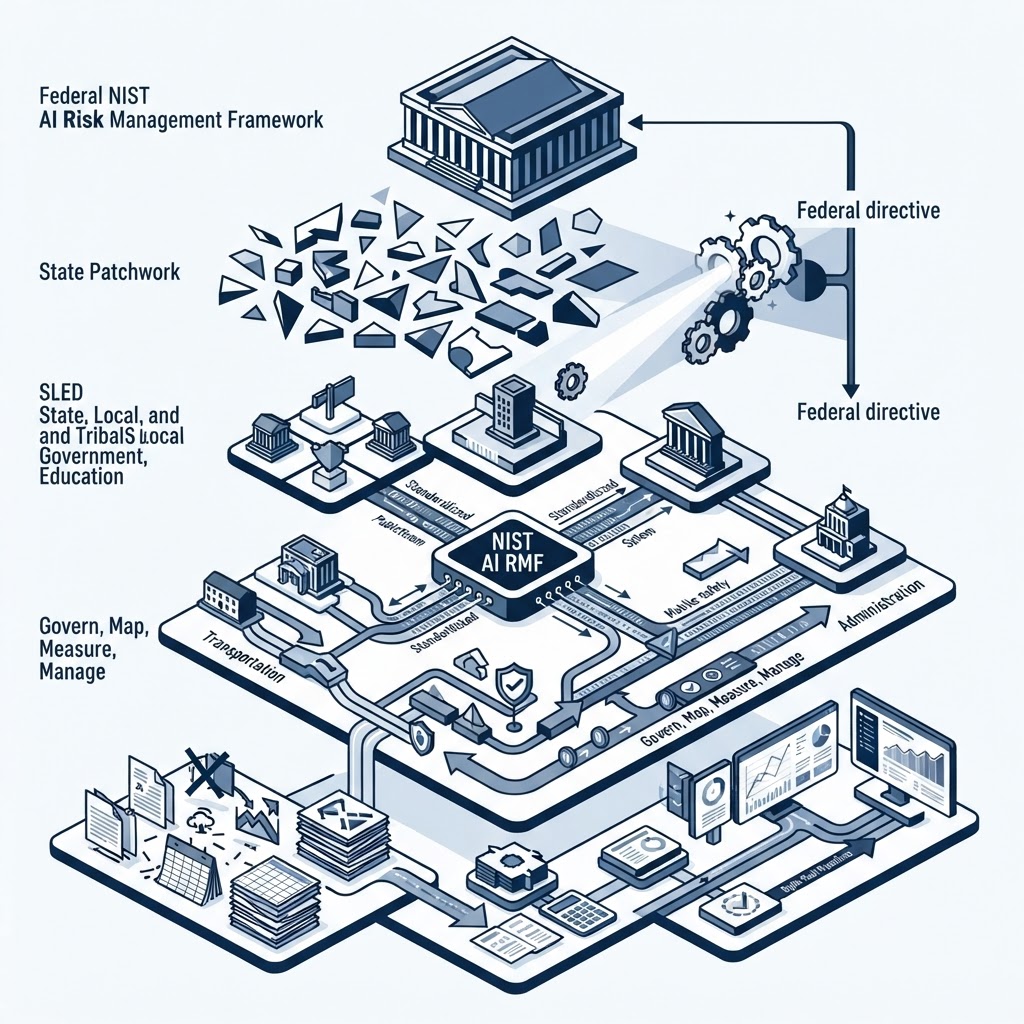
The federal government is intensifying its push for unified national AI regulation in August 2026, positioning the NIST AI RMF as the primary standard to override a patchwork of state-level laws. This shift forces SLED agencies to move beyond one-time compliance checks toward continuous, machine-readable risk management across the AI lifecycle.
Published by
APEX AI Guardrails Editorial Team
August 21, 2026
Reading time
7
minutes
As of August 21, 2026, the NIST AI Risk Management Framework has emerged as the definitive standard for organizations seeking to manage AI-related threats amidst a significant push for unified national legislation. The Biden-Harris administration recently intensified efforts to preempt a fragmented landscape of state-level AI laws, issuing warnings to local lawmakers about potential innovation barriers. For state, local, and education (SLED) leaders, this shift necessitates an immediate alignment with federal governance standards to ensure procurement eligibility and long-term regulatory compliance.
Why is the U.S. federal government challenging state-level AI regulations in August 2026?
The federal government is pushing for a unified national AI policy to prevent a patchwork of conflicting state laws that could stifle innovation. In August 2026, administration officials began issuing letters to state legislatures to discourage independent regulations, favoring a single federal standard based on the NIST AI Risk Management Framework to streamline compliance for agencies and contractors nationwide.
The August 2026 Inflection Point: The NIST AI Risk Management Framework vs. State Patchwork
The landscape of American AI policy reached a critical crossroads in mid-August 2026 as the federal government actively challenged the burgeoning patchwork of state-level artificial intelligence regulations. This shift marks a strategic move by the administration to discourage states from enacting independent, often conflicting, AI laws that could hinder national innovation and complicate the compliance landscape for multi-state entities. According to Reuters, this federal push aims to establish a consistent regulatory floor, effectively preempting state bills that vary significantly in their approach to algorithmic accountability and transparency.
SLED agencies now find themselves at the center of this jurisdictional tug-of-war, balancing the need to comply with local executive orders while aligning with the increasingly dominant federal standards. The administration’s intensification of this unified legislative push in August 2026 signals a departure from previous hands-off approaches, suggesting that the era of state-by-state AI experimentation may be drawing to a close in favor of a centralized national strategy. This centralization is expected to reduce the complexity for technology vendors who provide critical infrastructure services across state lines, ensuring that procurement compliance remains uniform across different regions and agencies.
When will the NIST AI RMF 1.0 undergo its first major revision to align with the 2025 AI Action Plan?
NIST is currently processing feedback from its updated engagement portal, which was refreshed on August 13, 2026, to facilitate the revision of AI RMF 1.0. The update aims to align the framework with the 2025 White House AI Action Plan, specifically removing legacy references to DEI and climate change while focusing on core safety and security metrics for AI risk management.
Status of the NIST AI Risk Management Framework 1.0 Revision and Practitioner Feedback
The NIST AI Risk Management Framework is currently undergoing a transformative revision process to better align with the 2025 White House AI Action Plan. This strategic realignment tasks NIST with refining the framework to focus exclusively on technical safety, security, and performance metrics, notably by removing previous references to misinformation, DEI, and climate change that were present in earlier drafts. To ensure these changes reflect current technological realities, NIST updated its engagement portal on August 13, 2026, to solicit real-world feedback from practitioners and stakeholders.
This feedback loop is vital for the eventual release of the revised Framework, which will serve as the definitive guide for responsible AI use. Following the finalization of the revised core framework, NIST plans an immediate update to the AI RMF Playbook to provide actionable implementation steps for agency IT leaders. As organizations increasingly implement the NIST AI RMF to manage risks effectively, this revision ensures that the guidance remains a living document.
Furthermore, recent updates to NIST SP 800-18r2 emphasize machine-readable data formats. This transition to automated risk management documentation allows agencies to integrate real-time monitoring of AI systems, moving away from static spreadsheets and toward dynamic dashboards that track model behavior throughout the entire AI lifecycle.
Evolving Compliance Realities for Local Jurisdictions and Education Districts
For county and municipal governments, the transition toward a unified federal standard fundamentally alters procurement and vendor risk management strategies. No longer can local agencies rely on static, one-time onboarding checks for AI services; instead, the mid-2026 guidance emphasizes the continuous assessment of third-party vendors, APIs, and open-source models. This shift is particularly visible in how the Treasury Department utilized the NIST AI RMF as a foundational layer for its sector-specific guidance issued earlier this year, establishing 230+ specific control objectives that other agencies are now mimicking.
Additionally, as of August 2026, the NIST framework is being leveraged as a primary operational companion for organizations meeting high-risk obligations under the EU AI Act. This global interoperability means that the framework's four core functions—Govern, Map, Measure, and Manage—are being mapped to international standards like ISO 42001. Local IT directors must now audit their shadow AI footprint and integrate AI Data Loss Prevention (DLP) protocols that mirror these global requirements.
Training staff to recognize the limitations of AI-generated outputs is now a mandatory component of these governance structures. As the federal government discourages independent state laws, local agencies that proactively adopt the NIST framework will find themselves better positioned to maintain eligibility for federal grants, avoiding the costly retrofitting that comes with non-compliance in a shifting regulatory environment.
Strategic Implementation Steps for Governance Teams
- →Adopt the Govern, Map, Measure, and Manage functions to align with ISO 42001 and ensure interoperability with the EU AI Act for international compliance. • Transition risk management documentation to machine-readable formats as per the new NIST SP 800-18r2 updates to support automated and real-time risk management decisions. • Audit third-party APIs and open-source models continuously rather than relying on annual vendor assessments to mitigate evolving supply chain vulnerabilities. • Review the 230+ control objectives established in the Treasury Department's sector-specific guidance to benchmark agency maturity and identify governance gaps. • Monitor the NIST engagement portal for upcoming revisions to the AI RMF Playbook, ensuring that internal AI acceptable use policies reflect the 2025 White House AI Action Plan. • Formalize an AI governance charter that defines algorithmic accountability and establishes clear roles for AI transparency within the department.
What are the regulatory consequences for SLED agencies that fail to adopt NIST-aligned AI governance in 2026?
Failure to align with the NIST AI Risk Management Framework risks disqualification from federal grant programs and government contracts that increasingly mandate standardized risk reporting. Beyond funding, agencies face heightened legal exposure under emerging federal preemption rules, as unstandardized governance models may violate new national transparency and algorithmic accountability requirements currently being pushed by the administration in August 2026.
The NIST AI Risk Management Framework has transitioned from an optional set of best practices into the essential backbone of a unified national AI policy. As the federal government moves to consolidate authority and eliminate regulatory fragmentation, public sector leaders must prioritize NIST-aligned governance to ensure operational continuity. Staying informed through the NIST engagement process will be critical for compliance officers as they navigate the rapid evolution of AI safety and security standards through the end of 2026.
Tagged
About APEX AI Guardrails: We publish expert AI news and governance insights updated 4× daily. Our editorial team consists of retired government IT professionals, AI governance specialists, and compliance experts with deep experience in local government operations.
Related Articles
Government AI
AI Hallucination Risk Governance in SLED: September 4 Disciplinary Actions and New Deployer Liability
September 4, 2026
AI Governance
AI Deepfake Disinformation Threats: Global Governments Ramp Up Oversight in September 2026
September 4, 2026
Government AI
AI Transparency Government Decision Making: California Passes 30 Oversight Bills Ahead of September Deadline
September 4, 2026