
NIST AI Risk Management Framework Becomes 'Base Layer' for Federal AI Liability Standards as of August 2026
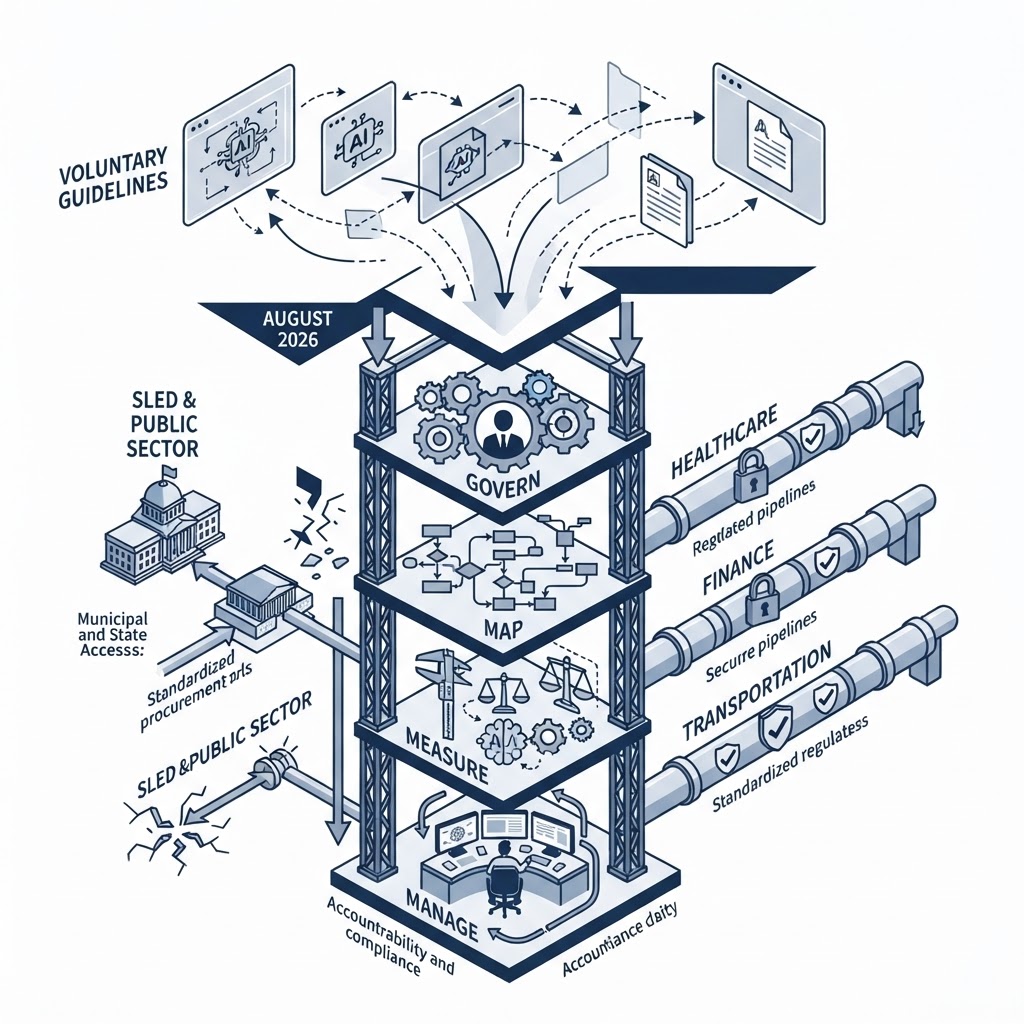
As of August 2026, the NIST AI Risk Management Framework has been elevated to the foundational baseline for federal AI liability standards and state-level regulatory alignment. This shift requires government IT leaders to transition from voluntary adoption to mandatory socio-technical compliance.
Published by
APEX AI Guardrails Editorial Team
August 14, 2026
Reading time
7
minutes
The NIST AI Risk Management Framework has officially transitioned into the foundational regulatory 'base layer' that federal agencies use to define sector-specific compliance expectations as of August 10, 2026. This systemic shift follows recent updates emphasizing the framework's role as a primary tool for government agencies to meet the safety requirements of Executive Order 14110. For government IT and compliance leaders, this development transforms the framework from a voluntary guideline into a critical benchmark for determining legal liability and ensuring safe system deployment across the public sector.
Why is the NIST AI Risk Management Framework being adopted as the foundation for federal AI liability standards in August 2026?
Federal regulators are adopting the NIST AI Risk Management Framework as a 'base layer' because it provides a standardized language for identifying and mitigating socio-technical risks. According to research published on August 10, 2026, this framework allows agencies to build specific compliance expectations while maintaining a unified approach to trustworthiness. By utilizing the framework's four core functions, the government establishes a consistent legal benchmark for 'responsible AI' across all sectors.
The Transition of the NIST AI Risk Management Framework from Voluntary Guidelines to Regulatory Foundation
Federal agencies reached a definitive conclusion in early August 2026 that voluntary adoption of safety guidelines is no longer sufficient to manage the rapid proliferation of generative AI tools. As of August 10, 2026, the NIST AI Risk Management Framework (RMF) has become the essential scaffolding upon which specific regulatory requirements for healthcare, finance, and transportation are now being built. This evolution incorporates the RMF's four core functions—Govern, Map, Measure, and Manage—directly into federal liability standards.
By doing so, the government establishes a clear definition of what constitutes a 'trustworthy AI system' in a legal context. The move is designed to curb algorithmic bias and enhance security while providing a clear safe harbor for organizations that rigorously follow the framework. Furthermore, these guidelines are now being used to evaluate vendor contracts, ensuring that third-party AI providers adhere to the same stringent safety standards as the agencies they serve.
This shift marks the end of the 'wild west' era of AI implementation, replacing ambiguity with a structured, socio-technical approach to risk assessment that prioritizes public safety and data privacy above all else. Legal experts note that this transition reflects a broader trend of codifying ethics into enforceable technical standards.
In what ways does the NIST AI RMF Playbook help agencies comply with Executive Order 14110 requirements?
The NIST AI RMF Playbook serves as the primary implementation resource for agencies to achieve the safety and security goals of Executive Order 14110. As verified on August 11, 2026, the playbook offers actionable steps for incorporating trustworthiness into the AI lifecycle. It helps agencies inventory their AI systems, prioritize risks, and allocate resources to ensure that every deployed model meets federal benchmarks for resilience and algorithmic accountability.
Navigating the August 2026 Regulatory Inflection Point for the NIST AI Risk Management Framework
The regulatory landscape for artificial intelligence reached a critical inflection point on August 12, 2026, as the federal government intensified efforts to preempt a fragmented patchwork of state-level laws. A primary driver of this urgency is the implementation of California’s AI Transparency Act, which became fully operative on August 2, 2026, creating immediate compliance friction for national organizations. To resolve these conflicts, agencies are leaning heavily on the NIST AI Risk Management Framework to create a unified risk management approach that satisfies both federal executive orders and emerging state mandates.
The goal is to prevent a scenario where a single AI system must comply with fifty different sets of rules. However, the path forward is complicated by political tensions. Recent reports on August 10, 2026, suggest that hiring choices by major developers like OpenAI are straining relationships with the White House, further pressuring federal agencies to enforce strict compliance.
Legal experts now view August 2026 as the month when AI governance transitioned from abstract policy debate into a mandatory operational reality for every government contractor and agency.
Impact Analysis for SLED and Public Sector Entities Regarding New Standards
For SLED (State, Local, and Education) leaders, the elevation of the NIST AI Risk Management Framework to a federal baseline necessitates an immediate audit of procurement processes. Municipalities can no longer afford to treat AI tools as simple software purchases; they must now evaluate vendors based on their ability to demonstrate compliance with NIST's socio-technical characteristics. This includes rigorous testing for safety, security, and resilience as outlined in updated guidance published August 6, 2026.
Public sector IT leaders are particularly concerned with 'shadow AI'—unsanctioned tools used by staff that bypass standard security protocols. To mitigate these risks, agencies must implement AI acceptable use policies that align with the RMF’s 'Govern' function. Furthermore, staffing and training budgets must be redirected to ensure that personnel understand how to use the NIST AI RMF Playbook to manage AI model lifecycles.
Failure to align with these federal benchmarks could lead to significant legal exposure, especially if an AI system causes harm or violates privacy rights. Local governments must act now to bridge the policy gap between their current operations and the new federal liability standards emerging this month.
Actionable Priorities for Compliance Teams Following the August Update
- →Conduct an immediate inventory of all AI systems currently in use or under procurement to ensure alignment with the 'Map' function of the NIST AI RMF. • Utilize the NIST AI RMF Playbook to integrate trustworthiness benchmarks into every stage of the AI lifecycle, from design to decommissioning. • Review and update vendor contracts to include specific requirements for algorithmic accountability and data transparency as mandated by new federal liability standards. • Establish an internal AI Governance Charter that designates responsible parties for monitoring AI system performance and safety outcomes. • Implement AI Data Loss Prevention (DLP) tools to prevent the accidental exposure of sensitive public data through generative AI interfaces. • Align organizational risk priorities with the requirements of Executive Order 14110 to ensure continued eligibility for federal grant funding and support.
Which specific vulnerabilities are most critical for agencies failing to adopt these standards by late 2026?
Agencies failing to adopt the NIST AI Risk Management Framework face increased legal liability under new federal standards. As this framework becomes the 'base layer' for regulation, non-compliance may be viewed as a failure to exercise due diligence in managing AI risks. This could lead to lawsuits, loss of federal funding under Executive Order 14110, and enforcement actions from federal agencies looking to harmonize state and federal safety requirements while mitigating algorithmic harm.
The establishment of the NIST AI Risk Management Framework as a regulatory baseline marks a definitive shift in how the public sector must approach artificial intelligence. By integrating these socio-technical standards into federal liability models, the government is providing a necessary roadmap for navigating a complex and fragmented legal environment. Compliance leaders must prioritize the adoption of the NIST AI Risk Management Framework today to ensure their agencies remain secure, accountable, and legally protected in the years to come.
Tagged
About APEX AI Guardrails: We publish expert AI news and governance insights updated 4× daily. Our editorial team consists of retired government IT professionals, AI governance specialists, and compliance experts with deep experience in local government operations.
Related Articles
Government AI
AI Hallucination Risk Governance in SLED: September 4 Disciplinary Actions and New Deployer Liability
September 4, 2026
AI Governance
AI Deepfake Disinformation Threats: Global Governments Ramp Up Oversight in September 2026
September 4, 2026
Government AI
AI Transparency Government Decision Making: California Passes 30 Oversight Bills Ahead of September Deadline
September 4, 2026