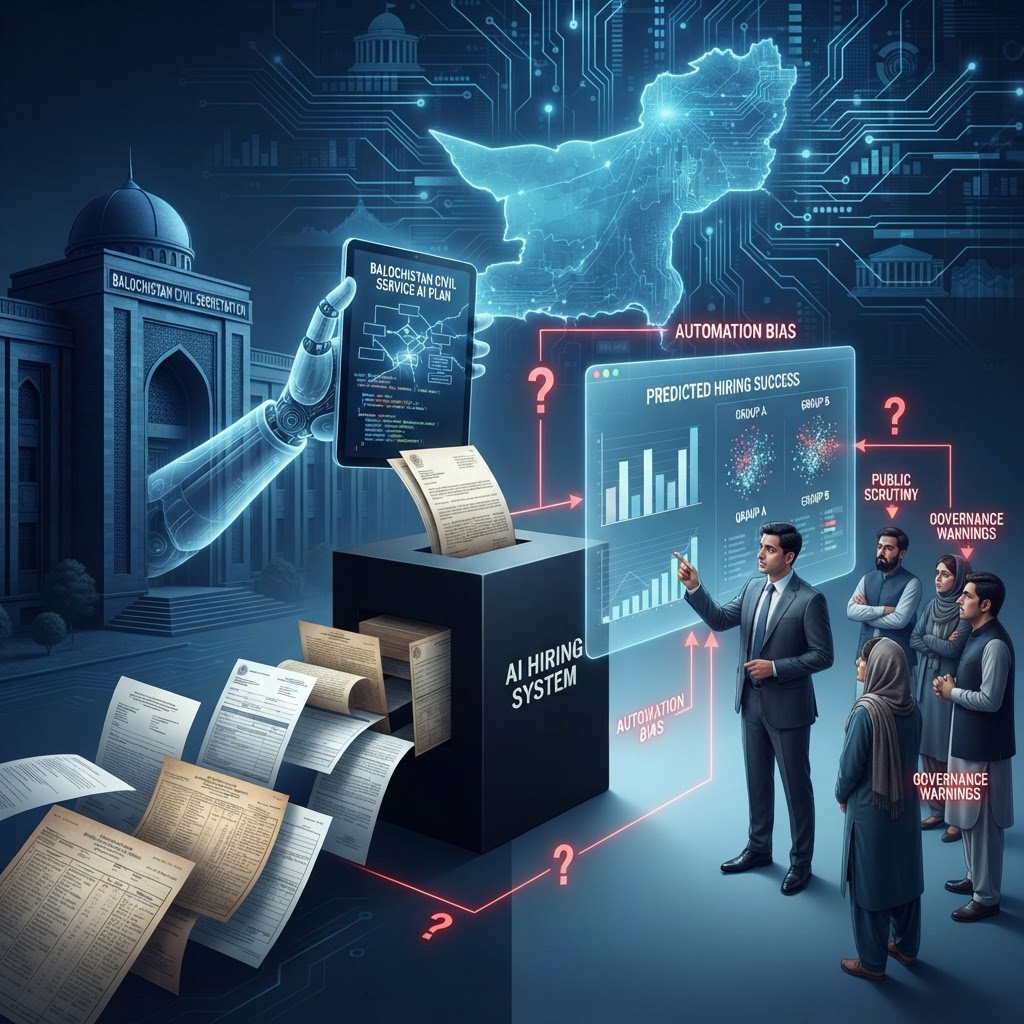
Public Sector Algorithmic Accountability: New Balochistan Civil Service AI Plan Sparks Global Governance Warnings
Balochistan's plan to deploy artificial intelligence for civil service hiring has ignited an international debate regarding algorithmic bias and systemic procurement guardrails. As jurisdictions introduce strict oversight frameworks, public sector agencies face mounting pressure to balance administrative efficiency with constitutional fairness.
Published by
APEX AI Guardrails Editorial Team
September 4, 2026
Reading time
6
minutes
Public sector algorithmic accountability has entered the global spotlight as regional authorities attempt to automate high-stakes public employment decisions without clear constitutional safeguards. The provincial administration of Balochistan, Pakistan, recently triggered international concern among governance specialists after announcing an artificial intelligence recruitment mechanism designed to evaluate civil service candidates. For state, local, and provincial public sector IT leaders, this controversial rollout emphasizes why responsible AI adoption, independent auditing, and strict procurement compliance must precede any automation of citizen-facing public administration.
Why are civil rights groups raising alarms over Balochistan's civil service AI hiring initiative?
Civil rights experts warn that the initiative lacks constitutional accountability and risks replicating historical employment discrimination against marginalized populations. Because machine learning models evaluate candidates against past recruitment data, they frequently perpetuate legacy disparities. Governance advocates caution that automated screening creates severe automation bias, leading civil service interview panels to defer uncritically to opaque software scores rather than exercising independent human judgment under statutory standards.
Balochistan Recruitment Plan Highlights Urgent Need for Public Sector Algorithmic Accountability
Government modernization efforts reached a contentious milestone when Balochistan announced plans to use an AI-based system for civil service hiring, sparking warnings over algorithmic bias based on historical hiring data, lack of constitutional accountability, and automation bias among officials. Public sector recruitment requires transparent, merit-based selection protocols protected by administrative law, yet machine learning models deployed without independent bias audits risk systematically rejecting qualified minority applicants based on legacy proxies. Critics highlight that automated talent-filtering tools frequently lack explainability mechanisms capable of surviving judicial review when rejected candidates seek administrative appeal.
Furthermore, public officials utilizing automated scoring matrices often experience severe automation bias, uncritically accepting algorithmically calculated suitability ratings while setting aside holistic evaluation. Without formal validation against frameworks like the NIST AI RMF or comprehensive pre-deployment disparity assessments, replacing traditional examination oversight with proprietary commercial algorithms creates profound institutional vulnerabilities. Public administration scholars stress that civil service commissions cannot outsource their constitutional duty of equitable vetting to third-party codebases, particularly when historical employment rosters reflect decades of regional, socioeconomic, and gender imbalances.
How are public agencies embedding mandatory fairness controls during AI software procurement?
Public agencies are implementing mandatory pre-procurement AI Impact Assessments that evaluate training data provenance, disparate impact risks, and model explainability before signing contracts. Frameworks such as Australia's Digital Transformation Agency policy mandate that agencies register high-risk use cases, assign named accountable executive owners, and retain contractual audit rights over third-party software, ensuring vendor algorithmic fairness aligns with international standards like NIST AI RMF GOVERN directives.
Procurement Mandates and Public Sector Algorithmic Accountability Safeguards Expand Worldwide
In response to uncontrolled automated deployments, public administrations worldwide are instituting strict pre-acquisition guardrails to prevent discriminatory algorithmic deployments before software enters public networks. For instance, Australia's Digital Transformation Agency mandates that all 94 Commonwealth agencies track AI use cases with accountable owners and enforce AI Impact Assessments covering fairness and human oversight ahead of a December 2026 deadline. This whole-of-government mandate demonstrates how national procurement frameworks are evolving from aspirational ethics guidelines into binding compliance regimes.
Under these structured controls, agencies cannot deploy automated decision platforms without cataloging the application in a public registry, assigning an executive sponsor, and proving continuous human-in-the-loop validation. Simultaneously, regulatory authorities are clarifying that sovereign procurement shields neither governmental bodies nor enterprise suppliers from anti-discrimination enforcement. The U.S.
Equal Employment Opportunity Commission has reiterated that software vendors face direct liability for algorithmic discrimination under federal civil rights laws, while international statutes like South Korea's AI Framework Act mandate strict non-discrimination assessments across public services. These parallel actions illustrate that public procurement contracts must explicitly assign legal responsibility, enforce explainability, and prohibit black-box algorithmic selection across administrative workflows.
Direct Governance and Operational Exposure for Municipal, County, and State Agencies
Sub-national agencies and municipal departments face mounting legal exposure when deploying unvetted commercial automation across workforce hiring, social safety net programs, and public services. Regulatory authorities have intensified audits against automated screening algorithms, noting that regulators worldwide are tightening algorithmic bias enforcement, including the EEOC holding AI vendors liable for employment discrimination and South Korea's AI Framework Act mandating fairness and non-discrimination across public services. Local entities that adopt commercial automated software without instituting rigorous AI acceptable use policy charters risk systemic compliance failures under evolving statutory rules.
Local government procurement officers must establish clear operational boundaries against shadow AI tools used by departmental interview boards and hiring committees. Deploying robust AI DLP protocols and regular disparity tests allows IT compliance officers to measure whether third-party software produces adverse impacts against protected classes. Furthermore, municipal legal teams must mandate that vendors supply traceable algorithmic transparency files and technical audit logs before contract execution.
Failing to institutionalize continuous monitoring not only triggers costly civil rights litigation but also erodes public faith in democratic governance.
Essential Compliance Actions for Public Administration Decision-Makers
- →Maintain a centralized, publicly accessible AI use case register detailing every machine learning algorithm utilized across hiring, procurement, and public benefit administration.
- →Enforce pre-procurement AI Impact Assessments aligned with the NIST AI RMF to measure statistical parity, demographic representation, and disparate impact before contract signing.
- →Establish designated accountable agency owners who retain legal, administrative, and constitutional responsibility for outcomes generated by automated decision systems.
- →Mandate human-in-the-loop review mechanisms with verifiable authority to override algorithmic screening scores and eliminate organizational automation bias.
- →Incorporate strict indemnity and compliance clauses within vendor contracts requiring third-party algorithmic explainability, continuous auditing access, and explicit liability for bias violations.
- →Conduct mandatory training for agency civil service boards on mitigating cognitive overreliance on machine learning metrics during applicant evaluations.
What legal liabilities do public agencies face when using discriminatory recruitment algorithms?
Agencies face significant legal exposure under national civil rights statutes, equal opportunity mandates, and constitutional due process clauses when hiring algorithms exhibit demographic bias. If an unvetted automated tool produces disparate impact against protected groups, courts and enforcement bodies like the U.S. EEOC can invalidate hiring lists, mandate extensive back-pay restitution, and hold public entities liable alongside commercial software vendors for statutory non-compliance.
The unfolding controversy surrounding Balochistan's recruitment technology underscores that public sector algorithmic accountability must serve as an uncompromised prerequisite for digital administrative modernization. As municipal and state jurisdictions expand automation, civil service systems must institutionalize strict impact assessments, independent auditing, and accountable human oversight to preserve constitutional equity. Agency compliance directors and IT leadership must act immediately to establish robust responsible AI governance before automated screening tools undermine public trust.
Tagged
About APEX AI Guardrails: We publish expert AI news and governance insights updated 4× daily. Our editorial team consists of retired government IT professionals, AI governance specialists, and compliance experts with deep experience in local government operations.