
UK Launches National Centre for Information Defence to Combat AI Deepfake Threats (September 28, 2026)
The UK government has unveiled a new National Centre for Information Defence to tackle state-sponsored AI disinformation. This initiative seeks to integrate intelligence, law enforcement, and social media platforms to maintain public trust.
Published by
APEX AI Guardrails Editorial Team
September 29, 2026
Reading time
6
minutes
The UK government has officially announced the creation of a National Centre for Information Defence to actively counter growing AI deepfake disinformation threats from hostile international actors. This strategic move aligns with global efforts to secure digital information ecosystems against synthetic media attacks that target national stability. For government IT and compliance leaders, this development signals a critical shift toward mandatory, inter-agency collaboration to protect institutional credibility and public discourse.
How is the UK government addressing the rise of state-sponsored AI deepfake disinformation threats?
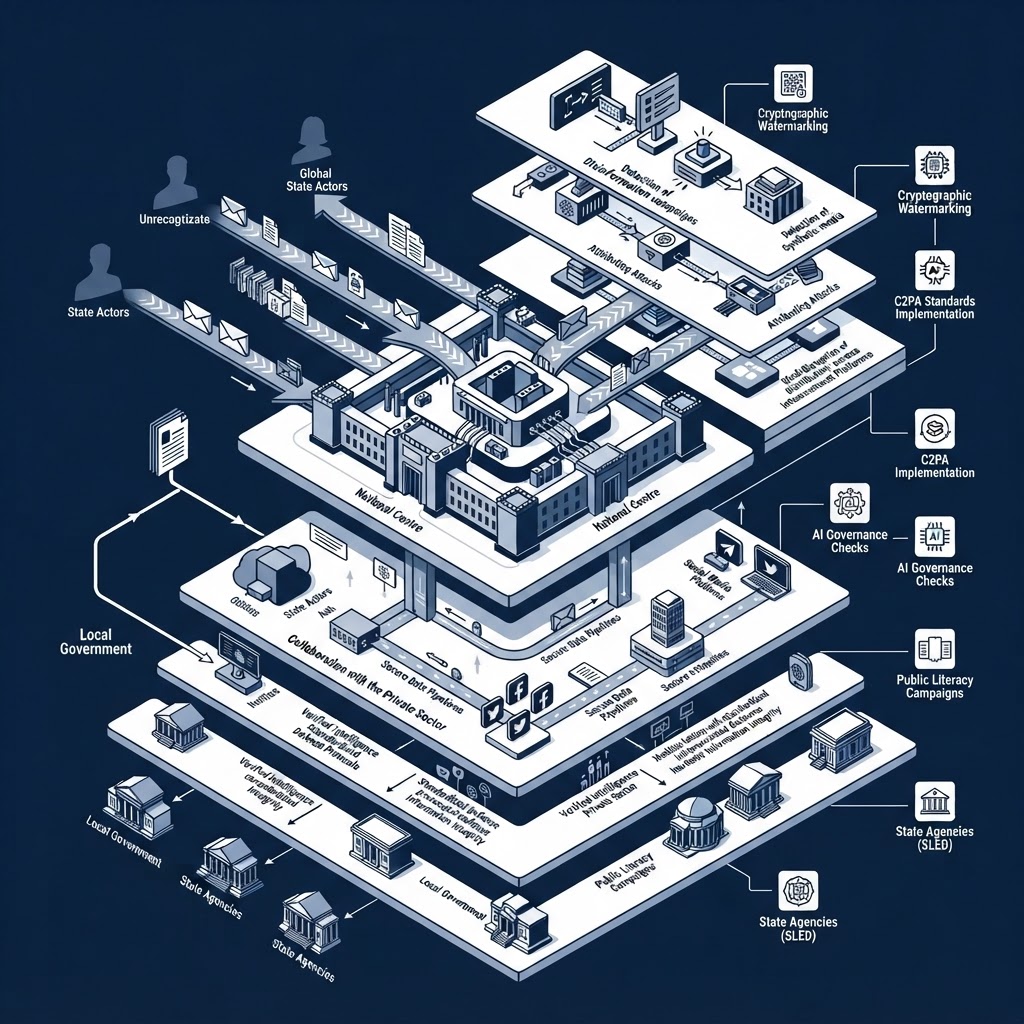
The UK is establishing a National Centre for Information Defence, which aims to detect, attribute, and disrupt synthetic media attacks. As reported by Biometric Update, this agency integrates resources from intelligence services, law enforcement, and major social media companies to create a unified front against sophisticated, AI-driven information warfare tactics that threaten public trust and state infrastructure.
Operationalizing the National Centre for Information Defence
The newly unveiled initiative marks a transformative approach to national digital security, prioritizing the identification of foreign-led influence campaigns. By centralizing operations, the UK aims to close the gap between rapid-response intelligence and long-term defensive strategy. According to The Guardian, the centre will function as a central node for tracking disinformation, specifically targeting the synthetic media techniques often employed by state actors like Russia.
This structure mirrors the rigorous standards found in the NIST AI RMF, emphasizing the importance of measurement and verification within the broader information lifecycle. Government leaders should recognize this as a move toward a more integrated information defense posture, moving beyond siloed cybersecurity measures. By fostering formal partnerships with the private sector, the government acknowledges that the digital platforms serving as the battleground for these AI deepfake disinformation threats must be active participants in the detection process.
This inter-agency model provides a scalable blueprint for other nations and local entities looking to bolster their own resilience against the influx of manipulated content that undermines democratic institutions and complicates public policy communication.
What are the primary objectives of the newly formed National Centre for Information Defence regarding synthetic media?
The centre is tasked with three core mandates: detecting the origin of AI-generated misinformation, attributing attacks to specific state actors, and disrupting the distribution of synthetic media across social platforms. By centralizing these functions, the UK intends to move from a reactive to a proactive defense posture, ensuring that intelligence agencies and private sector partners work in lockstep to verify content integrity before it causes widespread public harm.
The Strategic Challenge of the Liar's Dividend and Public Trust
Navigating the landscape of synthetic media requires more than just high-tech detection; it demands an understanding of the psychological impact on the citizenry. Recent academic analysis published September 28, 2026, warns of the "Liar's Dividend," where the mere accusation that an authentic video is a deepfake serves as a tool to delegitimize truthful information, as detailed in research from UvA. This creates a volatile environment for public sector leaders who must verify the authenticity of official communications while simultaneously defending against false claims of manipulation.
To address this, agencies must adopt robust AI governance charters that clearly define their content verification workflows. Compliance teams should review their current AI acceptable use policy to ensure it accounts for the potential weaponization of deepfake labels. Relying solely on software solutions to flag deepfakes is insufficient; agencies must also invest in transparency and public literacy campaigns to ensure that constituents can distinguish between verified government messaging and malicious disinformation.
Failure to manage this perception gap can lead to rapid erosion of institutional authority, potentially stalling policy adoption and public cooperation in critical areas like emergency management or public health.
Proactive Steps for State and Local Agency Information Integrity
State and local governments must now prioritize digital provenance to insulate themselves from the risks associated with AI-driven content manipulation. Unlike large federal entities, municipal agencies often lack the dedicated intelligence assets to verify media, making them vulnerable to localized information attacks that could trigger civil unrest or administrative disruption. Procurement compliance is the first line of defense; agencies should prioritize vendors that embed cryptographic watermarking or C2PA-compliant standards in their media production tools.
Furthermore, internal staff training must evolve to include specific detection techniques for identifying synthetic audio and video anomalies. Agencies should implement an AI transparency framework that mandates the disclosure of AI involvement in any automated government-to-citizen communication, thereby setting a standard of trust. By integrating these checks into standard operating procedures, local government leaders can create an environment where institutional truth remains verifiable despite the noise of the internet.
This proactive framework not only protects against active disinformation campaigns but also builds the long-term public trust necessary for digital transformation initiatives to succeed without fear of widespread public skepticism regarding the authenticity of government data.
Recommended Governance Actions for Public Sector Leaders
- →Establish a clear AI governance charter that dictates how the agency will verify and disclose the use of synthetic media in public communications. • Conduct regular risk assessments to identify potential "Liar’s Dividend" vulnerabilities within current public messaging workflows. • Prioritize the procurement of software and media platforms that support open standards for digital content provenance and cryptographic watermarking. • Launch internal training programs to help public information officers recognize common patterns of AI deepfake disinformation threats. • Align regional security protocols with the NIST AI RMF to ensure a standardized approach to AI transparency and risk management. • Develop a crisis communication plan that addresses how to respond when official government content is falsely labeled as a deepfake.
How does the concept of the Liar's Dividend change how agencies should communicate during a crisis?
The Liar’s Dividend suggests that public trust is fragile; therefore, agencies must proactively provide authenticated copies of original files. During a crisis, releasing verified metadata and maintaining a secure, blockchain-verified repository for official communications is essential. This strategy allows the public to cross-reference content, ensuring that bad actors cannot use accusations of fabrication to undermine official guidance during critical, time-sensitive emergency situations.
Addressing AI deepfake disinformation threats requires a structural commitment to transparency and technical verification at every level of government. As the UK’s new national centre begins its work, agencies must mirror these efforts by hardening their own information defense frameworks. Maintaining institutional integrity in an era of synthetic media is not merely a technical challenge, but a fundamental prerequisite for democratic governance.
Sources
- UK plans information defence centre as AI deepfake threat grows | Biometric Update
- New UK agency to fight ‘information warfare’ from likes of Russia, Burnham tells UN | Cyberwar | The Guardian
- It’s Nothing but a Deepfake! The Effects of Misinformation and Deepfake Labels Delegitimizing an Authentic Political Speech
Tagged
About APEX AI Guardrails: We publish expert AI news and governance insights updated 4× daily. Our editorial team consists of retired government IT professionals, AI governance specialists, and compliance experts with deep experience in local government operations.
Related Articles
AI Governance
Mitigating AI Hallucination Risk in Government: New October 19 Federal Oversight Trends
October 19, 2026
AI Governance
Combating AI Deepfake Disinformation: How Government Agencies Can Restore Public Trust as of October 19, 2026
October 19, 2026
AI Governance
New Federal AI Systems Transparency Act Introduced Amid Growing Regulatory Pressure
October 19, 2026