
UK Launches National Centre for Information Defence to Combat AI Deepfake Threats on September 28
The UK government has established a specialized agency to detect and neutralize state-sponsored AI disinformation. This move aims to secure democratic integrity against the growing influence of synthetic media.
Published by
APEX AI Guardrails Editorial Team
September 29, 2026
Reading time
6
minutes
The UK government is officially establishing a National Centre for Information Defence to actively detect, attribute, and disrupt AI deepfake disinformation threats originating from hostile state actors. This inter-agency initiative arrives as geopolitical adversaries increasingly deploy synthetic media at industrial scale to destabilize democratic processes. For government IT and compliance leaders, this development signals an urgent mandate to fortify digital communication channels against sophisticated, AI-enabled information warfare operations.
How does the newly announced UK National Centre for Information Defence plan to tackle malicious AI content?
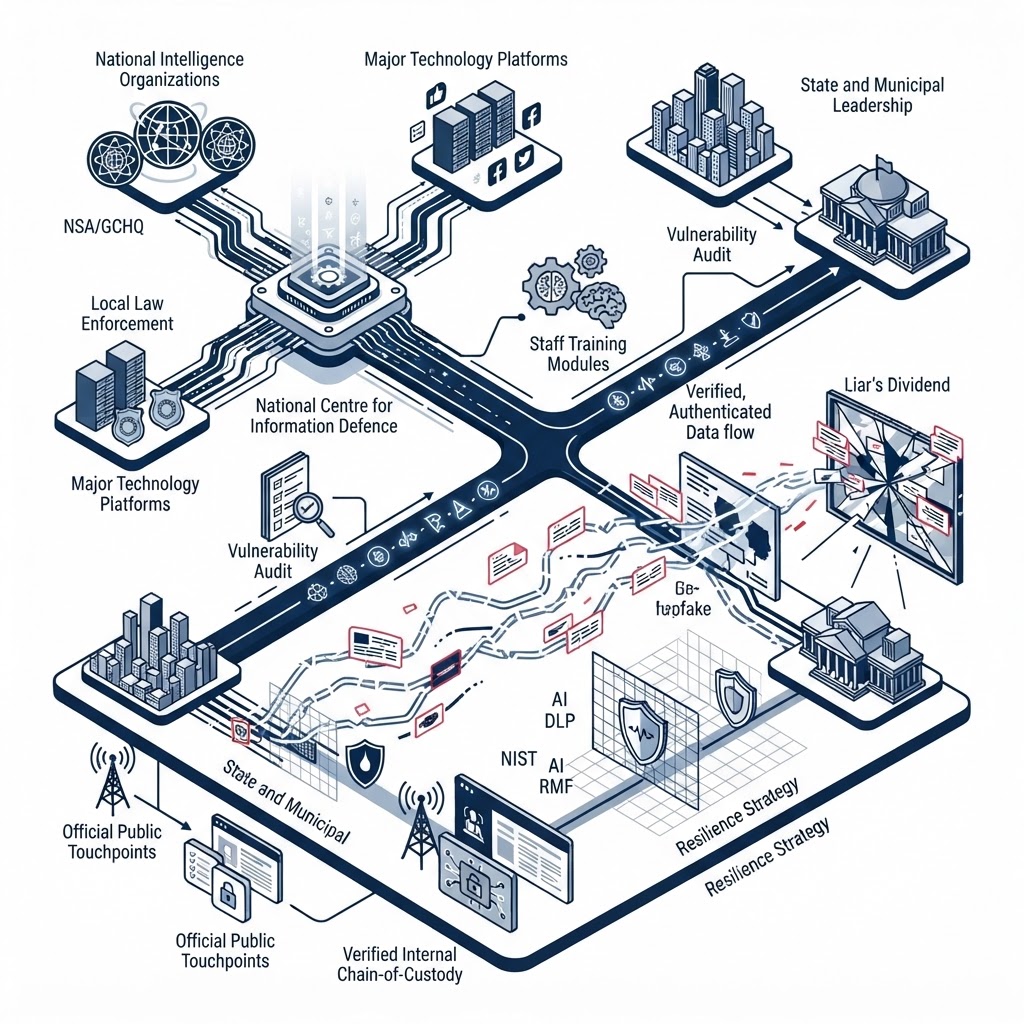
The centre will integrate intelligence agencies, law enforcement, and private-sector social media companies to create a unified front against information warfare. By focusing on the detection and attribution of synthetic media, the agency aims to disrupt campaigns from hostile states. This proactive posture aligns with international efforts to standardize AI risk management and protect digital information integrity from state-sponsored manipulation.
Coordinating Intelligence Against AI Deepfake Disinformation Threats
The creation of the National Centre for Information Defence represents a significant evolution in how the UK handles synthetic threats, as reported by Biometric Update. By bringing together the disparate expertise of national intelligence organizations, local law enforcement, and major technology platforms, the government intends to counteract the rising tide of sophisticated propaganda. This strategy is essential, as traditional content moderation is no longer sufficient to stop the rapid deployment of high-fidelity synthetic videos and audio clips.
According to The Guardian, this agency will specifically target the tactics used by hostile regimes to conduct coordinated information warfare. From an AI governance perspective, this indicates a shift toward state-level algorithmic accountability and proactive threat hunting. Organizations managing sensitive public infrastructure must prepare for a future where attribution is as important as detection, requiring robust integration of NIST AI RMF principles to ensure that incoming data streams are verified and that organizational communications are protected from becoming tools of hostile influence campaigns.
What is the recommended timeline for public agencies to assess their internal vulnerability to synthetic media campaigns?
Public agencies should prioritize a vulnerability audit within the next quarter, following the NIST AI RMF framework to categorize high-risk communication assets. Start by identifying mission-critical public touchpoints, implementing multi-factor authentication for official broadcast accounts, and establishing a verified internal chain-of-custody for all outgoing digital assets. This ensures that any deepfake content attempting to impersonate agency leadership can be quickly identified and officially debunked.
Navigating the 'Liar’s Dividend' and Public Trust
A significant secondary challenge arising from the prevalence of AI deepfake disinformation threats is the phenomenon known as the "liar’s dividend." Fresh research published on September 28, 2026 demonstrates that simply accusing authentic content of being a deepfake can be just as damaging to public trust as the fake content itself. When political actors or bad actors cast doubt on the veracity of real videos by labeling them as AI-generated, it creates a fog of confusion that erodes democratic discourse. Compliance teams must navigate this landscape with extreme caution, as the mere attempt to debunk a deepfake can inadvertently lend legitimacy to the perpetrator's false claims.
Leaders in the public sector need to adopt rigorous authentication protocols that go beyond human intuition. Relying on digital watermarking and cryptographic provenance standards—consistent with OMB guidance on secure AI use—is now a necessity to ensure that official information can be mathematically proven as authentic. Without these technical safeguards, agencies remain vulnerable to accusations of synthetic tampering, which can delegitimize even the most transparent and truthful official government communications.
Resilience Strategies for State and Municipal Leadership
For counties and municipalities, the risk of falling victim to AI deepfake disinformation threats is not merely theoretical but a direct threat to operational continuity and public safety. Procurement and IT teams must prioritize the vetting of vendors, ensuring that any AI-driven communication tools or social media management software meet strict AI DLP (Data Loss Prevention) and transparency requirements. It is no longer enough to rely on basic content filters; local governments must invest in staff training that enables public information officers to identify the hallmarks of synthetic media while avoiding the trap of confirming or denying content in a way that triggers the liar’s dividend.
Furthermore, policy gaps regarding the use of generative AI in official channels must be closed immediately to prevent shadow AI usage, which creates unmonitored attack surfaces. Agencies should develop an AI acceptable use policy that clearly defines the procedures for handling suspicious media and outlines a rapid-response communication strategy to maintain public confidence during a crisis. By formalizing these governance structures today, local leaders can proactively mitigate the impact of sophisticated information attacks and ensure that the digital channels of their municipality remain a source of verified, trustworthy information for all constituents.
Essential Steps for Strengthening Information Integrity
- →Establish a dedicated AI-verified communication protocol to cryptographically confirm the origin of all official public statements. • Implement ongoing staff training modules focused on detecting subtle artifacts in synthetic media and managing the psychological impact of the liar’s dividend. • Integrate NIST AI RMF subcategories into vendor procurement to ensure all third-party AI tools have verifiable transparency and attribution features. • Develop a cross-departmental incident response plan that specifically addresses the rapid debunking of AI-generated content through verified authentication methods. • Require cryptographic watermarking for all sensitive public videos to provide a clear benchmark for distinguishing authentic information from disinformation campaigns.
What are the primary consequences for government organizations that fail to secure their digital communications against these emerging threats?
Failure to address these threats can lead to the erosion of institutional credibility, loss of public trust, and the potential for civil disorder triggered by deepfake misinformation. Beyond the reputational risk, organizations may face severe operational disruption if AI-enabled attacks successfully spoof official directives or emergency warnings. Regulatory scrutiny will likely increase, holding public entities accountable for failing to uphold basic digital security standards for authentic communication.
As the UK establishes its new national defense strategy, the reality remains that AI deepfake disinformation threats require a combination of advanced technical detection and disciplined crisis communication. Government leaders must prioritize proactive verification frameworks today to safeguard the truth against both malicious synthetic content and the erosion of trust caused by the liar’s dividend. Staying informed and compliant is the first line of defense in protecting the integrity of our public institutions.
Sources
- UK plans information defence centre as AI deepfake threat grows | Biometric Update
- New UK agency to fight ‘information warfare’ from likes of Russia, Burnham tells UN | Cyberwar | The Guardian
- It’s Nothing but a Deepfake! The Effects of Misinformation and Deepfake Labels Delegitimizing an Authentic Political Speech
Tagged
About APEX AI Guardrails: We publish expert AI news and governance insights updated 4× daily. Our editorial team consists of retired government IT professionals, AI governance specialists, and compliance experts with deep experience in local government operations.