
UK Launches National Centre for Information Defence to Combat AI Deepfake Disinformation Threats
The UK government has announced a new National Centre for Information Defence to counter the surge in AI-enabled misinformation campaigns. This initiative marks a strategic shift toward proactive institutional defense against synthetic media attacks.
Published by
APEX AI Guardrails Editorial Team
September 28, 2026
Reading time
6
minutes
As of September 27, 2026, the UK government is establishing a new National Centre for Information Defence specifically to counter surging AI deepfake disinformation threats. This initiative seeks to neutralize the growing capacity of hostile state actors to disseminate synthetic content at scale. For government IT and compliance leaders, this development signals an urgent need for enhanced digital authentication and robust AI risk management protocols.
Why is the UK creating a National Centre for Information Defence regarding AI deepfake disinformation threats?
The UK government is launching this centre to counter the increasing sophistication of AI-driven information attacks. As Biometric Update reports, hostile state actors are exploiting generative tools to create synthetic media, which threatens public trust and institutional integrity. The facility will act as a centralized hub to identify, monitor, and mitigate these emerging digital risks through proactive detection and strategic response mechanisms.
Strategic Response to AI Deepfake Disinformation Threats
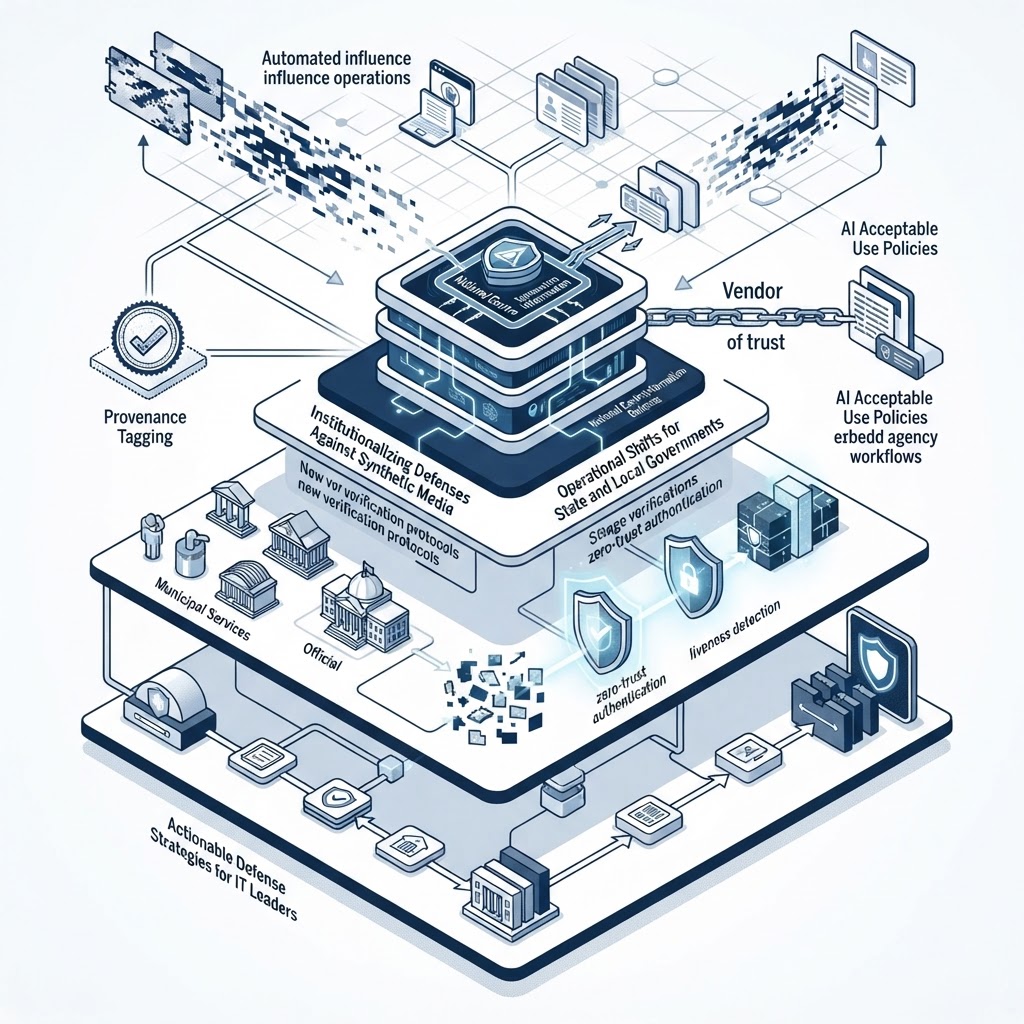
The creation of the National Centre for Information Defence represents a significant evolution in national security policy as AI deepfake disinformation threats become more accessible. By institutionalizing these defenses, the UK moves beyond reactive content moderation into a proactive posture designed to dismantle automated influence operations. The Biometric Update analysis highlights that this centre will specifically target the scalable nature of synthetic deception, which allows bad actors to mass-produce deceptive narratives with minimal human overhead.
This infrastructure aligns with global efforts—similar to the NIST AI RMF framework—to build resiliency into the digital information ecosystem. By coordinating across intelligence and technical domains, the government aims to stay ahead of the rapid pace of synthetic media advancements. Agencies must now recognize that the baseline for digital legitimacy has shifted; static validation methods are no longer sufficient against deepfakes that evolve in real-time.
This center will likely serve as the definitive source for actionable intelligence, assisting departments in auditing their internal workflows to prevent the infiltration of malicious synthetic media into official channels.
How should public sector agencies prepare for threats from AI-generated deepfake content?
Agencies should adopt zero-trust authentication and liveness detection protocols. Following the NIST AI RMF approach to identifying and managing risks, IT leaders should implement mandatory provenance tagging for all official digital media. Regularly reviewing AI acceptable use policies and conducting threat modeling exercises that include synthetic media scenarios will help agencies identify vulnerabilities in their public-facing communication channels before they are exploited by hostile actors.
Institutionalizing Defenses Against Synthetic Media
The urgency behind the UK’s new centre underscores the systemic risk posed by AI deepfake disinformation threats to the foundational trust in democratic institutions. When public-facing digital services are compromised by high-fidelity synthetic video or audio, the fallout extends far beyond temporary confusion, damaging the credibility of legitimate governance. Compliance teams must now integrate AI DLP and algorithmic accountability measures to detect unauthorized media manipulations within their networks.
Relying on Biometric Update reporting, it is clear that the barrier to creating deceptive, damaging content has collapsed, forcing a pivot toward specialized, AI-driven detection technologies. Agencies that ignore this trend risk falling victim to disinformation campaigns that could sway public opinion or disrupt administrative operations. Organizations should prioritize the implementation of liveness detection and cryptographic watermarking to ensure that digital assets can be reliably traced back to official sources.
This shift is consistent with CISA guidelines regarding the protection of information integrity and requires a unified approach to vendor oversight. Ensuring that third-party service providers adhere to strict AI transparency standards is no longer optional; it is a critical component of maintaining the security perimeter of the modern digital state.
Operational Shifts for State and Local Governments
State and local government entities must prepare for a future where AI deepfake disinformation threats target their specific jurisdictions with localized narratives. The establishment of the UK's centre provides a model for how smaller agencies can benefit from centralized, high-level threat intelligence to protect their own digital surfaces. Local procurement officials should prioritize the acquisition of AI-ready software that includes built-in verification features, treating synthetic media mitigation as a necessary layer of IT procurement compliance.
Staff training must move past basic phishing awareness to incorporate modules on identifying subtle visual and auditory artifacts associated with deepfakes. Furthermore, policy gaps concerning the usage of generative AI must be addressed immediately; if employees are using unverified tools to produce public messaging, they may inadvertently create openings for bad actors. By establishing a clear AI governance charter that defines acceptable use and verification procedures, municipalities can create a robust defense-in-depth strategy.
Collaboration with national bodies will be essential as these threats become more decentralized and difficult to trace. Focusing on authentication over mere reputation will allow agencies to maintain public trust despite the proliferation of sophisticated disinformation campaigns.
Actionable Defense Strategies for IT Leaders
- →Audit existing public-facing media pipelines for gaps in cryptographic verification and provenance tracking. • Integrate NIST AI RMF principles into agency-wide risk management workflows to address synthetic media hazards. • Require vendors to certify the use of liveness detection and deepfake mitigation tools within all AI service contracts. • Update staff training modules to focus on recognizing synthetic artifacts in high-stakes public communications. • Establish an AI governance charter that mandates the review of all generative content against established integrity standards. • Monitor guidance from the new National Centre for Information Defence to refine local defense postures.
What are the primary consequences for government organizations that fail to address AI deepfake disinformation threats?
Failure to mitigate these threats can result in a catastrophic loss of public trust, which is difficult to recover. Beyond reputational damage, organizations may face operational paralysis, as citizens struggle to distinguish between legitimate alerts and malicious, AI-generated fabrications. Regulatory scrutiny is increasing, and agencies could face liability for failure to implement necessary safeguards, potentially violating compliance requirements set by federal and state-level cybersecurity and AI integrity mandates.
The creation of the UK's National Centre for Information Defence marks a turning point in our collective strategy against AI deepfake disinformation threats. As these synthetic dangers evolve, proactive authentication and structural verification must become cornerstones of government digital infrastructure. Compliance leaders must act now to integrate these new defensive standards before the integrity of the information environment is irrevocably compromised.
Tagged
About APEX AI Guardrails: We publish expert AI news and governance insights updated 4× daily. Our editorial team consists of retired government IT professionals, AI governance specialists, and compliance experts with deep experience in local government operations.