
UK Launches National Centre for Information Defence to Combat AI Deepfake Disinformation Threats
Prime Minister Andy Burnham has unveiled a new national agency dedicated to neutralizing state-sponsored, AI-driven information warfare. This initiative marks a pivotal shift in how the government protects institutional integrity from deepfakes and automated propaganda.
Published by
APEX AI Guardrails Editorial Team
September 26, 2026
Reading time
6
minutes
The UK government has officially inaugurated the National Centre for Information Defence, a specialized body designed to counter escalating AI deepfake disinformation threats targeting democratic stability. Prime Minister Andy Burnham announced the agency this week to combat an industrial-scale wave of synthetic media and bot-driven influence campaigns deployed by hostile foreign powers. For government IT and security leaders, this move signals a mandatory transition toward proactive threat detection and enhanced digital resilience in public sector infrastructure.
How does the new National Centre for Information Defence function?
The centre operates on a 'detect, attribute, and disrupt' model to neutralize hostile information operations. According to recent announcements, the agency integrates intelligence assets, law enforcement agencies, and social media data to identify and block AI-generated campaigns. By aligning with international safety standards, the center seeks to dismantle the technical infrastructure used by foreign actors to spread disinformation while upholding the integrity of the public information space during geopolitical tension.
Strategic Response to AI Deepfake Disinformation Threats
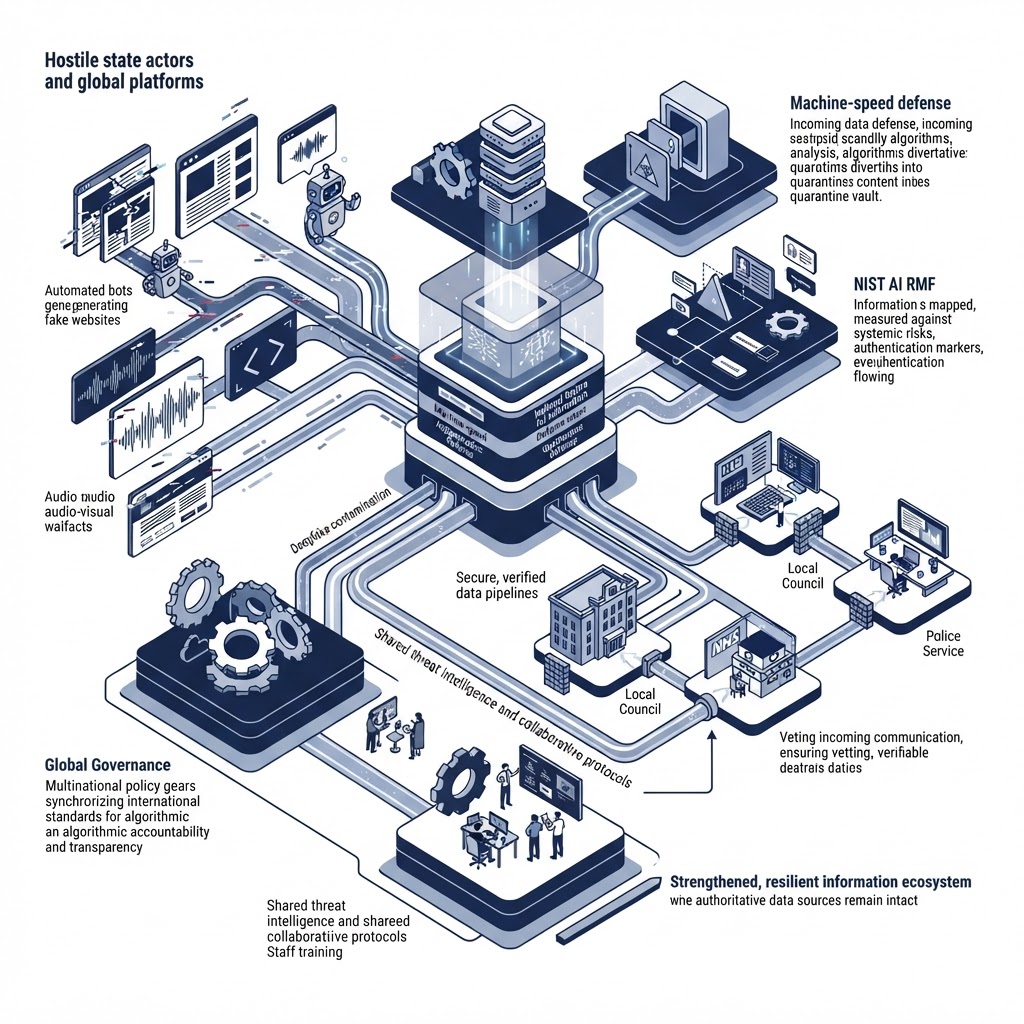
The establishment of the National Centre for Information Defence represents a significant escalation in the UK's commitment to defending against information warfare, as confirmed in the official UN address by Prime Minister Andy Burnham. Hostile state actors are currently deploying sophisticated tools that weaponize generative AI to automate the creation of fake websites, falsified news reports, and synthetic audio-visual content. These operations are explicitly engineered to exploit public anxiety and systematically erode trust in essential government institutions.
Under this new mandate, the agency will bridge the gap between national intelligence services and frontline digital platforms to ensure that AI-enabled attacks are identified and mitigated before they reach mass audiences. This approach mirrors key components of the NIST AI RMF, focusing on the mapping and measurement of systemic risks within the information ecosystem. By centralizing efforts, the government aims to force a paradigm shift from reactive, manual fact-checking to a systematic, machine-speed defense model.
This framework is essential for maintaining operational continuity across public services, which are increasingly vulnerable to the psychological impacts of large-scale, automated deception campaigns that threaten the very core of societal stability and national security.
What is the expected timeline for the agency to coordinate with private sector entities?
The initiative is designed for immediate integration, leveraging existing cybersecurity partnerships between the UK government and global social media corporations. By utilizing shared threat intelligence pipelines, the agency facilitates real-time data exchange to address AI-driven misinformation spikes. Organizations should prepare for standardized reporting requirements and collaborative protocols as the National Centre for Information Defence begins active monitoring of foreign-led digital interference operations starting this quarter.
Strengthening Global Standards and Governance Against AI Manipulation
The UK's decision to launch this agency highlights a growing international urgency to standardize the governance of generative models used in malicious disinformation campaigns. As noted by Prime Minister Andy Burnham at the UN, the fight against disinformation is now a central component of global geopolitical conflict that requires a unified, multinational policy response. By leading this initiative, the UK aims to set a global benchmark for algorithmic accountability, pushing for transparency and watermarking standards that can effectively trace AI-generated content back to its source.
Compliance leaders should view this as a clear indicator of upcoming regulatory shifts; as governments treat AI deepfake disinformation threats as a national security emergency, the standards for enterprise-level AI DLP (Data Loss Prevention) and content authentication will tighten significantly. This evolution means that the legal risks associated with shadow AI—particularly when such tools are used to unintentionally propagate state-sponsored propaganda—are rising. Organizations must move beyond mere AI acceptable use policies and begin implementing robust technical controls that enable the rapid attribution and filtration of synthetic media to maintain compliance with emerging national safety requirements.
Protecting Local and State Infrastructure from Synthetic Deception
For local, municipal, and state agencies, the rise of state-sponsored AI operations means that the battle against misinformation is no longer just a national government concern. Public sector entities must now audit their procurement processes to ensure that AI-driven communication tools and citizen-engagement platforms have built-in safeguards against deepfake contamination. This involves conducting rigorous assessments of third-party vendors to determine if they possess the capability to identify and block AI-generated disinformation before it affects local public messaging.
Moreover, the risk of shadow AI is acutely high at the municipal level, where limited oversight of unauthorized AI tools can create security gaps that hostile actors are eager to exploit. IT leaders should prioritize the implementation of a comprehensive AI governance charter that explicitly defines how employees interact with generative tools, ensuring that all public-facing information remains verified and traceable. Training staff to recognize the warning signs of synthetic media—such as subtle artifacts in AI-generated imagery or unnatural cadences in synthetic audio—is now a critical component of digital literacy.
By aligning with national defense strategies, local governments can build a localized, resilient front that protects community trust and ensures that the public remains informed by accurate, verifiable, and authoritative data sources despite global information warfare pressures.
What Leaders Should Do Next to Mitigate AI Risks
- →Establish a cross-departmental AI governance committee to oversee the deployment of all generative AI tools across agency operations. • Audit current procurement contracts to ensure third-party vendors comply with emerging national safety standards for synthetic media detection. • Integrate AI DLP (Data Loss Prevention) solutions to monitor and filter potential deepfake content within internal and public communication channels. • Develop or update an AI acceptable use policy that emphasizes the verification of AI-generated content to prevent the spread of misinformation. • Conduct regular staff training exercises focused on identifying the technical markers of AI-generated disinformation and state-sponsored propaganda. • Collaborate with regional cybersecurity centers to share anonymized intelligence regarding suspicious digital traffic or coordinated influence attempts.
What are the consequences for agencies that fail to address AI-driven misinformation risks?
Agencies failing to mitigate AI deepfake disinformation threats face significant operational risk, including the loss of public trust, compromised institutional reputation, and the potential for severe disruption of public services. From a regulatory perspective, future legislation may hold organizations accountable for failing to prevent the dissemination of harmful synthetic content. Compliance gaps can lead to legal liability, loss of funding, and increased vulnerability to targeted influence operations by hostile foreign powers.
The emergence of the National Centre for Information Defence reflects a global transition toward prioritizing proactive, technical defense against the weaponization of artificial intelligence. Leaders must ensure their organizations are resilient to the evolving landscape of AI deepfake disinformation threats to protect institutional integrity. Now is the time to align your digital infrastructure and internal policies with these new national security imperatives.
Tagged
About APEX AI Guardrails: We publish expert AI news and governance insights updated 4× daily. Our editorial team consists of retired government IT professionals, AI governance specialists, and compliance experts with deep experience in local government operations.
Related Articles
AI Governance
Mitigating AI Hallucination Risk in Government: New October 19 Federal Oversight Trends
October 19, 2026
AI Governance
Combating AI Deepfake Disinformation: How Government Agencies Can Restore Public Trust as of October 19, 2026
October 19, 2026
AI Governance
New Federal AI Systems Transparency Act Introduced Amid Growing Regulatory Pressure
October 19, 2026