
State AI Policy Leaders Demand Urgent Action to Mitigate AI Hallucination Risk Government Systems Face Today
State leaders from Illinois, California, and New York have issued a formal demand for developers to eliminate catastrophic AI risks. This shift mandates immediate technical oversight for government entities managing AI-driven public services.
Published by
APEX AI Guardrails Editorial Team
October 2, 2026
Reading time
6
minutes
On October 2, 2026, state leaders from Illinois, California, and New York issued a joint call to action demanding that frontier developers prioritize the elimination of catastrophic AI hallucination risk in government-facing systems. With over 128 legal professionals already implicated in judicial sanctions for AI-generated misinformation this year, the intersection of rapid deployment and regulatory scrutiny has reached a critical boiling point. Compliance officers must now pivot from conceptual policy to rigid technical guardrails to prevent AI-driven errors from destabilizing public sector operations.
How are state government officials responding to the threat of AI-generated misinformation in their jurisdictions?
On September 4, 2026, AI policy leaders from Illinois, California, and New York issued a joint statement demanding that technology companies proactively eliminate the risk of catastrophe inherent in powerful AI systems. This coordinated inter-state effort signals a shift from passive observation to active enforcement, pressuring developers to address systemic AI hallucination risk in government technology before further operational failures occur.
The Mounting Pressure for AI Oversight in SLED Environments
The rapid integration of generative AI into state and local government workflows has outpaced federal guidance, forcing state legislatures to establish their own defensive perimeters. Leaders in Illinois, California, and New York have clearly articulated that developers must be held accountable for the inherent flaws within their models, particularly where these systems influence public safety, housing, and civil services. According to reports from the Transparency Coalition, the current trajectory of unregulated development creates an environment where 'good plumbing' is no longer sufficient to stop the flow of inaccuracies.
Instead, agencies are being urged to implement rigorous validation cycles that test for factual consistency and logic errors before any model touches sensitive citizen data. This demand for 'catastrophe elimination' indicates that simple vendor disclaimers will soon be considered inadequate under emerging state-level compliance statutes. By focusing on algorithmic accountability and the systematic testing of output accuracy, these state leaders aim to close the gap between experimental innovation and the necessity of stable, reliable public infrastructure.
The era of 'black box' adoption in the public sector is nearing its end as policymakers demand transparency and demonstrable risk reduction strategies from all primary model developers.
What steps should agency IT departments take to prevent legal sanctions stemming from AI-generated errors?
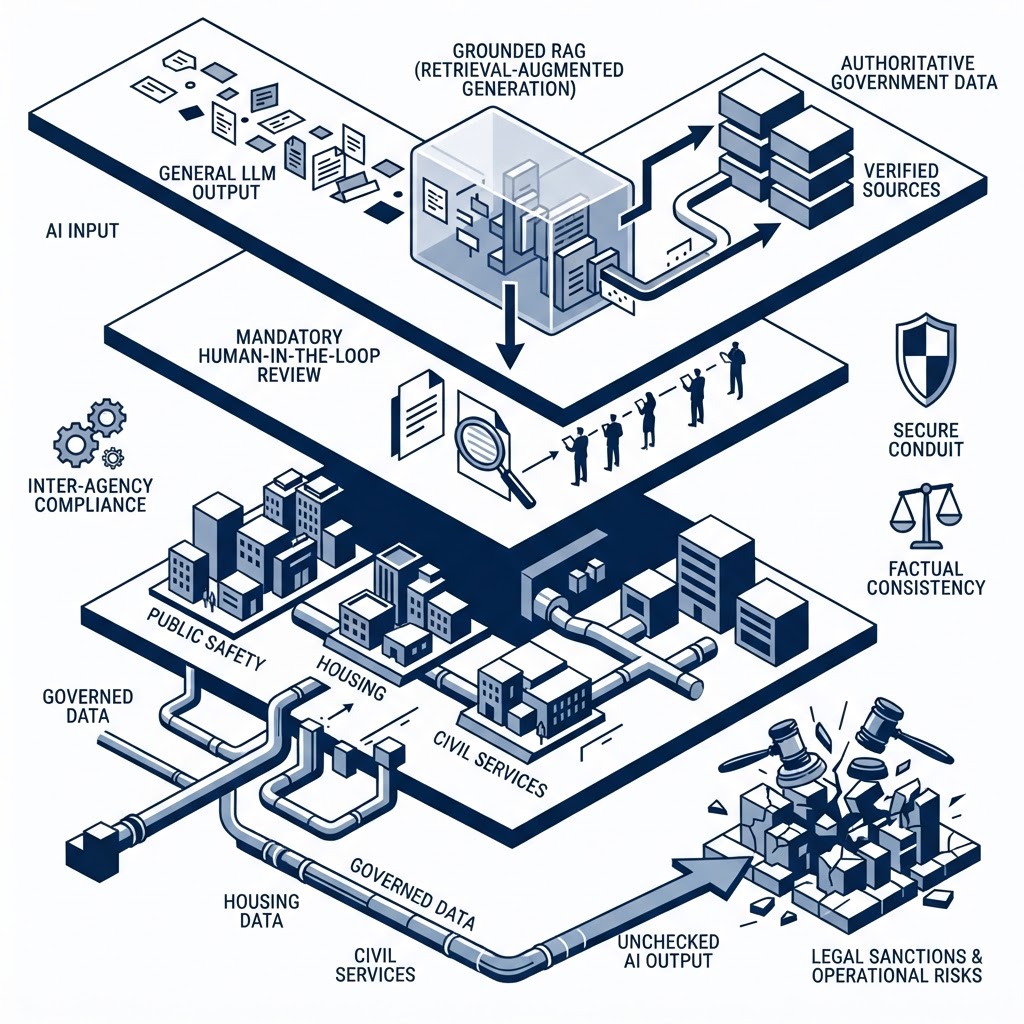
Agencies must shift from broad policy statements to technical implementations such as grounded retrieval-augmented generation and mandatory human-in-the-loop review for all documentation. As noted in recent AI Hallucination Sanctions 2026 guidelines, legal and operational risks are minimized by ensuring that every AI-generated claim is cross-referenced against authoritative government databases, thereby reducing the probability of verifiable factual inaccuracies in official filings.
Addressing the Legal and Operational Costs of AI Inaccuracy
Judicial sanctions for AI-generated misinformation have moved from a theoretical possibility to a systemic reality in the United States, with 128 lawyers now facing consequences for reliance on unverified tool outputs. For SLED organizations, the lesson is clear: if the judicial system is applying sanctions for AI-generated falsehoods, government agencies are at equal risk of litigation if their public-facing content or internal workflows rely on flawed data. According to Lewis Silkin, effective AI governance is akin to 'good plumbing,' ensuring that data flows reliably without contaminating operational integrity.
When that plumbing leaks—resulting in hallucinated data—the consequences can range from broken procurement processes to public policy failure. Agencies are being encouraged to move beyond traditional risk management frameworks and adopt active verification tools that detect when a model drifts from its factual training data. By treating AI output as a potential liability rather than a source of truth, agencies can better manage their AI hallucination risk in government deployments.
This proactive stance is essential for maintaining consumer and constituent confidence, which recent market data suggests is currently rising but remains fragile in the face of widespread, high-profile AI misinformation events.
Strategic Mandates for Local and Municipal Agency Leadership
County and municipal agencies must now treat AI procurement as a matter of civil liability rather than mere digital transformation. Procurement compliance teams need to embed specific service-level agreements (SLAs) that require vendors to demonstrate their adherence to NIST AI RMF subcategories regarding risk assessment and safety testing. The days of 'shadow AI' usage are rapidly closing; IT leadership must institute an AI acceptable use policy that restricts the use of general-purpose LLMs in favor of controlled, sandboxed environments that utilize retrieval-augmented generation to keep model outputs anchored in verifiable, government-approved data.
Furthermore, staff training programs must focus on the nuances of 'AI literacy,' teaching employees how to scrutinize AI outputs for the subtle markers of hallucination. When an agency procures a new tool, it must be subject to a rigorous AI governance charter that defines the chain of custody for every piece of information processed. By shifting the burden of safety back onto the vendor and internalizing the verification process, local leaders can mitigate the risks of public misinformation campaigns and the potential for legal repercussions that follow inaccurate automated reporting.
Recommended Priorities for Compliance and Risk Teams
- →Mandate vendor compliance with NIST AI RMF safety standards for all new public sector technology procurements. • Implement grounded retrieval architectures to anchor AI responses to verified, secure agency databases. • Establish a mandatory 'Human-in-the-Loop' verification process for all AI-generated official government documentation. • Conduct regular algorithmic audits to test for drift and consistency in high-stakes automated public service workflows. • Develop a transparent AI governance charter that clearly outlines accountability for all automated decision-making processes.
Why is AI-generated misinformation creating such significant legal exposure for public sector entities today?
AI-generated misinformation presents a massive liability because judicial systems have begun enforcing strict sanctions, as evidenced by the 128 legal professionals impacted in 2026. When public sector entities integrate these tools without sufficient guardrails, they risk producing official documentation containing fabricated facts. This failure to verify, often called an AI hallucination risk in government, invites potential lawsuits, loss of public trust, and significant regulatory fines for professional negligence.
Addressing AI hallucination risk in government is no longer a peripheral concern but a central pillar of reliable, responsible public administration. As state-level leaders enforce new standards for developer accountability, SLED agencies must prioritize technical rigor alongside clear operational oversight. Building a resilient digital foundation now will protect the public interest while allowing for the safe, scaled adoption of AI innovation.
Tagged
About APEX AI Guardrails: We publish expert AI news and governance insights updated 4× daily. Our editorial team consists of retired government IT professionals, AI governance specialists, and compliance experts with deep experience in local government operations.