
New October 2026 Illinois AI Mandates Signal Shift in Algorithmic Accountability for Public Sector
Illinois has officially implemented landmark legislation prohibiting biased AI in employment decisions, marking a pivotal shift toward strict algorithmic accountability. This regulatory change requires government and public sector leaders to overhaul their procurement and transparency strategies immediately.
Published by
APEX AI Guardrails Editorial Team
October 2, 2026
Reading time
6
minutes
New state-level mandates in Illinois are forcing a fundamental transformation in algorithmic accountability for the public sector by outlawing discriminatory AI in employment decisions. Research shows that 40% of large organizations have already faced severe reputational damage due to biased algorithmic outcomes, underscoring the urgent need for robust governance frameworks. For government IT and compliance leaders, this shift signifies that voluntary guidelines are no longer sufficient to mitigate legal and ethical risks.
How does the 2026 Illinois AI law change how public sector employers use automated hiring tools?
As of October 2026, Illinois has implemented a new provision making it illegal for employers to use AI in employment decisions if the technology produces discriminatory results against a protected class. Employers must now audit their software for bias to ensure compliance, moving beyond simple reliance on vendor claims to prove that their algorithmic systems do not perpetuate systemic unfairness or violate civil rights protections during the recruitment process.
The Evolution of Algorithmic Accountability Public Sector Regulations
The regulatory landscape for government technology is undergoing a rapid transition from voluntary frameworks like the White House AI Bill of Rights to enforceable state-level mandates. Following the lead of the California Civil Rights Department, which already treats discriminatory AI as a violation of existing civil rights statutes, Illinois has codified explicit prohibitions against biased automated decision-making. This legal pivot addresses a growing crisis where public entities blindly adopt AI Recruiting & Hiring Laws without testing for disparate impact.
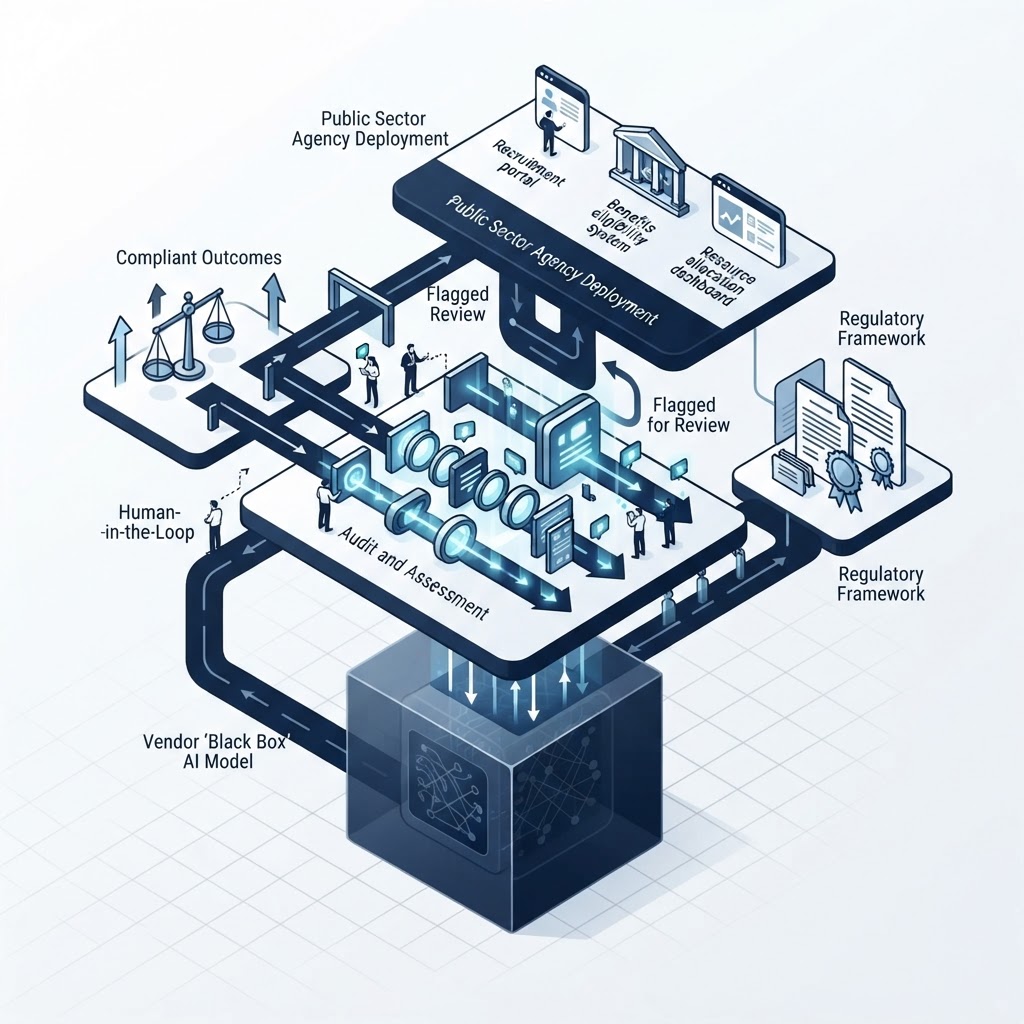
The reliance on private sector black-box models has historically shielded agencies from the consequences of biased outputs, but the 2026 Illinois provision effectively strips away this shield. Agencies must now demonstrate proactive oversight or face significant litigation risks. By requiring rigorous verification of AI-driven employment outcomes, Illinois is setting a precedent that other states are expected to follow, forcing a total reset of how public agencies vet human resources software.
This trend confirms that algorithmic accountability in the public sector is no longer an optional best practice but a foundational component of modern civil service compliance.
What are the essential steps for public agencies to achieve compliance with new AI auditing requirements?
Agencies should first conduct a comprehensive inventory of all deployed AI, followed by the implementation of Algorithmic Impact Assessments (AIAs) to identify potential biases. By adopting algorithmic registers, organizations can document the lifecycle of their tools, including vendor transparency data. Finally, IT leaders must establish clear internal policies that mandate recurring audits and human-in-the-loop oversight to ensure any identified discriminatory patterns are addressed before they impact hiring outcomes.
Mitigating the Public Sector 'Black Box' Compliance Crisis
Public sector AI adoption is frequently hindered by the 'black box' problem, where proprietary vendor software hides decision-making logic from public scrutiny. According to reports on AI in the public sector: from black boxes to meaningful transparency, reliance on vendor sales pitches often obscures the lack of democratic accountability in automated tools. This opacity creates a massive liability for municipal and state agencies that are legally responsible for the outcomes of their technology.
To combat this, governance teams must mandate deeper visibility into vendor data training sets and decision-making weights. The Algorithmic accountability for the public sector | Ada Lovelace Institute research emphasizes that agencies are increasingly turning to Algorithmic Impact Assessments (AIAs) to penetrate this barrier and evaluate systems for hidden biases. Without these assessments, agencies are susceptible to the same reputational issues that have plagued 40% of large companies attempting to deploy unverified systems.
Consequently, procurement departments must pivot away from standard vendor agreements toward contracts that include mandatory transparency clauses and rights to audit code. This approach ensures that technical deployment aligns with public interest and regulatory requirements regarding nondiscrimination.
Managing AI Procurement Risks for State and Local Government
Municipalities and county agencies must treat AI procurement with the same rigor as sensitive financial data handling. The primary challenge is closing the gap between high-level policy and front-line technical implementation. As agencies modernize, they often fail to account for the 'black box' of proprietary tools, leading to unintended bias in critical areas like public service eligibility or workforce management.
Procurement leaders must now demand comprehensive documentation on how software handles protected class data and request clear explanations of the machine learning models' fairness metrics. This strategy helps avoid the pitfall of purchasing 'shadow AI' that bypasses standard governance. Staff training must also evolve; agency employees responsible for reviewing AI outputs require specialized knowledge to detect when an algorithm might be producing biased results.
By establishing internal governance charters that clearly define acceptable use and bias-reporting procedures, agencies can foster a culture of responsible innovation. The goal is to move from passive tool consumption to active AI lifecycle management. Aligning these internal processes with external accountability mandates ensures that state and local government agencies remain resilient against legal challenges and maintain the public trust necessary for effective governance in the age of automation.
Essential Actions for Algorithmic Accountability Leaders
- →Establish a mandatory algorithmic register to document the provenance and purpose of every AI tool used within the agency. • Conduct regular Algorithmic Impact Assessments (AIAs) prior to the deployment of any high-stakes automated decision-making system. • Update all vendor procurement contracts to include clauses guaranteeing access to model transparency data and bias-mitigation reports. • Implement human-in-the-loop requirements that ensure no high-impact personnel decision is made by an autonomous system without expert review. • Train procurement and IT staff on the specific requirements of the new Illinois and California-style civil rights provisions for AI systems. • Develop a clear protocol for the immediate suspension of AI tools that demonstrate statistical evidence of bias against protected classes.
What are the potential consequences if an agency fails to mitigate bias in their deployed AI systems?
Agencies face severe reputational damage, the loss of public trust, and significant legal liability under new state civil rights laws like the Illinois provision. Beyond litigation, failing to account for algorithmic bias can result in mandatory system shutdowns, expensive retroactive audits, and the total invalidation of high-stakes decisions, creating operational paralysis while the agency struggles to reconcile their automated tools with legal compliance standards.
The 2026 legislative landscape confirms that algorithmic accountability in the public sector is now a permanent requirement for organizational health and legal compliance. As state mandates grow more stringent, agencies that proactively audit their tools will be better positioned to avoid the systemic risks associated with black-box technology. Compliance leaders must act now to integrate these transparency protocols into their core technology strategy to safeguard public interest and professional credibility.
Tagged
About APEX AI Guardrails: We publish expert AI news and governance insights updated 4× daily. Our editorial team consists of retired government IT professionals, AI governance specialists, and compliance experts with deep experience in local government operations.