
New Multi-Agent Voting Protocol Emerges as Key Strategy for AI Hallucination Risk Mitigation in Government
As of September 2026, new multi-agent consensus protocols are providing a technical pathway to reduce AI hallucination risks in public sector deployments. These strategies, combined with robust governance, are essential for maintaining accuracy in critical government operations.
Published by
APEX AI Guardrails Editorial Team
September 25, 2026
Reading time
6
minutes
Effective AI hallucination risk mitigation is now reaching a turning point as researchers deploy consensus-based architectures to ensure accuracy in public sector decision-making. With reports indicating that 56% of AI-driven attacks have surged as of 2026, government IT leaders are increasingly prioritizing verification layers over blind model trust. This technological shift is essential for safeguarding mission-critical functions like emergency management and public health from unreliable machine outputs.
How does a multi-agent voting protocol reduce errors in government AI applications?
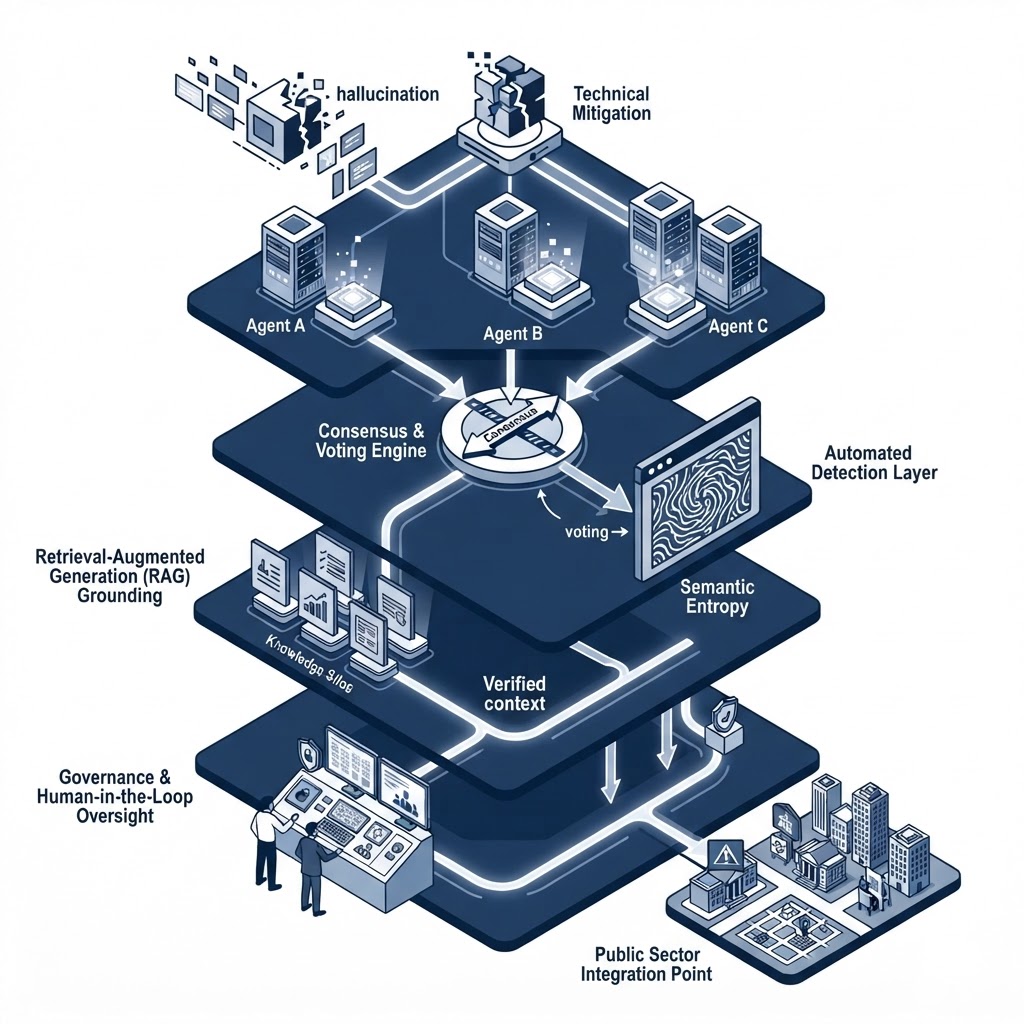
A multi-agent protocol, such as those pioneered by Binghamton University, queries seven unique LLMs simultaneously for a single prompt. By utilizing a voting mechanism to compare outputs, the system identifies the most consistent and accurate information, effectively filtering out hallucinations. This approach aligns with NIST AI RMF guidelines by incorporating automated validation loops into the AI lifecycle to ensure that outputs remain grounded in verifiable, domain-specific data rather than probabilistic noise.
Technical Frameworks Driving AI Hallucination Risk Mitigation
The integration of specialized AI units is fundamentally altering the approach to AI hallucination risk mitigation across the public sector. Researchers at Binghamton University have recently demonstrated a protocol that queries multiple LLMs simultaneously, leveraging a consensus-based voting mechanism to identify the most accurate, hallucination-free response. This methodology is particularly relevant as Palo Alto Networks emphasizes that effective protection requires a rigorous three-pillar approach: technical mitigation through RAG and prompt engineering, automated detection, and robust governance workflows.
By moving away from a single-model reliance, agencies can minimize the impact of individual model errors on sensitive automated processes. Furthermore, interoperable agent frameworks like OVON allow disparate, specialized AI agents to collaborate and cross-verify findings, providing a secondary layer of scrutiny that is critical for algorithmic accountability. Implementing these agentic architectures ensures that data-heavy workflows, such as financial forecasting or legislative analysis, remain supported by multiple verification channels.
By grounding these systems in verified organizational databases via Retrieval-Augmented Generation (RAG), government entities can significantly reduce the propensity for generative models to produce plausible but incorrect information.
What is the most effective operational strategy for managing AI output reliability?
The most effective strategy combines technical mitigation with strict human-in-the-loop oversight. Agencies should deploy Retrieval-Augmented Generation (RAG) to ground responses, use multi-agent voting to verify facts, and implement automated detection to flag entropy in real-time. This governance framework ensures that when an AI system encounters uncertainty, the process pauses for human verification, upholding compliance with internal AI acceptable use policies and mitigating risks associated with shadow AI deployments.
Compliance Landscapes and the Rising Threat of AI Inaccuracies
Heightened risk exposure in the government sector is now a direct consequence of the rapid integration of generative models without sufficient verification protocols. Data from IBM reveals a 56% increase in AI-driven attacks as of 2026, forcing a re-evaluation of how public agencies approach model safety. When models hallucinate—inventing false facts or citing non-existent statutes—they undermine the foundation of democratic transparency and public trust.
Compliance teams must now treat hallucination as an inherent model characteristic rather than a software bug, mandating that security controls assume outputs may be inaccurate by default. This transition requires a shift toward formal AI governance charters that require specific risk assessments for any AI tool deployed in public-facing services. Failure to implement these checks can lead to significant liability, especially when models provide erroneous guidance in emergency response, social services, or public health communication.
By adopting NIST AI RMF frameworks, agencies can establish the necessary guardrails to monitor for semantic entropy, effectively catching inaccuracies before they propagate into downstream government systems. Ensuring responsible AI usage today requires moving beyond simple prompts to a sophisticated architecture of verification.
Strategic Impacts for State and Local Public Sector Operations
Municipalities and state agencies face unique challenges when procuring and managing AI solutions that promise high levels of autonomy. For local governments, the primary hurdle is ensuring that vendor-provided models adhere to strict procurement compliance standards, including mandatory audit trails and explainability requirements. Many agencies are now updating their AI acceptable use policies to include specific mandates for multi-agent validation in high-stakes domains, such as urban planning and law enforcement reporting.
Vendor risk assessment has also evolved; IT procurement offices are increasingly disqualifying models that lack internal mechanisms for hallucination detection or that do not allow for RAG-based data grounding. By training staff to interpret AI confidence scores and recognize when a model might be struggling to ground its response, agencies create a layer of institutional resilience. Furthermore, the shift toward interoperable frameworks means that local governments can eventually integrate specialized agents that share intelligence without exposing sensitive underlying data.
As public demand for automated efficiency grows, the ability to balance speed with rigorous verification will define the next phase of digital transformation. Proactive agencies are already auditing current tools to identify where hallucination risks might be highest, ensuring that every deployment remains under a robust governance framework.
Implementation Roadmap for Compliance and IT Leaders
- →Mandate the use of multi-agent consensus protocols to verify high-stakes public sector outputs. • Deploy automated detection tools to monitor for semantic entropy in real-time model responses. • Ground all internal generative AI initiatives in verified, RAG-enabled organizational data silos. • Update AI governance charters to treat model hallucination as a standard, manageable operational risk. • Establish human-in-the-loop oversight requirements for any AI decisioning tool impacting public service delivery.
What are the regulatory and operational consequences of ignoring hallucination risks?
Ignoring these risks can lead to regulatory non-compliance, public distrust, and potential legal liability if an AI-driven error causes harm. Operationally, it results in the spread of misinformation and the erosion of service reliability. According to IBM, organizations that fail to integrate controls assuming inherent model flaws leave themselves vulnerable to sophisticated attacks, potentially resulting in security breaches and data corruption that violate state and federal algorithmic accountability requirements.
Prioritizing AI hallucination risk mitigation is now a mandatory standard for any government agency deploying generative technologies. By adopting multi-agent voting, RAG, and rigorous human-in-the-loop protocols, leadership can effectively build the resilient systems necessary for secure public sector innovation. Compliance teams must act now to institutionalize these verification layers before further integrating autonomous agents into critical state infrastructure.
Sources
- Researchers develop new way to reduce AI hallucinations - Binghamton News
- What Are AI Hallucinations? | IBM
- Hallucination Mitigation using Agentic AI Natural Language ...
- [What Are AI Hallucinations? [+ Protection Tips] - Palo Alto Networks](https://www.paloaltonetworks.com/cyberpedia/what-ai-hallucinations)
Tagged
About APEX AI Guardrails: We publish expert AI news and governance insights updated 4× daily. Our editorial team consists of retired government IT professionals, AI governance specialists, and compliance experts with deep experience in local government operations.
Related Articles
AI Governance
Mitigating AI Hallucination Risks: October 16 Update on SLED Governance Frameworks
October 16, 2026
AI Governance
Combating AI Deepfake Disinformation: New Legislative Efforts to Protect Government Public Trust
October 16, 2026
AI Governance
AI Transparency and Explainability: New UK and California Mandates Reshape Government Decision-Making as of October 16, 2026
October 16, 2026