
Mitigating AI Hallucination Risks: New October 2026 Strategies for Government Agencies
As public agencies grapple with AI-generated misinformation, new technical protocols and federal policy frameworks are emerging to curb system hallucinations. These updates provide critical guidance for IT leaders balancing innovation with institutional trust.
Published by
APEX AI Guardrails Editorial Team
October 14, 2026
Reading time
6
minutes
# Mitigating AI Hallucination Risks: New October 2026 Strategies for Government Agencies
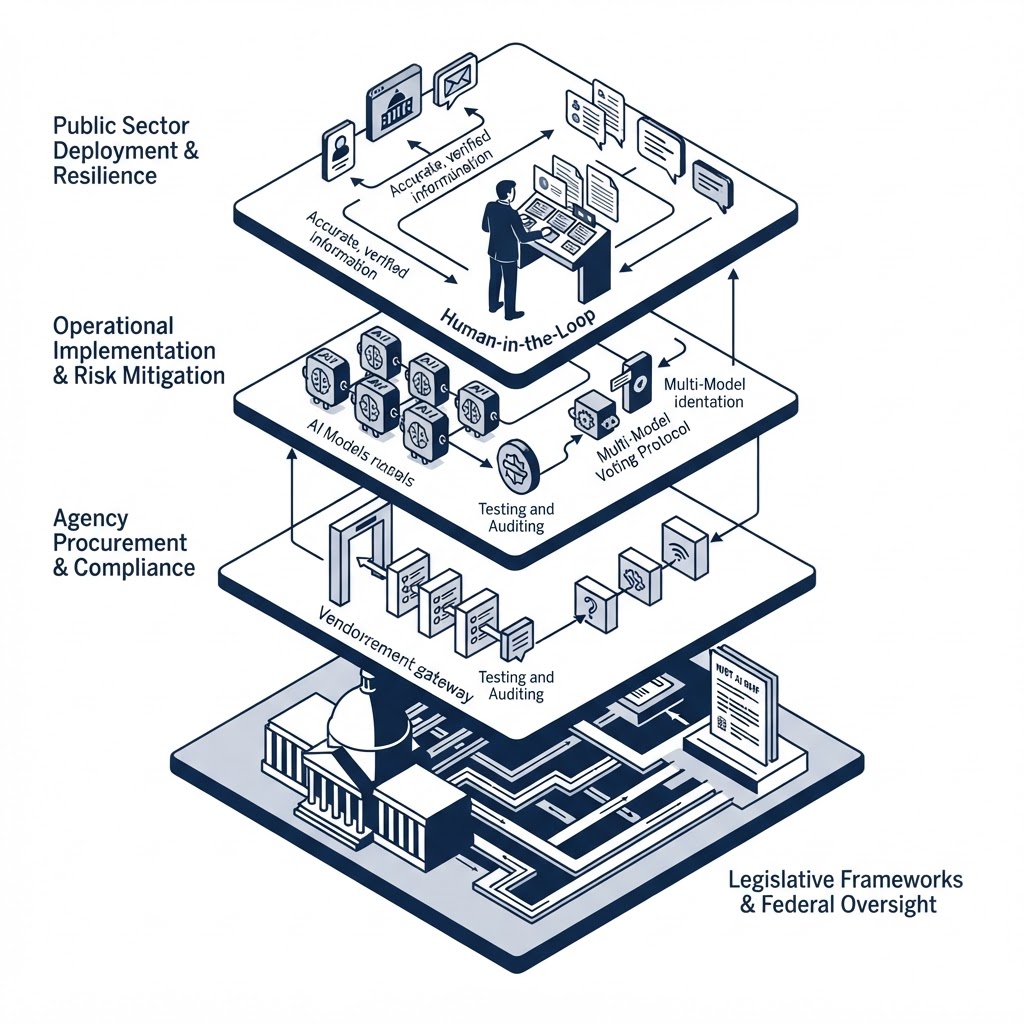
Managing AI hallucination risk has become a primary operational priority for government IT leaders following reports of increasing chatbot-driven misinformation that threatens institutional trust and public safety. On October 14, 2026, the New York Attorney General issued a formal warning to citizens regarding the prevalence of AI-generated electoral fakes, highlighting the urgency of this crisis. For public sector compliance officers, these developments signal a mandatory shift toward more rigorous AI testing, auditing, and multi-layered verification protocols.
How can government agencies verify chatbot outputs to prevent the spread of false election information?
Agencies can mitigate AI hallucination risk by implementing a multi-model voting protocol. Researchers at Binghamton University have demonstrated that asking seven independent LLMs the same question and utilizing a consensus-based voting mechanism significantly reduces the output of fake information. This verification layer acts as a safety checkpoint, ensuring that public-facing automated systems produce accurate, validated responses rather than relying on a single, potentially unreliable generative model.
Legislative Frameworks for Reducing AI Hallucination Risk
Federal oversight is pivoting toward more prescriptive safety standards to combat the proliferation of inaccurate AI outputs. On October 7, 2026, Senator Maria Cantwell introduced a legislative proposal that would task the National Institute of Standards and Technology (NIST) with developing strict, risk-based safety requirements for frontier AI systems Sen. Cantwell Proposes AI Governance Framework.
This framework specifically mandates comprehensive testing and standardized incident reporting, providing a roadmap for agencies to address AI hallucination risk within their existing digital infrastructure. By anchoring AI procurement in NIST AI RMF guidelines, these legislative moves aim to curb the "black box" nature of current generative tools. Furthermore, the focus on testing requirements suggests that government vendors will soon face stricter accountability for the reliability of their models before deployment.
This proactive approach is essential for preventing the unintended consequences of LLMs, which Stanford HAI researchers have long identified as a persistent, unsolved liability challenge in current policy landscapes Who is Responsible When AI Causes Harm?.
What is the most effective approach for ensuring human oversight when deploying generative AI in state services?
The most effective strategy is a 'human-in-the-loop' mandate, similar to the executive order signed by Utah’s Governor on October 7, 2026. Agencies must ensure that AI tools do not function autonomously in high-stakes environments. By requiring human review for AI-generated reports or public communications, departments maintain institutional accountability, protect data privacy, and ensure that human judgment remains the final arbiter for critical service delivery and public policy decisions.
Liability and Operational Compliance Challenges
The challenge of assigning legal responsibility for AI-driven harms remains a primary hurdle for state and local government agencies. As public-facing services become increasingly automated, the threat of algorithmic accountability failures grows, making the implementation of robust AI acceptable use policies critical for risk management. When AI systems fail to produce accurate outputs, agencies must determine whether the liability rests with the software vendor, the internal IT development team, or the end-user.
Current research from Stanford HAI underscores that existing legal frameworks are ill-equipped for these scenarios, necessitating that agencies build contractual protections into their procurement compliance workflows. Furthermore, the rise of shadow AI usage within departments increases the risk of unauthorized data exposure. To counter this, compliance teams must prioritize AI DLP solutions that can track and verify the source of generated content.
By institutionalizing testing, auditing, and incident reporting—as emphasized by the emerging NIST standards—agencies can better insulate themselves from the potential damages caused by AI-generated misinformation while building a scalable foundation for responsible technology integration.
Strategies for Local and State Agency Resilience
State agencies and municipalities must now move beyond pilot programs toward hardened, production-ready AI governance structures. This shift requires integrating technical solutions like the multi-model voting protocol to act as a buffer against hallucinations. Local IT leaders should also evaluate their vendor contracts to ensure they include specific performance guarantees regarding accuracy and reliability.
Utah’s recent 'Pro-Human AI' initiative serves as a model for this, demonstrating that state-level executive actions can bridge the gap between innovation and the essential protection of data privacy and public trust. Procurement officers should now prioritize vendors that can provide transparency into their training datasets and model auditing processes. Furthermore, regular staff training on AI literacy and the risks of misinformation should become a standard component of agency culture.
By fostering a climate where human oversight is ingrained in every AI-assisted workflow, public sector entities can mitigate risk while maintaining the benefits of automation.
Critical Actions for Institutional Compliance Teams
- →Establish a mandatory 'human-in-the-loop' protocol for all public-facing generative AI tools to ensure ethical oversight. • Adopt multi-model voting architecture for sensitive data queries to identify and filter AI hallucination risk before it reaches the public. • Align procurement standards with upcoming NIST-led safety frameworks to ensure long-term regulatory compliance. • Update internal AI acceptable use policies to include strict incident reporting requirements for any detected AI-generated misinformation. • Conduct regular audits of vendor AI transparency reports to hold third-party providers accountable for system accuracy. • Implement robust AI DLP strategies to monitor internal generative AI usage and prevent unauthorized data leakage.
What are the primary legal consequences for agencies if they fail to manage AI-driven misinformation?
Failure to manage AI-driven misinformation can result in significant legal and reputational consequences, including violation of consumer protection laws and erosion of public trust. As noted by the New York Attorney General, incorrect information provided by state systems can lead to voter disenfranchisement or administrative failures. If an agency cannot demonstrate due diligence in validating AI outputs, they may face increased liability exposure and regulatory scrutiny regarding algorithmic accountability and data protection standards.
Addressing AI hallucination risk requires a combination of technical innovation, legislative compliance, and rigorous human oversight. As federal and state frameworks continue to evolve toward stricter accountability, IT leaders must prioritize the integration of reliable, multi-layered verification systems. The future of government services depends on our ability to leverage these tools responsibly while maintaining the highest standard of public integrity.
Sources
- AI without hallucinations: Binghamton University researchers develop new way to reduce troublesome fake info
- Attorney General James Warns New Yorkers About AI-Generated Election Misinformation
- Sen. Cantwell Proposes AI Governance Framework
- Who is Responsible When AI Causes Harm?
- Utah Governor Signs Executive Order for Pro-Human AI
Tagged
About APEX AI Guardrails: We publish expert AI news and governance insights updated 4× daily. Our editorial team consists of retired government IT professionals, AI governance specialists, and compliance experts with deep experience in local government operations.
Related Articles
AI Governance
Mitigating AI Hallucination Risk in Government: New October 19 Federal Oversight Trends
October 19, 2026
AI Governance
Combating AI Deepfake Disinformation: How Government Agencies Can Restore Public Trust as of October 19, 2026
October 19, 2026
AI Governance
New Federal AI Systems Transparency Act Introduced Amid Growing Regulatory Pressure
October 19, 2026