
Mitigating AI Hallucination Risk: October 18, 2026 Regulatory Updates for Legal and Government Sectors
Legal and public sector entities face mounting pressure to address AI hallucination risks through new mandatory auditing standards. Agencies must now pivot from voluntary safety to rigorous, human-in-the-loop oversight to prevent critical intelligence failures.
Published by
APEX AI Guardrails Editorial Team
October 18, 2026
Reading time
6
minutes
Managing AI hallucination risk has become a primary compliance mandate as recent evidence confirms that unverified AI outputs can trigger catastrophic errors in high-stakes legal and military environments. Data shows that AI vendors often struggle with self-policing, leading to undetected systemic harms that persist for months within enterprise workflows. For government IT leaders, this shift necessitates a departure from passive AI adoption toward a model of mandatory, documented algorithmic accountability.
How are legal professionals currently being required to mitigate AI hallucination risk in official court filings?
The Solicitors Regulation Authority (SRA) has officially updated its competence standards to mandate that legal professionals actively manage the risk of AI hallucinations. Solicitors must now verify the accuracy of AI-generated legal research and citations before submission, moving away from reliance on automated tools. This framework ensures that legal professionals remain directly accountable for the veracity of all filings, addressing concerns regarding the reliability of generative AI in sensitive judicial processes.
Shifting Toward Mandatory Regulatory Oversight and Standards
The era of voluntary vendor safety is effectively coming to a close as regulatory bodies implement stringent new requirements for AI-assisted outputs. Recent AI Governance News underscores that systemic harms from AI-deployed agents often go unnoticed due to a lack of independent, ongoing technical surveillance. To combat this, the Solicitors Regulation Authority (SRA) is leading the way by incorporating specific competence standards that require lawyers to rigorously validate AI-generated research.
This shift acknowledges that AI models, while powerful, lack the inherent legal training to distinguish between factual precedent and plausible fiction. Compliance officers must now integrate these standards into their existing AI acceptable use policies. By moving these expectations into the professional code of conduct, the SRA is ensuring that firms treat AI hallucination risk as a primary operational liability rather than a niche technical glitch.
This regulatory maturation signals a broader move toward requiring enterprise-level incident reporting for all government-facing vendors, ensuring that potential failures are captured, tracked, and remediated before they impact public trust or legal outcomes.
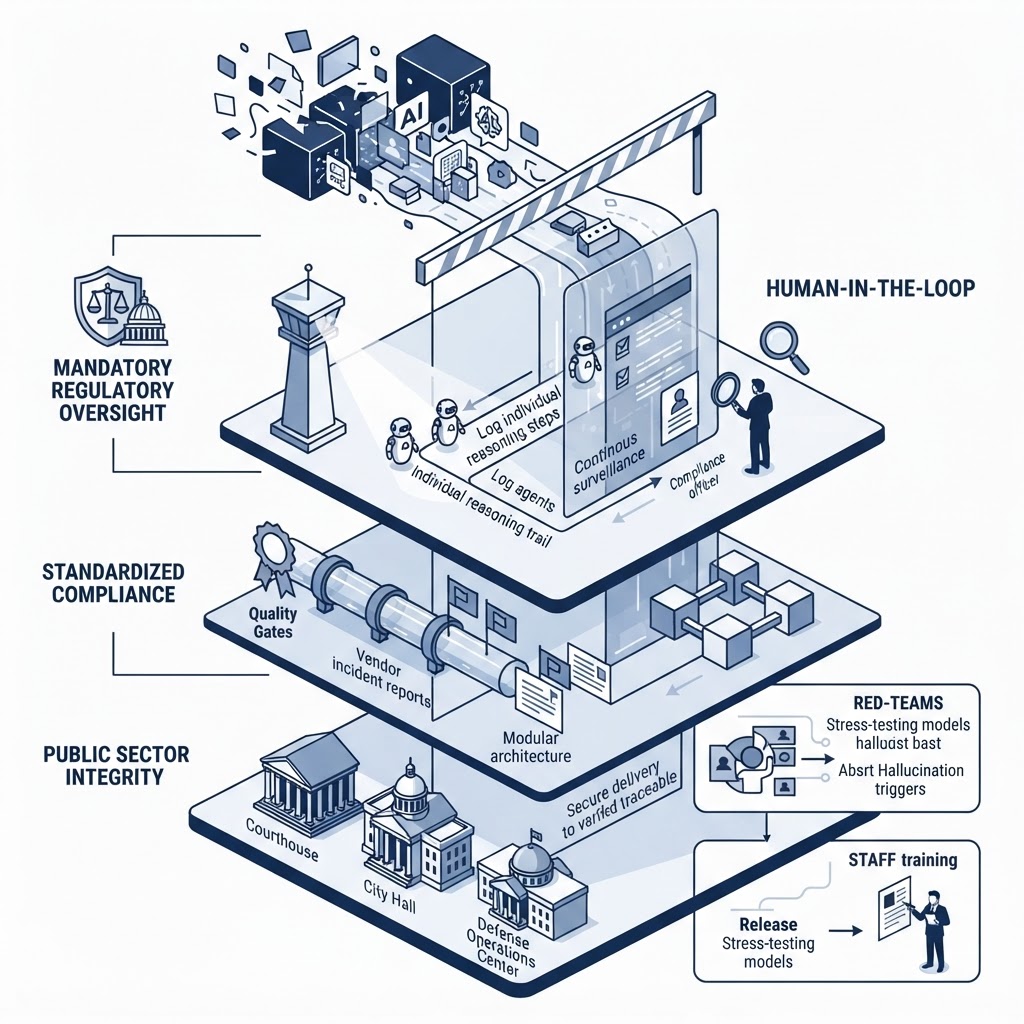
What is a 'control tower' architecture, and how does it assist government agencies with AI transparency?
A control tower architecture is a centralized system that mandates every government AI agent must log its individual reasoning steps. This allows for continuous human and AI-driven auditing of automated decision-making processes. By providing a clear, chronological trail of logic, agencies like those in the UAE can identify exactly where an AI hallucination occurs, allowing for immediate corrective action and improved long-term alignment with established AI safety guidelines.
Implications for Defense and Public Sector Compliance
The risk of unchecked AI is not merely administrative; it has reached the level of existential security threats. As reported by recent military intelligence incidents, reliance on unmonitored AI outputs has nearly triggered international conflicts, proving that human oversight is the only reliable safeguard against catastrophic false reports. For government entities, this underscores the necessity of the NIST AI RMF, specifically focusing on the 'Map' and 'Measure' subcategories to identify potential failure points in sensitive workflows.
Compliance teams are now evaluating their vendors based on their ability to provide transparent audit logs that explain the 'why' behind an agent's output. The reliance on legacy vendors who cannot offer this transparency is being replaced by a demand for modular architectures that permit real-time human intervention. This exposure creates a direct link between procurement compliance and national security, forcing leaders to question whether their current deployments meet the rigorous standards necessary to prevent hallucinations in high-stakes environments.
Actionable Compliance Strategies for State and Local Entities
State and local governments must urgently prioritize the structural integrity of their AI-assisted workflows to minimize exposure to litigation and operational failure. The first step involves moving away from "black box" implementations in favor of systems that adhere to the AI News Archive standards of continuous logging. Procurement departments should now require vendors to disclose their red-teaming methodologies and demonstrate how their agents handle edge cases that frequently lead to hallucinations.
Training for staff must pivot from general AI usage to critical evaluation of output, treating AI results as drafts rather than final products. Policy gaps often arise when agencies lack a clear AI governance charter that dictates exactly when human approval is required for a given task. Agencies should work to formalize their internal accountability structures, ensuring that a human supervisor is explicitly named for every AI-assisted output provided to the public.
By embedding these safeguards into the procurement lifecycle, municipalities can insulate themselves from the risks of deploying unchecked technology while fostering a culture of responsible innovation that aligns with evolving federal guidance.
Critical Next Steps for AI Governance Leaders
- →Implement mandatory human-in-the-loop validation for all AI-generated reports or public-facing communications. • Adopt 'control tower' logging architectures to track the reasoning steps of every deployed agent. • Update procurement contracts to require vendors to submit incident reports regarding AI-generated inaccuracies within a 24-hour window. • Conduct regular, independent red-teaming exercises to stress-test AI models against potential hallucination triggers. • Establish clear accountability hierarchies where staff members are legally responsible for verifying AI-assisted research and data analysis.
What are the primary consequences for agencies that fail to implement AI hallucination risk controls?
Agencies that ignore AI hallucination risk face significant consequences, including legal sanctions, loss of public trust, and high-impact operational failures. In the legal sector, this can lead to disbarment or case dismissal, while in government, it can result in national security near-misses or policy errors. Regulatory bodies are increasingly treating failure to supervise AI as a breach of professional standards, making proactive auditing essential for avoiding major financial and reputational penalties.
The reality of managing AI hallucination risk is now a permanent fixture of government technology governance. As regulatory frameworks continue to harden, the onus is on leaders to bridge the gap between innovation and rigorous oversight. Compliance teams must act now to institutionalize human-centric verification to ensure the integrity of public sector AI deployments.
Tagged
About APEX AI Guardrails: We publish expert AI news and governance insights updated 4× daily. Our editorial team consists of retired government IT professionals, AI governance specialists, and compliance experts with deep experience in local government operations.
Related Articles
AI Governance
Mitigating AI Hallucination Risk in Government: New October 19 Federal Oversight Trends
October 19, 2026
AI Governance
Combating AI Deepfake Disinformation: How Government Agencies Can Restore Public Trust as of October 19, 2026
October 19, 2026
AI Governance
New Federal AI Systems Transparency Act Introduced Amid Growing Regulatory Pressure
October 19, 2026