
Deepfake Disinformation Threats: How Governments Are Responding to New October 2026 AI Election Risks
Government leaders face an urgent challenge as AI-driven disinformation risks increase during the 2026 election cycle. New regulatory frameworks are emerging to mitigate these threats and protect public institutional trust.
Published by
APEX AI Guardrails Editorial Team
October 14, 2026
Reading time
6
minutes
AI deepfake disinformation threats are rapidly escalating, forcing public sector leaders to overhaul election security strategies as the 2026 cycle reaches its peak. With nearly 3,000 California residents recently providing feedback on state-level oversight, it is clear that public demand for algorithmic accountability and stricter guardrails is at an all-time high. For government IT and compliance officials, understanding these shifting regulatory landscapes is now mission-critical for maintaining the integrity of public information and agency credibility.
Are there specific state-level legislative trends emerging to combat AI-generated political deepfakes in 2026?
Yes, legislative efforts have accelerated significantly, with a global shift toward formalizing deepfake laws and establishing robust frontier AI frameworks. Recent data indicates that policymakers are prioritizing October 2026 AI Regulation Updates Highlight Deepfake Laws and Frontier AI Frameworks to protect electoral processes. These laws often require mandatory disclosure for AI-generated content, empowering citizens to verify the authenticity of media involving government officials and political candidates during active election cycles.
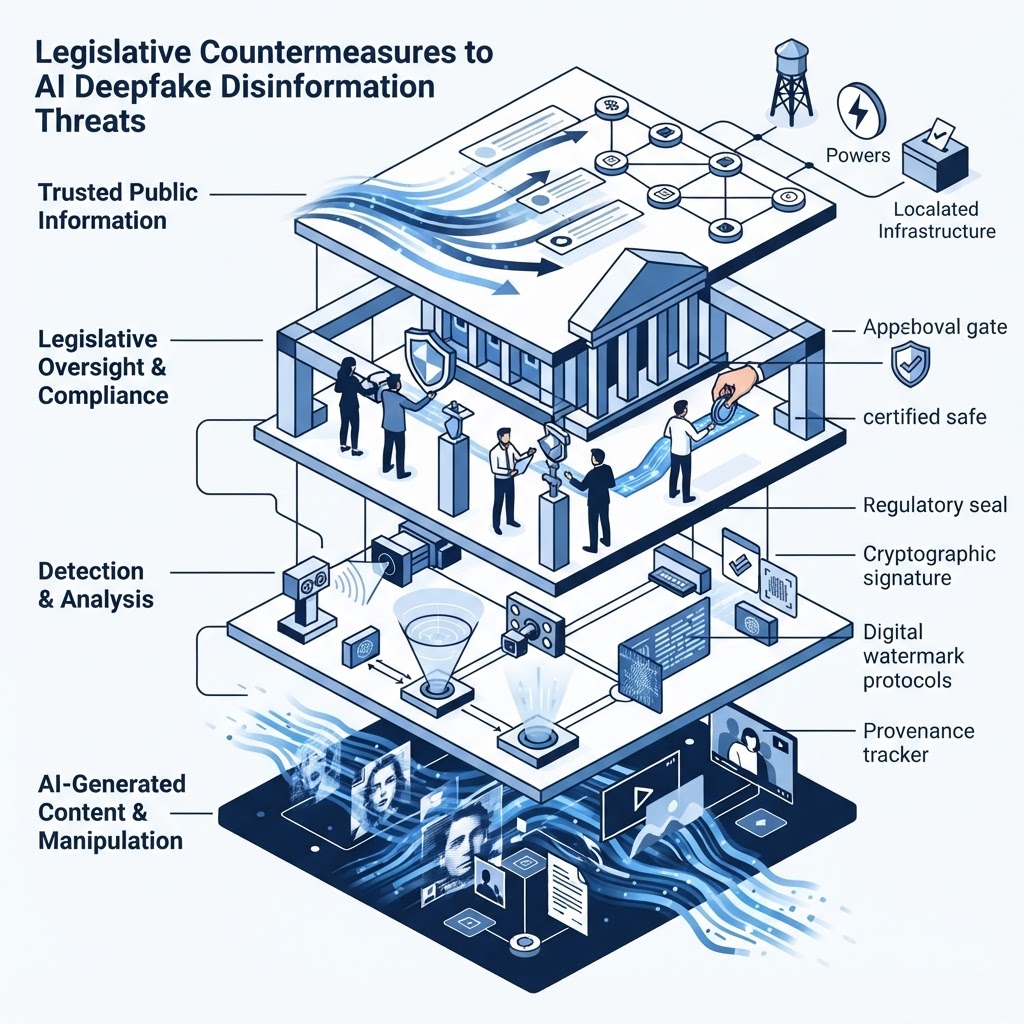
Legislative Countermeasures to AI Deepfake Disinformation Threats
The surge in AI-manipulated media has prompted aggressive legislative action aimed at curbing the proliferation of synthetic content designed to erode public trust. Italian Prime Minister Giorgi Meloni has recently taken the unprecedented step of filing to trademark her own voice as a defensive legal measure, signaling a new era of personal brand protection for high-level officials. This move mirrors broader international efforts to codify rights against unauthorized synthetic replication.
At the state level, public sentiment remains focused on restriction; recent feedback shows that nearly 3000 Californians are actively seeking stronger government intervention. This shift in public attitude is driving a movement toward an 'FDA-style' regulatory body capable of certifying the safety of frontier models before they are deployed in public-facing capacities. Such oversight is intended to ensure that advanced generative systems are not weaponized to undermine democratic processes or state-led information campaigns.
Compliance teams must now prepare for a future where standard AI acceptable use policies require explicit clauses regarding the verification and labeling of all synthetic media, ensuring that agencies maintain control over their digital communications.
How can government agencies verify the authenticity of digital communications to prevent being misled by synthetic media?
Agencies should implement digital watermarking and provenance standards consistent with the NIST AI RMF. By integrating cryptographic signatures into official communications, agencies can provide a 'source of truth' that allows the public to distinguish between authentic government releases and malicious deepfakes. Furthermore, staff should be trained in AI DLP and verification workflows to ensure that every outbound communication is authenticated against known, verified organizational media repositories before publication.
Industry Accountability and the Future of Algorithmic Governance
Major AI labs are currently under immense pressure to align their operational policies with the realities of ongoing election interference. Anthropic has recently updated its usage policy to explicitly ban model abuse and deceptive election campaigns, representing a significant step toward industry-led responsible AI governance. However, experts warn that these measures alone are insufficient without rigorous cross-agency enforcement.
Demis Hassabis of Google DeepMind has characterized recent AI security failures as 'early warning shots,' emphasizing that 2026 has been a sobering year for AI safety. For government leaders, this necessitates a proactive approach to procurement compliance, ensuring that any vendors leveraged for public communication or data analysis meet strict transparency requirements. The risk exposure for agencies that fail to govern their 'shadow AI' usage is massive, ranging from reputational damage to legal liability should an agency account be compromised by AI-driven disinformation.
By aligning with the OMB memos on responsible AI and federal guidance, agencies can build a defensible governance charter that prioritizes public trust while still allowing for the integration of necessary, safe innovation.
Managing AI Risks for State and Municipal Agencies
State and municipal agencies must address the reality that AI deepfake disinformation threats can compromise localized infrastructure and electoral reporting in real-time. The most immediate impact involves procurement; agencies must now demand 'AI-safety by design' from all technology partners, ensuring that vendors provide transparency into their training data and safety guardrails. Beyond procurement, internal staff training must be updated to include 'synthetic media awareness,' helping employees recognize the markers of AI-doctored content in official emails or public-facing social media.
Policymakers should also evaluate their current AI governance charter to identify gaps where human-in-the-loop validation is currently missing. By implementing a tiered approval process for any content generated or summarized by AI, agencies can minimize the potential for accidental spread of misinformation. Furthermore, agencies should leverage the NIST AI RMF to map their current algorithmic risks and implement data loss prevention tools that flag potential deepfake content entering the agency ecosystem.
Maintaining public trust is not merely a technical challenge, but a procedural one that requires constant vigilance and a clear, transparent policy that is communicated to constituents as part of a wider commitment to digital security and government transparency.
Critical Actions for Responsible AI Governance
- →Mandate that all technology vendors verify compliance with NIST AI RMF standards before contract approval. • Implement mandatory watermarking for all government-produced multimedia to verify authenticity. • Establish an AI incident response team to quickly identify and debunk synthetic media threats targeting the agency. • Conduct regular 'synthetic media' training for public relations and IT security staff to increase detection capabilities. • Audit existing AI-enabled software to ensure compliance with the latest October 2026 state-level deepfake regulations. • Require explicit, documented AI acceptable use policies for all third-party models integrated into agency workflows.
What are the consequences for government agencies that fail to address AI-driven deepfake disinformation within their infrastructure?
Failure to address these threats can lead to total erosion of public trust, unauthorized dissemination of sensitive information, and legal liability under emerging state laws. Agencies may face immediate operational shutdowns if AI-doctored media compromises internal systems, as seen in recent global safety warnings. Furthermore, failing to implement sufficient safeguards can trigger regulatory audits, forcing agencies to justify their AI governance failures to legislative oversight committees and the public.
Addressing the complex challenge of AI deepfake disinformation threats requires a unified strategy that bridges the gap between legislative policy and internal technical execution. As these technologies continue to evolve, compliance leaders must prioritize transparency, verification, and robust model governance to ensure the long-term integrity of their organizations. Proactive adoption of safety frameworks is the only way to safeguard democratic institutions against the risks posed by rapidly advancing synthetic media.
Sources
- Anthropic changes usage policy to ban model abuse and election interference
- Meloni files to trademark her voice in fight against deepfakes
- Google Deepmind's Hassabis calls AI hacks 'early warning shots'
- Nearly 3000 Californians weigh in on state's approach to AI regulation
- October 2026 AI Regulation Updates Highlight Deepfake Laws and Frontier AI Frameworks
Tagged
About APEX AI Guardrails: We publish expert AI news and governance insights updated 4× daily. Our editorial team consists of retired government IT professionals, AI governance specialists, and compliance experts with deep experience in local government operations.
Related Articles
AI Governance
Mitigating AI Hallucination Risk in Government: New October 19 Federal Oversight Trends
October 19, 2026
AI Governance
Combating AI Deepfake Disinformation: How Government Agencies Can Restore Public Trust as of October 19, 2026
October 19, 2026
AI Governance
New Federal AI Systems Transparency Act Introduced Amid Growing Regulatory Pressure
October 19, 2026