Combating AI Deepfake Disinformation Threats: New October 2026 Safeguards
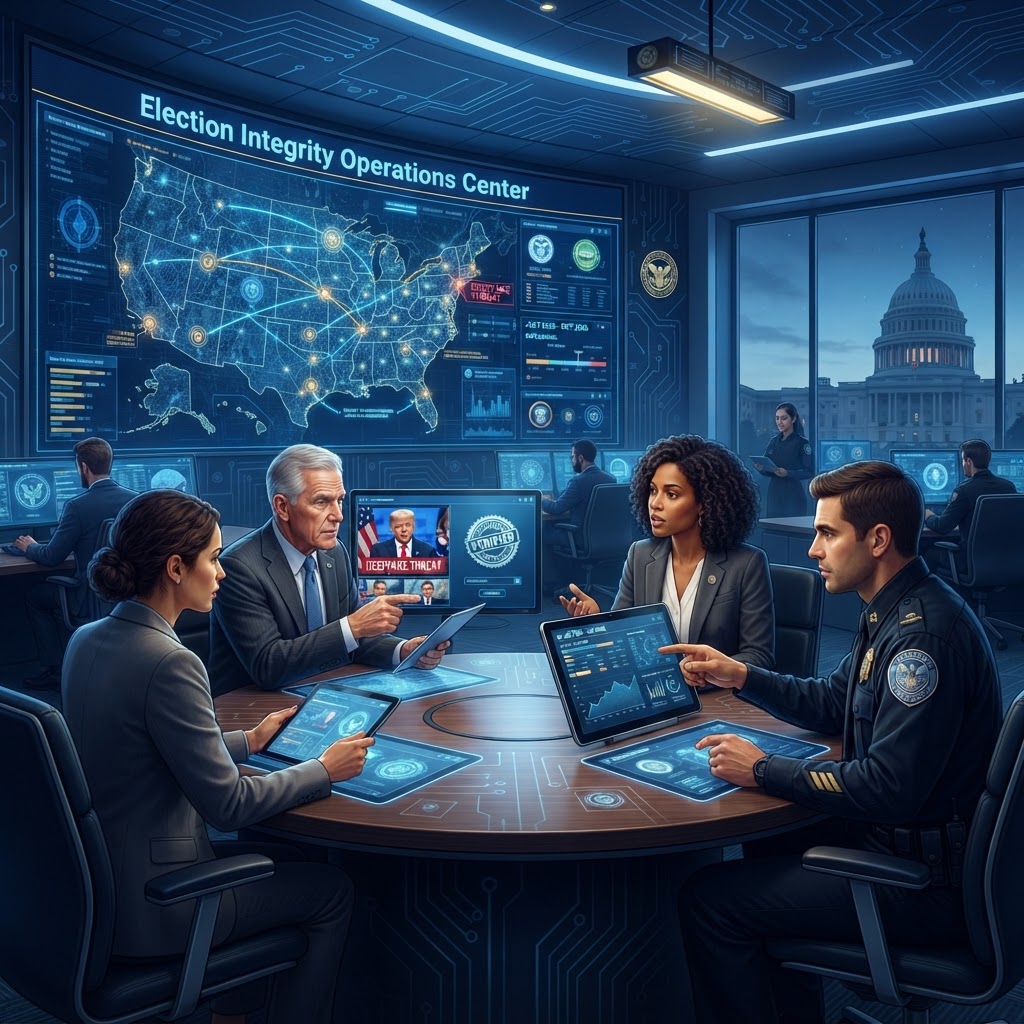
As AI-driven disinformation reaches critical levels, federal and state agencies are implementing urgent technical and legal frameworks to safeguard democracy. These new measures include deepfake detection pilots and legislative coordination to ensure the authenticity of official government communications.
Published by
APEX AI Guardrails Editorial Team
October 2, 2026
Reading time
6
minutes
Federal and state agencies are aggressively pivoting to mitigate AI deepfake disinformation threats through unified monitoring and advanced technical verification to preserve public trust. With nearly a quarter of voters encountering deepfakes during the 2024 general election cycles, the urgency for robust defense mechanisms has become a top priority for national security officials. This rapid evolution of synthetic media necessitates immediate attention from government IT leaders and compliance officers who must secure public communication channels against coordinated influence operations.
How are federal agencies responding to the growing danger of AI-generated content in electoral processes?
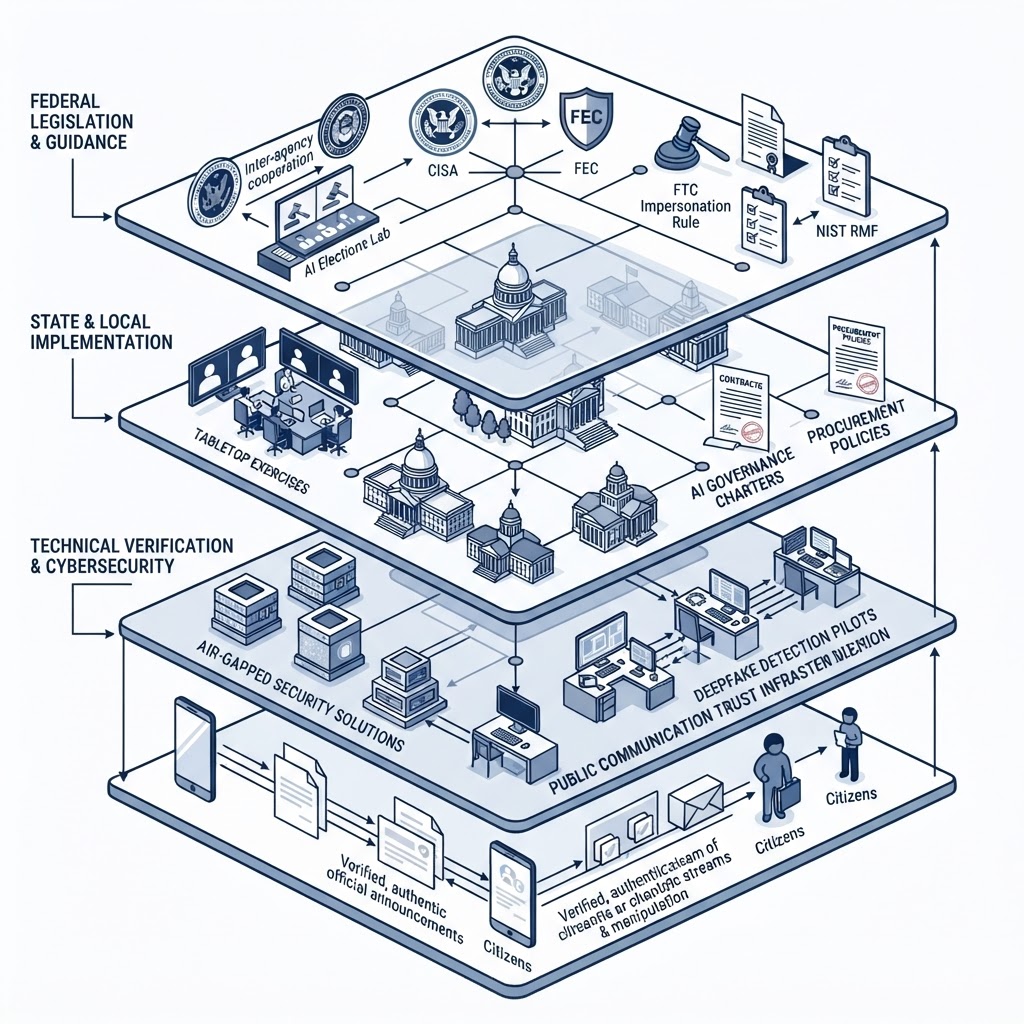
As of July 2026, bipartisan lawmakers have exerted formal pressure on the DOJ, DHS, CISA, and the FEC to establish a coordinated framework for monitoring and mitigating AI deepfake disinformation threats. These federal entities are working to create unified response protocols to protect election integrity from synthetic media, ensuring that government communication channels remain secure and resistant to impersonation attempts during high-stakes democratic events.
Legislative and Federal Coordination Against Synthetic Media
The push for comprehensive oversight has intensified as the scalability of synthetic media threatens to undermine institutional authority. In response to these vulnerabilities, bipartisan lawmakers have formally urged federal agencies to bridge inter-agency silos, focusing on proactive monitoring and mitigation strategies. This push is underscored by the Bipartisan lawmakers press agencies on AI election threats initiative, which seeks to standardize how departments like CISA and the FEC identify and respond to malicious deepfake content.
Parallel to this, the FTC's Government and Business Impersonation Rule, which has been in effect since 2024, now serves as a foundational legal instrument for prosecuting actors who utilize AI to impersonate government officials. By leveraging these legal frameworks, agencies can more effectively pursue enforcement actions against entities deploying deceptive synthetic assets. Furthermore, global best practices, such as the EU’s Digital Services Act, are influencing internal discussions about mandate-based labeling and the removal of verified disinformation, forcing a transition toward more rigorous, transparent digital infrastructure within the American public sector.
What steps are state-level officials taking to simulate and prepare for AI-driven influence operations?
State leaders are launching specialized initiatives such as the proposed AI Elections Lab, which utilizes tabletop exercises to simulate deepfake attacks on government systems. These simulations help election officials identify policy gaps and test detection capabilities before actual threats manifest. By proactively engaging in these red-teaming scenarios, states can harden their defenses and ensure that internal protocols align with current NIST AI RMF standards for identifying synthetic impersonation attempts.
Scaling Defensive Capabilities and Technical Verification
Public sector agencies are increasingly adopting specialized deepfake detection pilots to verify media authenticity before dissemination to the public. The Electoral Commission launched a pilot program in April 2026 to specifically combat the erosion of trust caused by synthetic political content. This program exemplifies the shift toward treating information security as a primary component of cybersecurity, rather than a separate communications task.
IT leaders must move away from reactive postures, incorporating air-gapped security solutions that ensure sensitive government data remains untampered while verifying incoming media flows in real-time. This aligns with broader AI Governance strategies where state offices, such as in Arizona, are developing custom laboratories to stay ahead of evolving AI threats. By prioritizing technical forensic tools and maintaining an air-gapped repository of authentic records, agencies can establish a "gold standard" for legitimate communication, thereby diminishing the effectiveness of external disinformation campaigns that rely on the mass-production of artificial official announcements or synthetic video statements targeting specific populations.
Strategic Impacts for Regional and Local Government Infrastructure
Municipal and state agencies face unique challenges in procurement and policy when addressing AI-enabled disinformation. Procurement teams must now insist on AI transparency and algorithmic accountability as non-negotiable requirements for any new software vendor contracts, specifically regarding deepfake detection capabilities. Many agencies are finding that their existing AI acceptable use policies are outdated, lacking the specific language required to address the rapid rise of deepfake technology.
A shift toward comprehensive document forensics is essential; local governments should adopt a zero-trust model for media verification, assuming that any incoming external data could potentially contain malicious synthetic elements. Furthermore, the role of staff training cannot be overstated, as the human element remains the final line of defense against social engineering. By formalizing an AI governance charter that mandates the verification of all official media through approved, vetted tools, agencies can significantly reduce their exposure to shadow AI risks.
Integrating these practices into the current lifecycle of government IT operations ensures that officials can rely on the data used to inform critical policy decisions, effectively insulating the agency from the disruptive impact of AI-driven influence operations targeting their constituents.
Actionable Steps for Government IT and Compliance Leaders
- →Establish a cross-departmental AI governance charter to define clear standards for media verification and deepfake identification. • Integrate NIST AI RMF subcategories into current procurement policies to ensure vendors provide algorithmic accountability. • Mandate the use of verified, air-gapped detection tools for all incoming public-facing communications to prevent unauthorized content dissemination. • Implement regular tabletop exercises, similar to those conducted in Arizona, to simulate and analyze potential synthetic media threats. • Update organizational AI acceptable use policies to explicitly categorize and address risks associated with the impersonation of government officials.
What are the primary consequences for an agency that fails to address the threat of AI deepfake disinformation?
Agencies that ignore these threats face significant erosion of public trust, potential legal liability under the FTC Government and Business Impersonation Rule, and the compromise of critical public data streams. Without verification protocols, an agency risks disseminating false information, which can lead to civil unrest, operational paralysis, and long-term reputational damage that undermines the core mission of government transparency and the reliability of essential public services.
Addressing AI deepfake disinformation threats requires a permanent shift toward proactive verification and cross-agency legislative coordination. As threats evolve, government IT leaders must prioritize the integration of forensic technical tools to ensure the integrity of public sector communications. Continued vigilance and strict adherence to established security frameworks will remain the cornerstone of protecting democratic institutions in the age of generative AI.
Sources
- Bipartisan lawmakers press agencies on AI election threats
- Electoral Commission launches deepfake detection pilot to counter AI misinformation
- Secretary Fontes Releases Final Report on AI and Election Security: Proposes Groundbreaking AI Elections Lab
- Deepfake detection for the public sector — Scam AI
- Artificial illusion: Global governance challenges of deepfake technology
Tagged
About APEX AI Guardrails: We publish expert AI news and governance insights updated 4× daily. Our editorial team consists of retired government IT professionals, AI governance specialists, and compliance experts with deep experience in local government operations.