
August 23, 2026: Scaling the NIST AI Risk Management Framework Across SLED Agencies
This strategic guide explores how state, local, and educational agencies are transitioning the NIST AI Risk Management Framework from a voluntary guideline into a mandatory pillar of public sector procurement and operational safety.
Published by
APEX AI Guardrails Editorial Team
August 23, 2026
Reading time
7
minutes
State and local government agencies are rapidly institutionalizing the NIST AI Risk Management Framework as the primary standard for ensuring algorithmic accountability and public safety. With 65 percent of SLED leaders identifying governance as the leading obstacle to technological modernization, the shift toward a structured risk posture is no longer optional for those seeking to maintain public trust. For government IT and compliance directors, implementing this framework is now a prerequisite for securing federal grants and passing state-level audits.
How are state and local governments currently integrating the NIST AI Risk Management Framework into their software procurement cycles as of 2026?
SLED agencies are now embedding the NIST AI RMF into RFPs by requiring vendors to provide risk mapping documentation and third-party attestations. This integration ensures that any AI-enabled tool—from automated traffic management to school district administrative assistants—aligns with the 'Govern' and 'Map' functions of the framework. According to recent guidance on NIST AI RMF for Government: Implementation Guide, this step-by-step approach significantly reduces the likelihood of deploying biased or insecure models in public services.
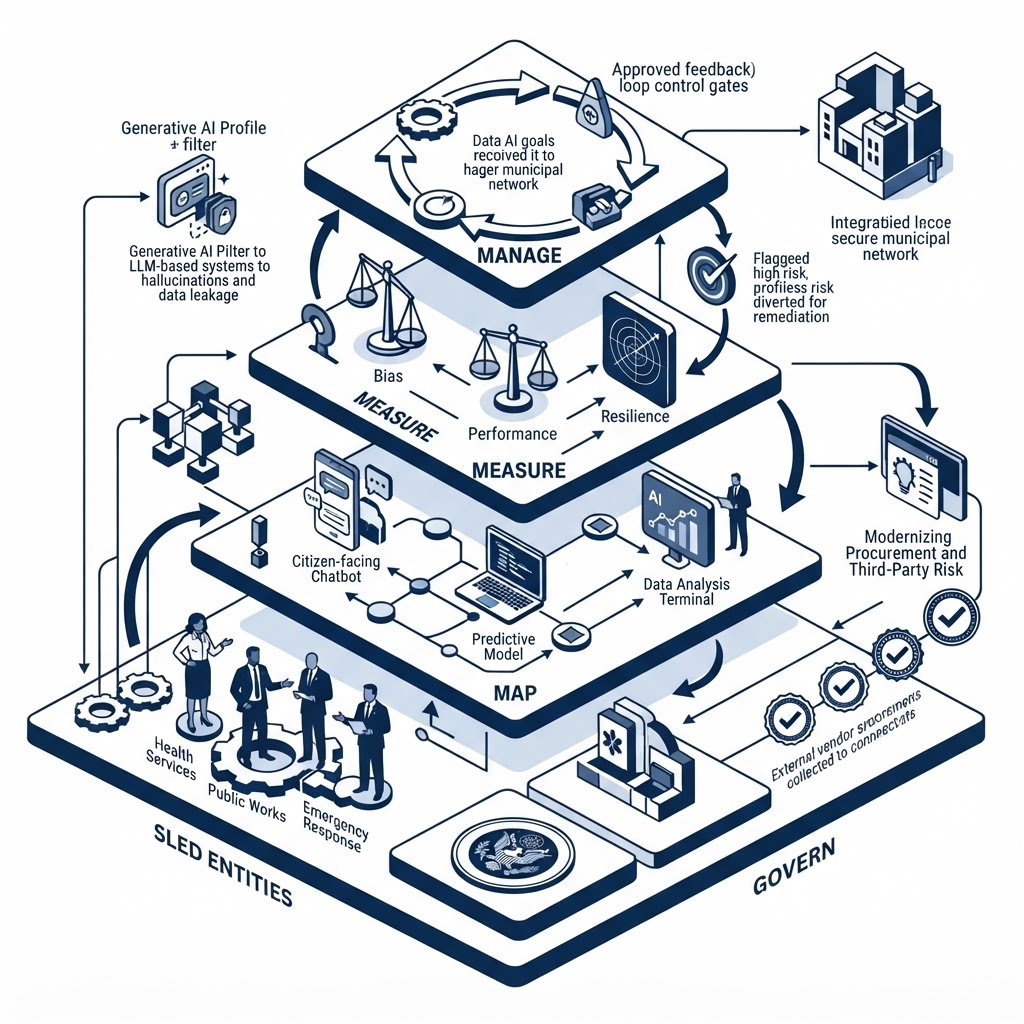
Operationalizing the NIST AI Risk Management Framework Within Public Sector Workflows. The transition from viewing the NIST AI Risk Management Framework as a voluntary suggestion to a core component of agency operations has accelerated throughout 2026. This shift is driven by the need for a unified language to describe AI risks across disparate departments, from health services to public works. By utilizing the four core functions—Govern, Map, Measure, and Manage—SLED entities are creating a reproducible cycle of oversight. The 'Govern' function establishes the necessary organizational culture, while 'Map' allows teams to identify the specific context in which an AI system will operate. This contextual awareness is critical because an AI tool used for library cataloging carries a significantly different risk profile than one used in predictive policing or emergency response. Furthermore, agencies are increasingly integrating the specific Generative AI Profile released by NIST to address the unique vulnerabilities of Large Language Models (LLMs). This profile helps IT leaders manage the risks associated with prompt injection, data leakage, and the 'hallucinations' that can occur when public servants utilize third-party vendor tools. By adopting these sector-specific implementation strategies, agencies are effectively moving beyond theoretical ethics into the realm of technical enforcement and persistent monitoring.
What specific steps should a municipal IT department take to map generative AI risks using the latest NIST profiles?
To effectively map generative AI risks, municipal IT departments should first identify the specific use cases—such as citizen-facing chatbots or internal data analysis—and then cross-reference these against the NIST Generative AI Profile. This involves cataloging data dependencies, evaluating the potential for biased outputs, and establishing a clear AI acceptable use policy. Agencies must ensure that these mapping activities are documented to satisfy growing demands for AI transparency and to facilitate future audits by state regulatory bodies.
Bridging the SLED Governance Gap Through Standardized AI Playbooks. Despite the clear benefits of automated systems, the governance gap remains a formidable hurdle, with a majority of SLED leaders citing it as their primary barrier to adoption. To bridge this gap, many jurisdictions are leveraging the NIST AI RMF Playbook to standardize compliance across diverse state and local departments. This standardization is vital for interoperability, ensuring that a county's AI data protection standards align with state-level mandates and federal benchmarks. Because NIST continues to engage with stakeholders to refine the framework, practitioners are encouraged to provide feedback that shapes future revisions, making the framework a living document that evolves alongside the technology. Alignment with the White House AI Action Plan has also become a priority, as federal funding is increasingly tied to the demonstration of responsible AI practices. Local governments that can prove adherence to NIST standards are finding it easier to justify their AI investments to both taxpayers and federal grant-making bodies. This alignment also helps in mitigating 'shadow AI,' where departments might procure tools without centralized IT oversight, by providing a clear, agency-wide AI governance charter that defines the rules of engagement for all employees and contractors.
Modernizing Procurement and Third-Party Risk for Local Jurisdictions. The impact on counties, municipalities, and state agencies is most visible in the total overhaul of procurement and third-party risk management (TPRM). As agencies rely more heavily on external vendors for AI capabilities, the NIST AI Risk Management Framework has become the base layer for compliance, with the FTC and SEC referencing its principles in various enforcement actions. This means that a local agency's failure to vet a vendor's AI model according to NIST standards could result in legal liability if that model causes harm or violates privacy laws. As noted in The NIST AI RMF and Third-Party Risk, the framework is now viewed as a foundational regulatory requirement rather than just a best practice. Procurement officers are now trained to look for 'AI transparency' labels and specific risk assessments that follow the 'Measure' and 'Manage' functions. This heightened scrutiny ensures that vendor-supplied models are not only performant but also resilient and fair. Additionally, financial institutions and other critical infrastructure sectors are adopting sector-specific guidance built directly upon the RMF, creating a ripple effect that forces government contractors to elevate their security standards. For SLED agencies, this means that the software ecosystem they inhabit is becoming more secure by default, provided they remain diligent in their implementation of the framework’s core pillars.
Strategic Roadmap for Future-Proofing Public Sector AI Compliance. • Establish a formal AI Governance Charter that designates roles for risk owners and defines acceptable use cases for all agency staff. • Conduct a comprehensive inventory of all current AI deployments to identify and mitigate 'shadow AI' risks that may exist outside of centralized IT. • Integrate the NIST 'Map' function into the earliest stages of the procurement lifecycle to ensure vendor models are evaluated before contracts are signed. • Implement AI Data Loss Prevention (DLP) tools to monitor for sensitive government data being entered into third-party generative AI platforms. • Participate in NIST engagement sessions to stay informed of upcoming framework revisions and to contribute to the evolution of public sector AI standards. • Regularly audit third-party AI models for algorithmic bias and performance drift using the metrics established in the 'Measure' function of the RMF.
Which regulatory penalties might SLED agencies face if they fail to align their AI deployments with established NIST safety standards?
While the NIST AI RMF is technically voluntary, it is increasingly cited by the FTC and state attorneys general as a benchmark for 'reasonable' security and consumer protection. Failure to align with these standards can lead to significant legal exposure, including civil penalties for discriminatory outcomes or privacy violations. Furthermore, non-compliance may result in the loss of federal funding or the revocation of authority to operate in shared state-federal data environments.
The NIST AI Risk Management Framework has evolved into the indispensable bedrock of modern SLED governance and procurement. As we move deeper into 2026, the ability to operationalize these risk functions will define which agencies succeed in their digital transformation and which ones succumb to the complexities of algorithmic liability. Compliance leaders must act now to bridge the governance gap and ensure their agency's AI strategy is both resilient and ethically sound.
Tagged
About APEX AI Guardrails: We publish expert AI news and governance insights updated 4× daily. Our editorial team consists of retired government IT professionals, AI governance specialists, and compliance experts with deep experience in local government operations.