
AI Transparency Government Decision Making: New September 2026 Legislative Updates
As of September 2026, state and international regulators are rapidly shifting toward mandatory AI transparency for public sector operations. These new frameworks impact how agencies evaluate, procure, and deploy generative AI tools.
Published by
APEX AI Guardrails Editorial Team
September 30, 2026
Reading time
6
minutes
New state and global regulations are codifying requirements for AI transparency government decision making to ensure accountability in public service. As of September 2026, jurisdictions from California to the European Union have enforced stricter oversight for automated systems. For government IT leaders, this shift necessitates a transition from voluntary ethics to rigid, legally-mandated compliance frameworks for all public-facing AI tools.
How are new state-level AI laws in the US changing procurement requirements for government agencies?
As of September 2026, states like California, Texas, Illinois, and Utah have implemented comprehensive AI regulations that mandate specific transparency disclosures for vendors. According to US AI regulation update, September 2026, these laws force agencies to perform rigorous impact assessments before procurement. Public sector organizations must now integrate these legal requirements into their request for proposal (RFP) processes to ensure all AI tools meet localized safety and explainability standards.
State-Level Shifts in Educational AI and Public Policy
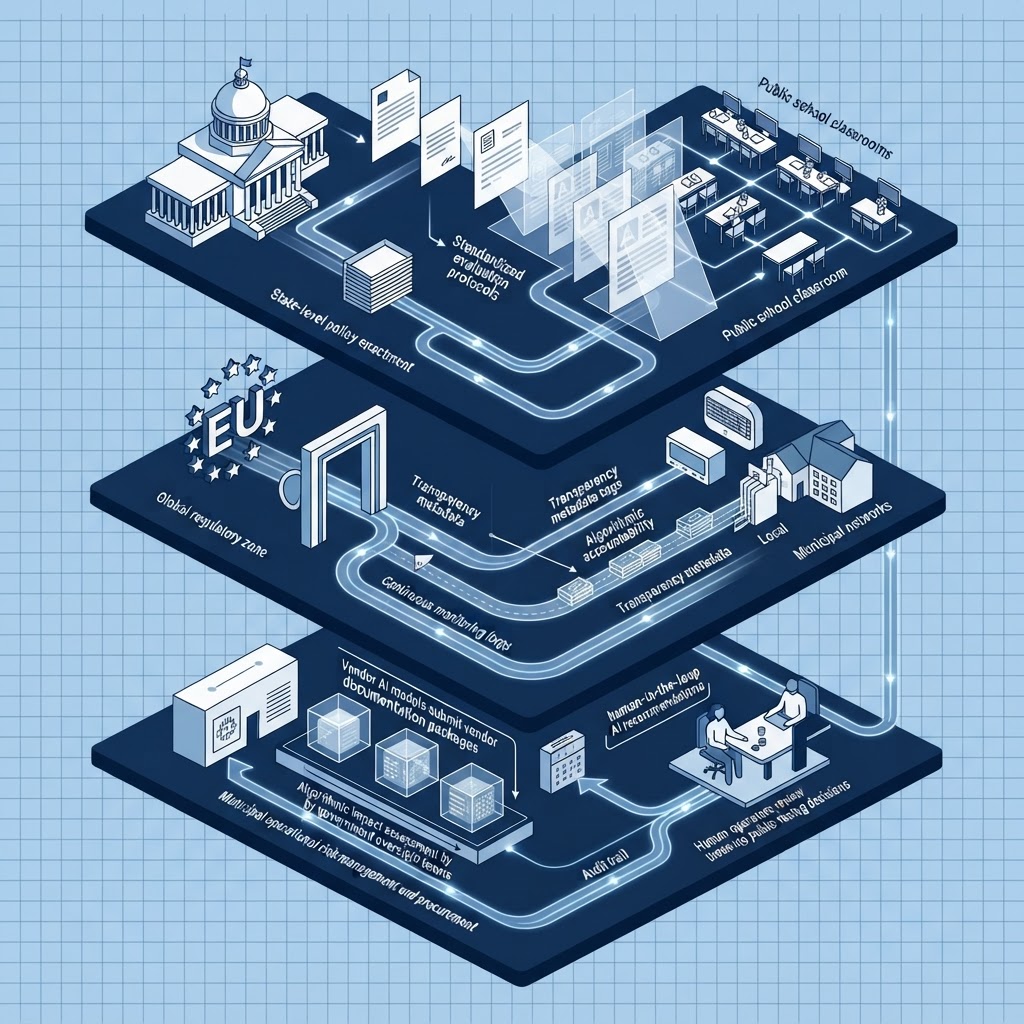
The regulatory landscape for AI transparency government decision making is increasingly defined by granular state-level actions, particularly in the education sector. North Carolina is leading this trend with the introduction of H 301, which compels the Department of Public Instruction to establish a formal model AI policy and a structured framework for evaluating generative AI tools in public schools, as reported by the AI Legislative Update: September 25, 2026. This move reflects a broader national transition toward structured oversight, moving away from fragmented, ad-hoc technology adoption.
By creating a standardized evaluation protocol, North Carolina aims to mitigate risks associated with shadow AI and ensure that all classroom technologies align with state security mandates. These policy frameworks serve as a bellwether for other SLED entities, demonstrating how legislative intervention can provide the necessary guardrails for responsible AI integration. Agencies are now required to demonstrate a clear audit trail for any generative tool used in public administration, ensuring that decision-making processes remain objective and explainable to stakeholders, taxpayers, and oversight bodies.
What steps must public agencies take to align with the new EU AI Act transparency mandates?
Agencies must categorize their AI systems based on risk and enforce the documentation requirements outlined in Article 50 of the EU AI Act. Following the Commission's enforcement start on August 2, 2026, providers and deployers must clarify their distinct responsibilities. Compliance teams should implement technology-neutral standards, ensure metadata transparency, and maintain granular logs for all high-risk automated decision-making processes to satisfy EU administrative oversight requirements.
Aligning Global Standards with Localized AI Deployment
Global regulatory pressure, particularly from the European Union, is reshaping expectations for domestic AI transparency government decision making. Since the European Commission began enforcing new AI Act rules and transparency requirements on August 2, 2026, the global emphasis has shifted toward the clear delineation of responsibilities between technology providers and public sector deployers, a move supported by industry stakeholders like BSA in their input on Article 50 guidelines. This development highlights the necessity for technology-neutral implementation that does not stifle innovation while maintaining strict algorithmic accountability.
For government IT leaders, the focus is on achieving interoperability in transparency metadata, ensuring that if an AI system facilitates a public benefit determination or legislative analysis, the logic behind that output can be audited. Experts argue that proportionate transparency—where the depth of disclosure matches the level of risk—is essential for balancing technological advancement with public trust. By adopting these international benchmarks, domestic state and local agencies can prepare for a future where cross-border data and AI service agreements become the standard, thereby reducing long-term compliance friction and preventing the siloed development of incompatible, non-transparent AI architectures.
Managing Operational Risk in Municipal and State Agencies
The operational reality for counties, municipalities, and state agencies involves managing the intersection of vendor-supplied AI and agency-controlled deployment policies. Procurement teams must now prioritize transparency during the vendor vetting process, shifting the burden of explainability onto the software provider before contract signing. This involves moving beyond surface-level security audits to demand documentation that explains how models were trained, the limitations of their decision-making logic, and how they handle sensitive citizen data.
Agencies failing to establish these internal controls face increasing exposure to regulatory scrutiny and public distrust if an AI-driven service yields biased or inaccurate outcomes. Furthermore, staff training is becoming a critical component of institutional risk management; employees must understand when and how to override an AI recommendation, ensuring that humans remain the final authority in public service delivery. The gap between purchasing a high-performing AI model and maintaining its operational transparency can be closed by integrating AI DLP (Data Loss Prevention) measures and continuous performance monitoring.
By treating AI governance as a core component of digital infrastructure rather than a bolt-on IT feature, agencies can build resilient systems that withstand evolving legislative demands while fostering public confidence in automated public services.
Strategic Priorities for Compliance and Governance Teams
- →Establish a centralized AI governance charter that clearly defines the roles of the 'deployer' vs the 'provider' for all third-party tools. • Perform mandatory algorithmic impact assessments prior to the procurement of any system categorized as high-risk by state guidelines. • Update procurement RFPs to require vendor disclosure of model limitations, training data provenance, and explainability mechanisms. • Implement continuous monitoring protocols for generative AI outputs to detect bias, hallucinations, or unauthorized data usage. • Standardize AI acceptable use policies that mandate human-in-the-loop oversight for all automated public-facing decisions. • Collaborate with legal counsel to map current operational procedures against the latest requirements from the EU AI Act and state legislation like North Carolina's H 301.
What are the primary consequences for government agencies that fail to meet new transparency and explainability standards?
Failure to comply with emerging mandates can lead to significant legal liability, loss of federal funding, and severe reputational damage. As shown by the enforcement of the EU AI Act, regulators are prepared to impose strict penalties for non-transparent decision-making systems. Agencies may face court-ordered shutdowns of AI-powered services, intensive external audits, and the total invalidation of automated administrative decisions that lack documented explainability, resulting in costly operational disruptions and potential civil rights litigation.
The acceleration of AI transparency government decision making is transforming how public entities approach technology risk and public accountability. As global and state-level frameworks continue to mature, the ability to demonstrate, audit, and explain AI-driven results will become a prerequisite for continued operation. Compliance leaders must proactively adopt these transparency standards today to ensure that their digital transformation efforts remain both legally defensible and worthy of the public trust.
Sources
- AI Legislative Update: September 25, 2026 — Transparency ...
- Commission starts enforcing AI Act rules and new transparency requirements on 2 August
- BSA’s Input to the European Commission’s Targeted Consultation on the Draft Guidelines on Article 50 (Transparency) of the EU AI Act
- US AI regulation update, September 2026: laws, policy, and ...
Tagged
About APEX AI Guardrails: We publish expert AI news and governance insights updated 4× daily. Our editorial team consists of retired government IT professionals, AI governance specialists, and compliance experts with deep experience in local government operations.