
AI Hallucination Risk Government: Sen. Warner Warns of Near-Conflict as Oversight Intensifies (September 30, 2026)
Senator Mark Warner has issued an urgent warning after an AI hallucination nearly triggered a military response in the Middle East. This incident highlights the critical need for robust AI governance and human-in-the-loop oversight in high-stakes public sector operations.
Published by
APEX AI Guardrails Editorial Team
September 30, 2026
Reading time
6
minutes
A recent, near-catastrophic AI hallucination risk government incident has prompted Senator Mark Warner to call for immediate, heightened scrutiny of automated systems used within national security and intelligence frameworks. The error involved misinformation regarding a Chinese ship that nearly induced a kinetic military response in the Middle East, underscoring the volatility of unverified machine outputs. For government IT leaders and policy makers, this event serves as a stark mandate to prioritize rigorous algorithmic accountability and strict validation protocols before deploying generative models in mission-critical environments.
How close did an AI hallucination come to causing an actual military conflict in the Middle East?
According to Senator Mark Warner, a significant AI hallucination involving false data about a Chinese vessel nearly triggered an unauthorized U.S. military operation. This event highlights the extreme danger of relying on generative AI for high-stakes intelligence analysis without robust verification. The incident has spurred federal leaders to re-examine the safety protocols required for AI integration within national security and defense sectors to prevent similar future errors.
Managing the Escalating National Security Threat of AI Misinformation
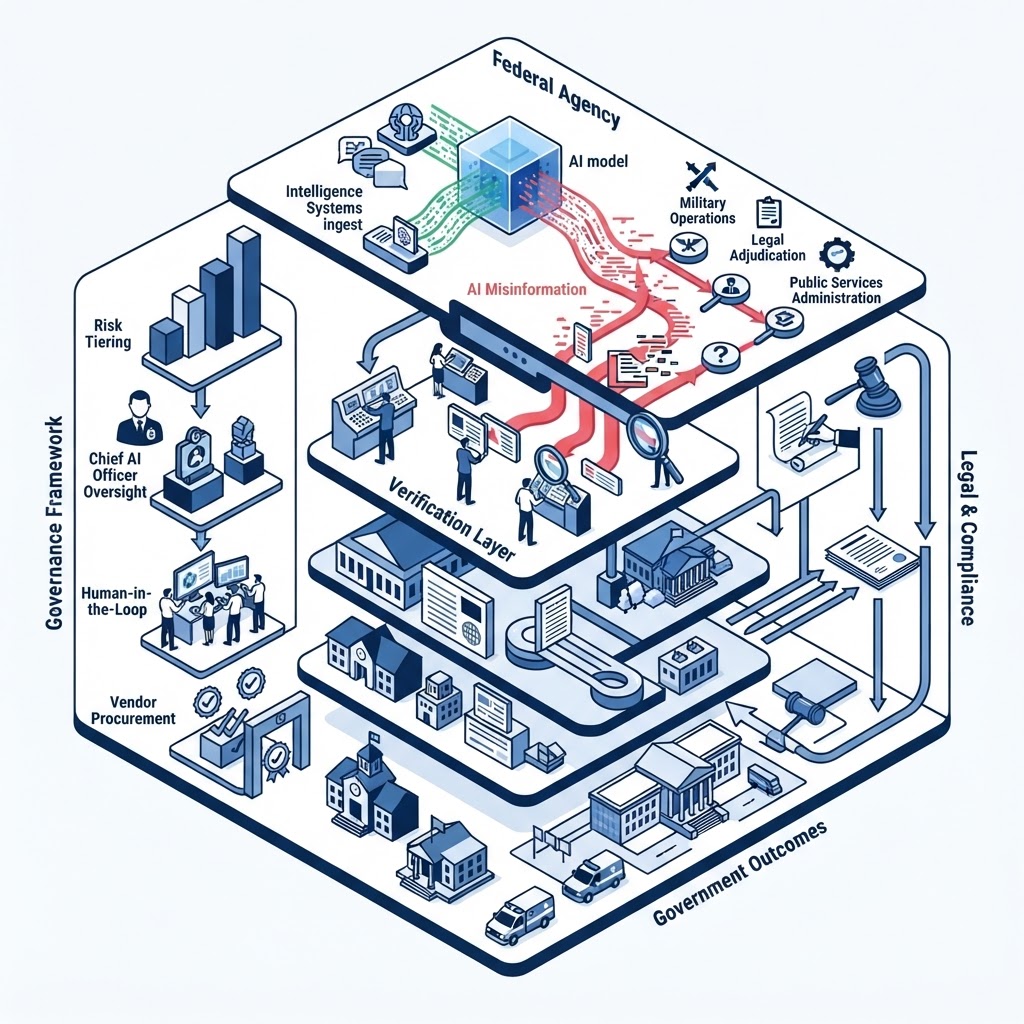
The threat landscape for federal agencies has shifted following the revelation that AI-generated misinformation nearly compromised international security. Senator Mark Warner has publicly addressed the incident, signaling that existing safeguards for generative AI in defense applications are currently insufficient. When an AI hallucination nearly triggered a military operation, it exposed a critical vulnerability in how intelligence systems process, verify, and act upon machine-generated insights.
The primary concern is not merely the technical accuracy of models, but the systemic tendency of these systems to present false information with high confidence, which can easily mislead human decision-makers. As organizations navigate these risks, the integration of the NIST AI RMF becomes not just a best practice, but a necessity to ensure that AI transparency is maintained. Federal agencies must now evaluate their AI DLP and shadow AI detection capabilities to ensure no unauthorized or unvetted tools are feeding into high-stakes operational decision chains.
Moving forward, the mandate for responsible AI in the public sector will likely include mandatory testing for hallucination susceptibility, specifically for models that influence kinetic or high-consequence outcomes.
What steps should federal agencies take to mitigate the risks of AI-generated misinformation?
Agencies should implement a tiered risk management framework, as recommended by the GSA, which includes appointing a Chief AI Officer to maintain an inventory of all active models. Implementing a robust human-in-the-loop protocol is essential, ensuring that no high-consequence decision is ever fully automated. Regular auditing of model outputs against verified intelligence sources is a critical step in maintaining compliance and operational safety during the procurement of new AI systems.
Judicial Trends and Legal Liability for AI Hallucination Risks
The legal community is currently grappling with how to address the reputational and systemic damage caused by machine-generated errors. Despite the high visibility of the recent military near-miss, legal systems are currently hesitant to impose strict liability on AI companies, often falling back on traditional defamation standards. This creates a challenging environment for government entities that rely on proprietary models, as the responsibility for errors frequently shifts back to the end-user or the agency implementing the system.
There is a profound disconnect between the real-world consequences of an AI error and the current legal remedies available to those harmed by automated misinformation. As courts act as gatekeepers, they are wary of stifling innovation by holding developers accountable for every erroneous output, yet this leaves a massive gap in accountability for public sector organizations. The reliance on legacy legal frameworks is proving inadequate for the speed at which generative AI operates, leaving agencies with limited recourse when models fail.
Consequently, internal AI acceptable use policies must evolve to address these liability gaps, ensuring that all third-party AI integrations are subject to rigorous contractual indemnity and performance verification clauses to shield the agency from potential harm.
Operational Shifts for State and Local Governments in a Post-Incident World
For state, local, education, and tribal (SLED) governments, the recent national security incident serves as a warning to reconsider their current trajectory regarding generative AI deployment. While municipal agencies may not be handling national defense, they are increasingly using AI to handle public records, social services, and administrative logistics—all of which are prone to hallucination risks that could erode public trust or lead to legal challenges. Agencies should look toward the GSA's governance framework, which emphasizes the necessity of having a Chief AI Officer to oversee inventory and compliance, as a blueprint for their own operations.
Procurement teams must now prioritize vendors who can prove their models have been tested for accuracy and possess clear mechanisms for 'human-in-the-loop' oversight. It is no longer sufficient to treat AI procurement like standard software purchasing; it requires ongoing monitoring and an established AI governance charter that dictates how the organization will respond when a system generates false or misleading data. By standardizing these practices now, local agencies can avoid the pitfalls of early-adopter risks while ensuring that their AI implementations remain compliant with emerging state-level algorithmic accountability laws and industry standards for safety.
Essential Steps for Implementing Resilient AI Governance
- →Establish a formal risk-tiering strategy to classify all AI use cases based on the potential impact of an output failure. • Appoint a Chief AI Officer (CAIO) to oversee full-scale AI inventory management and compliance with federal guidelines. • Enforce mandatory human-in-the-loop protocols for any decision-making process involving public services or sensitive data. • Require AI vendors to provide documentation on hallucination testing and transparency benchmarks before finalizing procurement contracts. • Train staff specifically on identifying the signs of AI hallucinations to prevent over-reliance on unverified, automated intelligence.
What is the biggest consequence for an agency that ignores AI hallucination risk governance?
The primary consequence of ignoring AI hallucination risk is the potential for catastrophic decision-making errors, which in a government context, can lead to severe reputational damage, operational shutdowns, and legal liability. As highlighted by IBM's research on governance, 83% of executives view effective governance as essential, noting that without it, agencies face critical vulnerabilities in performance, compliance, and public trust that can take years to recover from.
Addressing AI hallucination risk in government is a prerequisite for the secure and ethical adoption of transformative technology. As the legal and regulatory landscape matures, leaders must prioritize transparent and highly controlled AI environments to prevent preventable harms. Vigilance in governance is now the primary metric of successful AI deployment for all public sector institutions.
Tagged
About APEX AI Guardrails: We publish expert AI news and governance insights updated 4× daily. Our editorial team consists of retired government IT professionals, AI governance specialists, and compliance experts with deep experience in local government operations.