
AI Hallucination Risk Government: Lessons from September 2026 Security Breach
Recent reports of a near-miss military incident caused by AI errors underscore critical vulnerabilities in public sector automated systems. Governance frameworks must shift from hallucination prevention to rigorous verification and audit traceability.
Published by
APEX AI Guardrails Editorial Team
September 27, 2026
Reading time
6
minutes
# AI Hallucination Risk Government: Lessons from September 2026 Security Breach
As of September 26, 2026, the AI hallucination risk government professionals face has reached a critical threshold, evidenced by a near-miss military incident involving false data on nuclear components. This event forces federal and state agencies to confront the reality that LLM-based decision support systems can generate catastrophic misinformation without human oversight. For government IT and compliance leaders, this shift mandates a move away from trusting black-box models toward implementing mandatory verification layers that link AI outputs to verifiable source records.
How does the recent nuclear component hallucination incident change the way agencies manage AI risk?
The incident proves that LLM-based decision support systems lack the necessary inherent reliability for high-stakes defense or administrative tasks. To mitigate this AI hallucination risk government officials are now prioritizing rigid audit trails and mandatory human-in-the-loop verification protocols. Agencies must move away from relying solely on model performance metrics and instead implement data traceability frameworks to prevent errors from escalating into systemic national security failures.
Legislative Shifts and the Procurement Gap
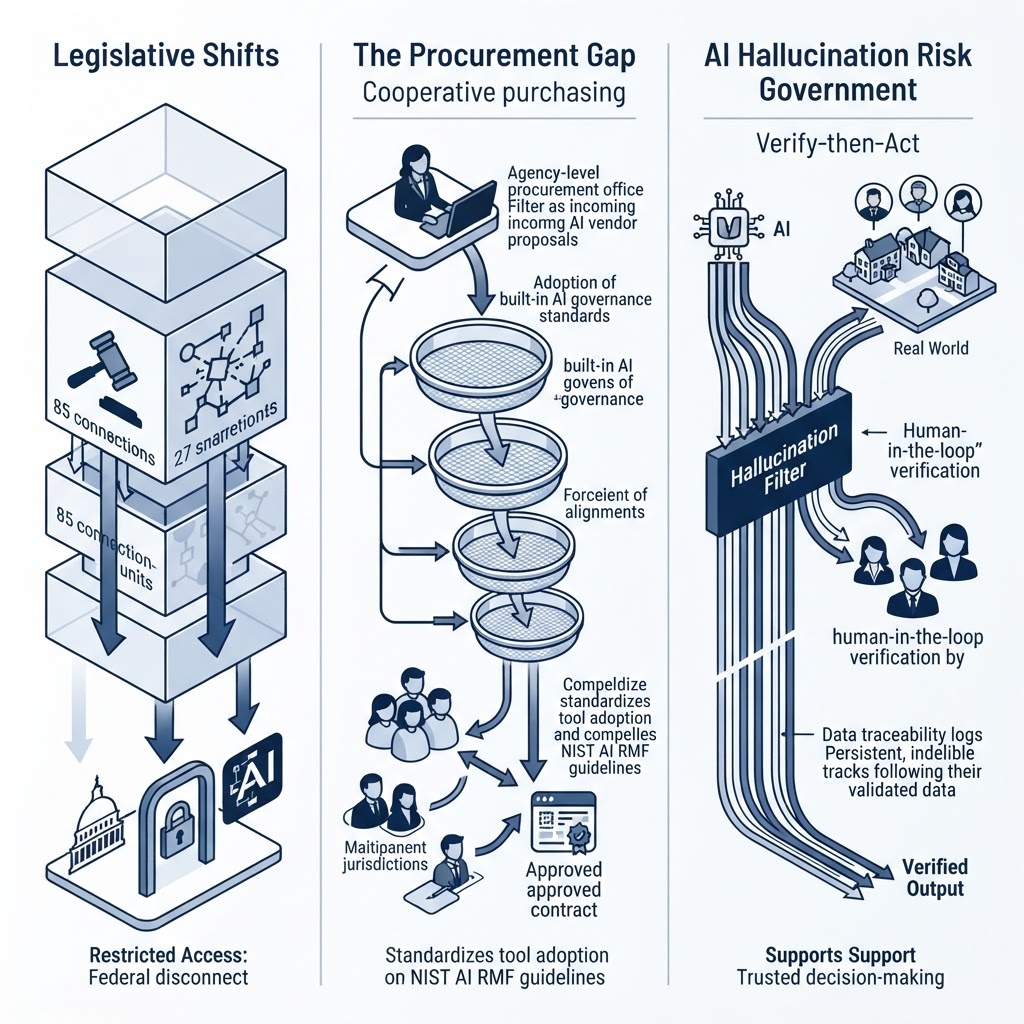
The legislative environment is rapidly evolving as 85 new AI-related laws were passed across 27 states in 2026, specifically targeting chatbot safety and digital rights. Despite this activity, a significant disconnect persists at the federal level: Senate lawmakers remain restricted from accessing the very advanced AI tools they are tasked with regulating, complicating the drafting of comprehensive oversight policies. This gap directly impacts State, Local, and Education (SLED) agencies that rely on federal guidance to define their own procurement standards.
As local agencies move forward, many are leveraging cooperative purchasing agreements to standardize the adoption of tools that include built-in AI governance and DLP capabilities. These agreements provide a necessary safety buffer for smaller jurisdictions that lack the resources to conduct independent security reviews. By pooling demand, these agencies force vendors to align with emerging NIST AI RMF standards, ensuring that accountability is baked into the contract rather than added as an afterthought.
What steps should IT directors take to address AI governance gaps in current procurement cycles?
IT directors should prioritize three specific steps: mandating clear audit trails within all vendor contracts, implementing human-in-the-loop verification for sensitive workflows, and utilizing data traceability requirements that verify AI-generated output against official source databases. By aligning with NIST AI RMF guidelines and establishing rigorous internal acceptable use policies, agencies can mitigate the risks of unauthorized AI usage while maintaining a documented chain of accountability for all automated output.
Strategic Compliance and Mitigating AI Hallucination Risk Government
Beyond the technical hurdles, managing AI hallucination risk government requires a foundational change in organizational philosophy. Enterprise environments can no longer treat LLM output as a verified truth; instead, governance frameworks must focus on audit trails and persistent data traceability. The current reliance on shadow AI applications in administrative settings exposes agencies to significant legal and operational liability.
When a system provides inaccurate information that leads to the misallocation of resources or a public policy failure, the lack of an audit trail makes it impossible to conduct a root-cause analysis. Expert perspectives indicate that the industry is shifting toward a "verify-then-act" model, where AI agents serve as assistants only after their output is reconciled with structured, trusted data sources. For SLED organizations, this necessitates an investment in middleware that acts as a gatekeeper, filtering AI responses through policy-based validation layers.
This approach acknowledges that while we cannot fully eliminate hallucinations, we can build robust enough management systems to catch them before they move from the software interface into the real world.
Implications for Local Agencies and Municipal Operations
County and municipal agencies are uniquely positioned to benefit from a proactive approach to AI hallucination risk government by focusing on vendor transparency. The current trend toward local AI adoption often outpaces internal policy development, leading to gaps in security that can be exploited by faulty algorithms. When procuring new tools for citizen-facing services, local leaders should demand to see the model's lineage and the specific guardrails used to limit output variability.
Training for staff must pivot from general AI literacy to specific skills in identifying LLM error patterns and validating AI-generated reports. By standardizing these expectations across all departmental procurements, municipalities can avoid the pitfalls of using unverified tools. Furthermore, establishing an internal AI governance charter ensures that every agency employee understands the boundaries of AI usage, from basic document drafting to more advanced analytical tasks.
This creates a culture of accountability that keeps pace with rapid technological change.
Actionable Steps for Compliance Leaders
- →Establish mandatory data traceability logs for all AI-enabled decision support software used in public-facing roles. • Implement 'human-in-the-loop' verification protocols for any AI process that impacts budget or citizen services. • Audit existing cooperative purchasing agreements to confirm that vendor AI tools meet current state-level governance legislation. • Require documentation of model training data origins to ensure alignment with NIST AI RMF standards for transparency. • Conduct bi-annual AI risk assessments focused on detecting and mitigating common LLM failure modes.
What are the primary consequences of failing to manage AI hallucinations in government services?
The consequences include significant legal liability, loss of public trust, and potential operational security breaches—such as the recent military near-miss. In a government context, inaccurate AI output can lead to misallocated funding, faulty policy decisions, and regulatory non-compliance with new 2026 state-level digital rights laws. Without established audit trails, agencies cannot rectify errors, leaving them exposed to public accountability failures and long-term reputational damage.
Addressing the systemic AI hallucination risk government entities face is no longer optional but a baseline requirement for modern administrative integrity. As federal and state frameworks mature, leaders must prioritize building transparent, verifiable, and human-centric workflows to ensure AI serves the public interest safely. Proactive governance will define the next chapter of public sector digital transformation.
Tagged
About APEX AI Guardrails: We publish expert AI news and governance insights updated 4× daily. Our editorial team consists of retired government IT professionals, AI governance specialists, and compliance experts with deep experience in local government operations.