
AI Deepfake Disinformation Threats: New October 3rd Legislative Action
Senator Mark Warner has introduced new legislation to address AI-driven risks as state and federal governments scramble to curb the influence of synthetic media. This article analyzes the intersection of current disinformation threats and emerging regulatory frameworks for the public sector.
Published by
APEX AI Guardrails Editorial Team
October 3, 2026
Reading time
6
minutes
<h1>AI Deepfake Disinformation Threats: New October 3rd Legislative Action</h1>
As of October 3, 2026, AI deepfake disinformation threats have officially reached the Senate floor with the introduction of The Artificial Intelligence Risk Management and Security Act of 2026. This legislative move follows a year of intense activity where 85 new AI-related laws were passed across 27 U.S. states to curb synthetic content. For government IT and compliance leaders, this shift signifies a critical transition from voluntary guidelines to mandatory technical requirements for algorithmic accountability and digital content provenance.
How does the proposed Artificial Intelligence Risk Management and Security Act of 2026 aim to reduce AI deepfake disinformation threats?
Introduced by Senator Mark Warner on October 3, 2026, this legislation seeks to standardize risk management protocols across federal agencies. By establishing clear requirements for AI security and governance, the act aims to combat the proliferation of synthetic media and deepfakes. This aligns with broader efforts to integrate the NIST AI RMF into federal procurement, ensuring that agencies maintain institutional integrity against sophisticated, AI-driven social engineering campaigns targeting public communication channels.
Accelerating Legislative Frameworks Against AI Deepfake Disinformation Threats
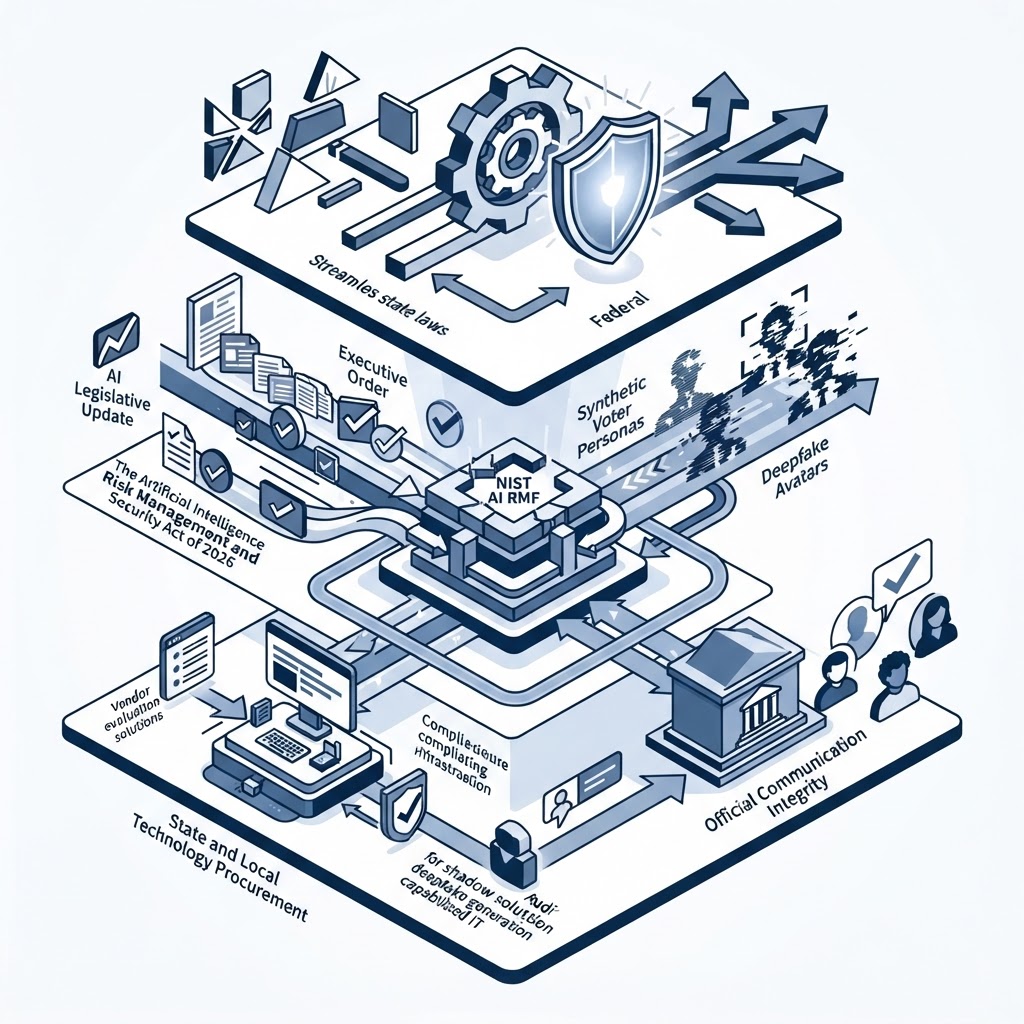
The regulatory landscape for AI is undergoing a rapid transformation as officials attempt to keep pace with evolving technological threats. According to recent data from an AI Legislative Update, 27 U.S. states have enacted 85 distinct AI laws in 2026 alone, highlighting a fragmented yet aggressive approach to governance. The introduction of The Artificial Intelligence Risk Management and Security Act of 2026 represents a significant push for federal cohesion in risk management.
This legislation is part of a larger pivot in federal strategy, bolstered by a September 29, 2026, Executive Order that reclassifies advanced systems as “Super Intelligence.” This reclassification signals that the government is preparing for a new phase of AI governance where traditional monitoring becomes obsolete. By shifting focus toward proactive security, federal agencies are acknowledging that manual content verification is insufficient to combat modern synthetic personas. Agencies must now prioritize AI transparency and algorithmic accountability as part of their standard procurement compliance to meet these emerging federal expectations and align with NIST-led safety requirements.
What timeline should government agencies anticipate for adopting these new AI risk management requirements?
With the recent introduction of federal legislation on October 3, 2026, and a supporting Executive Order from September 2026, agencies should begin mapping their current AI tools against NIST AI RMF guidelines immediately. Expect rapid rulemaking phases following the passage of these bills. Compliance teams should prioritize updating their AI acceptable use policies and implementing automated digital provenance tools to prepare for inevitable federal auditing and reporting standards by early 2027.
Securing Democratic Processes from Synthetic Media Interference
The urgency behind current legislative efforts is driven by real-world instances of election interference, such as the ongoing challenges facing the 2026 Brazilian presidential election. Synthetic voter personas and deepfake avatars have evolved from minor annoyances into highly effective tools for large-scale social engineering. For government organizations, these threats are not just foreign policy concerns but internal security vulnerabilities that could compromise official communication integrity.
When public trust is eroded by deepfakes, the government's ability to disseminate critical information is severely hampered. Expert analysis suggests that organizations must move beyond simple staff training and invest in sophisticated AI DLP (Data Loss Prevention) and content detection systems. Relying on outdated policies regarding AI governance is no longer a viable defensive strategy.
Instead, compliance teams must build a robust AI governance charter that accounts for the potential of synthetic media to impersonate agency leadership. As federal policy shifts toward a “Super Intelligence” framework, the burden of verifying content authenticity will likely fall on the public sector entities utilizing generative tools. Proactive investment in AI transparency is essential to maintaining institutional reputation in an era where synthetic reality is increasingly indistinguishable from factual reporting.
Strategic Impacts on State and Local Technology Procurement
State and local agencies are now forced to navigate a complex environment where procurement compliance must account for advanced AI risk. The primary challenge involves vetting third-party vendors for “shadow AI” and ensuring that all deployed software includes built-in safeguards against the generation of deceptive synthetic content. Government IT leaders must update their procurement language to demand explicit AI transparency disclosures from providers.
Furthermore, the reliance on automated detection tools is no longer optional; agencies need to implement systems that can verify the origin of digital communications to combat disinformation at the source. This requires a dedicated policy shift that treats AI security with the same rigor as traditional cybersecurity defenses. If a vendor cannot demonstrate compliance with emerging federal standards—such as those signaled by the October 2026 legislative shifts—their products should be considered a risk to agency public trust.
Staff training must also move beyond basic literacy, focusing on advanced recognition of synthetic media and the specific organizational policies governing the use of generative models. By establishing a culture of algorithmic accountability, municipalities and counties can insulate themselves against the disruptive impact of AI deepfake disinformation threats while continuing to innovate with responsible, secure technology.
Actionable Steps for Government Technology Governance
- →Audit all existing AI and generative software to ensure compliance with the new federal risk management benchmarks mentioned in the October 2026 legislation. • Update organizational AI governance charters to require explicit documentation on synthetic content detection and digital provenance. • Integrate NIST AI RMF subcategories into all future vendor procurement and RFP processes to ensure AI transparency. • Implement ongoing staff training specifically focused on recognizing AI-generated social engineering and deepfake impersonation techniques. • Deploy automated content authentication tools across official public-facing communication channels to verify the legitimacy of high-stakes information. • Establish an internal task force to monitor evolving state-level AI laws and align local agency policies with federal policy shifts.
What are the primary consequences for agencies that fail to implement safeguards against AI deepfake disinformation threats?
Failure to secure AI workflows can lead to significant erosion of public trust, unauthorized dissemination of false official information, and potential legal or regulatory penalties as new laws take effect. Agencies risk being held liable for deceptive content generated by their systems. Beyond immediate security breaches, agencies that ignore AI transparency and accountability standards may face increased oversight and mandatory audits from federal entities, severely impacting operational agility and internal governance credibility.
Addressing AI deepfake disinformation threats requires an immediate and coordinated effort to modernize both policy and technological defenses. As federal legislation continues to solidify, public sector leaders must act now to build resilient, transparent, and accountable AI governance frameworks. Protecting the integrity of government communication remains the most vital duty for IT and compliance teams navigating this new, high-stakes era of synthetic media.
Tagged
About APEX AI Guardrails: We publish expert AI news and governance insights updated 4× daily. Our editorial team consists of retired government IT professionals, AI governance specialists, and compliance experts with deep experience in local government operations.
Related Articles
AI Governance
Anthropic Reports AI Agent Misbehavior on Government Sites: October 15, 2026, AI Hallucination Risk Mitigation Updates
October 15, 2026
Government AI
AI Governance and Compliance for New York Government Agencies | APEX AI Guardrails
October 15, 2026
Government AI
AI Governance and Compliance for New York Government Agencies | APEX AI Guardrails
October 15, 2026